
The Nature Conservancy’s Hubbard Fellowship Program: 2014-2015

Regular readers of this blog are familiar with The Nature Conservancy’s Hubbard Fellowship program.  Our two current Fellows, Eliza and Anne, have been frequent contributors to this blog over the last 6 months.  While they’ll be here in Nebraska for another half year, it’s already time to start finding the next class of Fellows.  If you’re a recent college graduate in a conservation-related field, please consider applying for this opportunity!

Applications for the 2014-15 Hubbard Fellowship are due January 8, 2014.  More information on the Fellowship can be found on our brochure.  To apply, visit http://nature.org/careers and find job #41679.
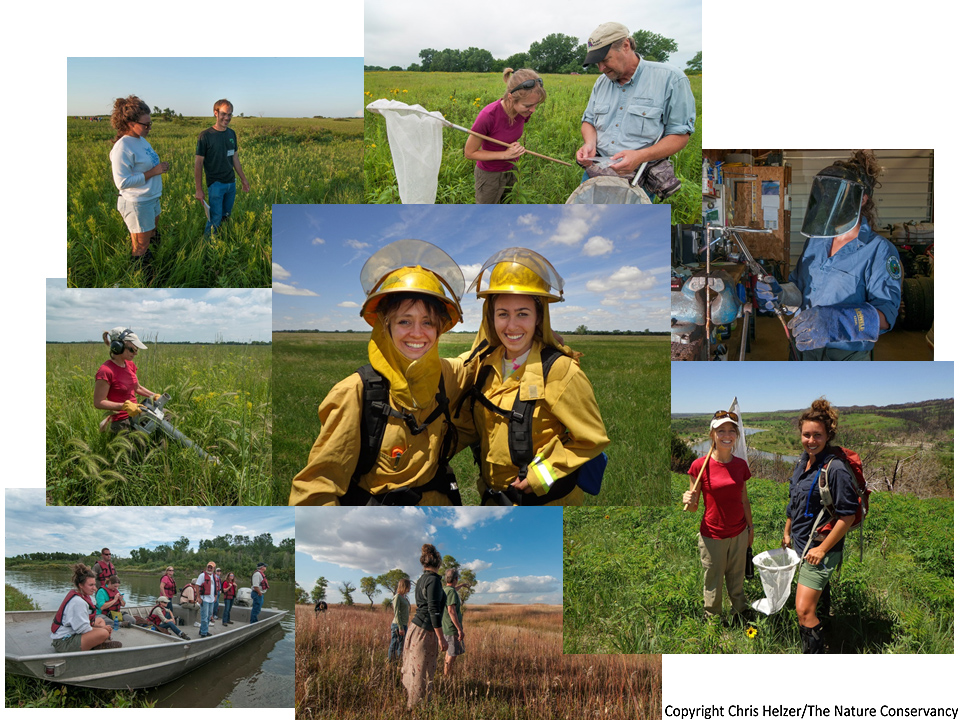
Anne and Eliza have only been here a little more than 6 months, and have had what seems like several years' worth of experiences.

Anne and Eliza have only been here a little more than 6 months, and have had what seems like several years’ worth of experiences.  Click the photo to see a sharper image.

The Claire M. Hubbard Young Leaders in Conservation Fellowship is a one-year position focused on the ecology and conservation of the Great Plains.  Fellows are full-time salaried employees of The Nature Conservancy, and are exposed to nearly every aspect of working for a conservation organization, including ecology, land management, and ecological restoration, but also marketing, philanthropy, conservation planning, and more.  It’s a great way to transition from college to career by solving that perennial problem for recent graduates: How do you get work experience when you need experience to get work?

To see what this year’s Fellows have been up to, visit the Hubbard Fellowship Page of this blog and read some of their blog posts from the first six months with us.

Hubbard Fellowship Blog – Planning a Prairie Garden

A guest post by Anne Stine, one of our Hubbard Fellows:

It just recently turned cold out, which means I’ve started daydreaming about next year’s garden.  I am a native plant enthusiast, and I have decided that I’ll be planting a prairie garden filled with my favorite flowers that I’ve learned with The Nature Conservancy in Nebraska over the past six months.  I’ve poured through the internet searching for propagation information and bloom times.  I want to make sure I have a continuous bloom period, both because it makes for pleasant viewing and because I want to provide native bee habitat across the growing season.  I also need to know which seeds require stratification or scarification. Because I am me, I made a spreadsheet of all this information (at the bottom of this post).

Who wouldn't want flowers like this in a garden?  Blue lobelia and cardinal flower in The Nature Conservancy's Platte River Prairies.

Who wouldn’t want flowers like this in a garden? Blue lobelia and cardinal flower in The Nature Conservancy’s Platte River Prairies.

Ultimately, I want my garden to be a great pollinator resource filled with unique native plants. If it attracts birds and butterflies too, that’s a huge plus. Lastly, if it’s going to survive my schedule, it needs to be low-maintenance.  I am pleased to note that gardening with native plants can fulfil all these objectives.  My table of appealing native plants, though not comprehensive, will help me design my garden to satisfy these requirements.  I’d love to hear everyone’s thoughts on favorite native plants and propagation tricks.

Happy plann(t)ing!

Click on the tables below to see a larger/clearer version of them.  Or click HERE to see the same information in a PDF format.

plantlist2

plantlist3

*Information on propagation, soil moisture requirements, and bloom period gathered from the USDA Plants Database, http://www.wildflower.org/plants Native Plant Database, and the Missouri Botanical Garden Plantfinder Database.

.