
I started my annual plant community monitoring this week. That work consists mainly of inventorying the plant species within small sampling plots. Forcing myself to walk regularly spaced transects and stare at a square meter of prairie at a time is a great way to find creatures and sights I might miss if I was just wandering aimlessly. This week, for example, I scared up a couple jackrabbits and found a quail nest within a few minutes of each other, and found a number of pretty neat insects. But in that particular prairie, the star of the show was Tradescantia bracteata (bracted spiderwort), which was scattered across the site in patches about the size of a small car.
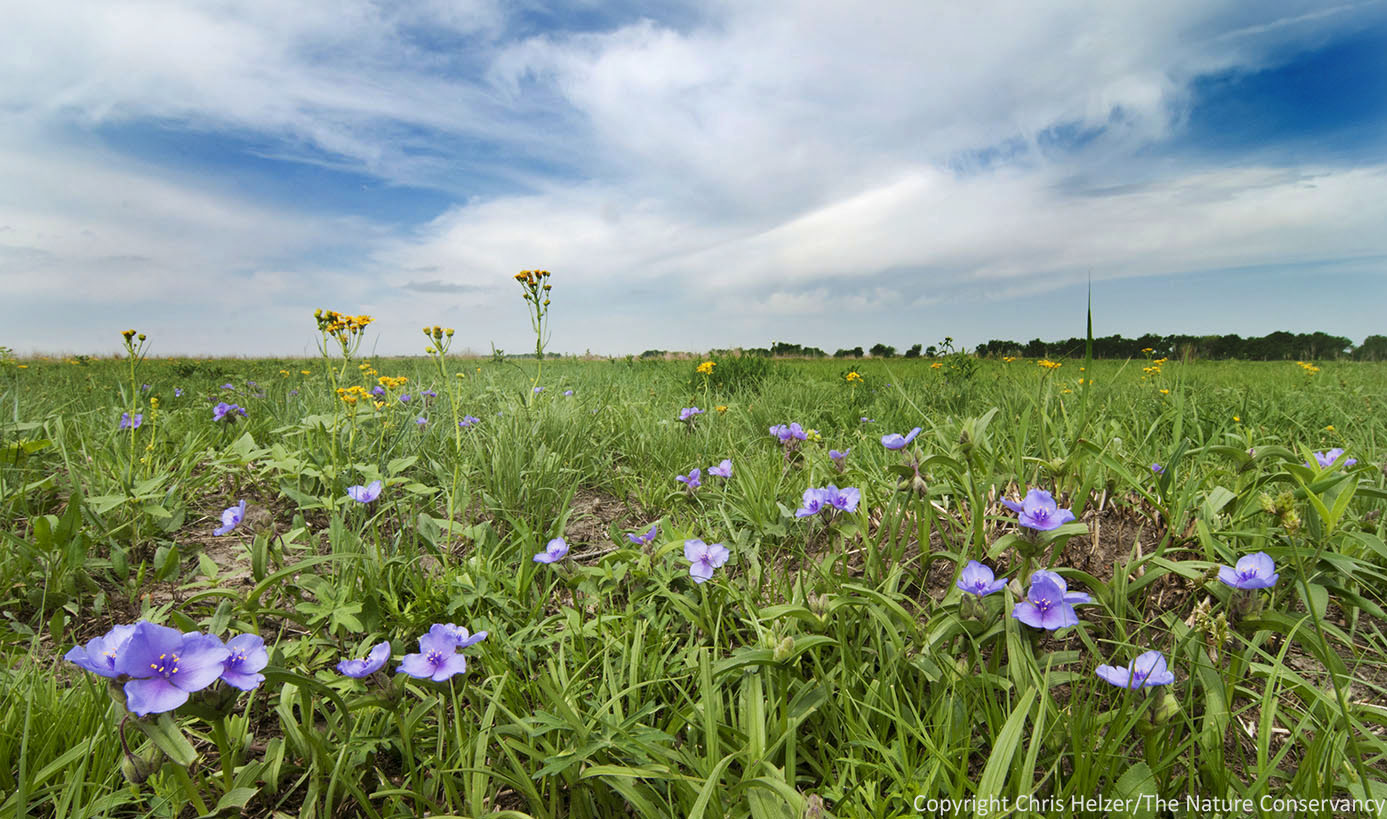
A close-up look at a patch of bracted spiderwort, with prairie ragwort (Senecio plattensis) in the background. The Nature Conservancy’s Platte River Prairies, Nebraska. You can click on the photo to see a larger and sharper version.
These spiderworts were blooming in a prairie we planted back in 2000. It has become of our most colorful sites – loaded with wildflowers of all kinds. I didn’t see much spiderwort during the first 5-7 years of the prairie’s establishment (most of which were drought years). Eventually, I started finding a lone plant here and there. Those scattered plants have now formed colonies that radiate outward every year.
If you look closely, you can see that several of the spiderwort plants in this photo have been grazed. They are blooming in a burned portion of the prairie, which is where cattle are focusing most of their attention (within our patch-burn grazing system). Cattle really like to eat spiderwort, so grazing will probably impact the 2013 growth and seed production of the plants in this photo. However, we just finished building a temporary electric fence to exclude cattle from about half of this same prairie for the rest of this growing season, so all the spiderwort patches in that exclosure should have a good year. Next year, the patch of flowers pictured here will get a break from grazing too.
Although grazing can keep spiderwort plants short and decrease seed production, most of this species’ reproduction happens through rhizomes (underground stems), so annual seed production is not critical for its survival or spread. In addition, periodic grazing helps open up space among the grasses and provides opportunities for spiderwort to continue its spread. In fact, areas of our prairies that get little or no grazing tend to have fewer and smaller patches of spiderwort (though the individual plants often grow taller).
 The Prairie Ecologist