
Goldenrod – Pretty Flower or Evil Invader?

Recent update.  If you are looking for information on how to reduce the abundance or dominance of tall goldenrod, here’s a great post from the Grassland Restoration Network you might find useful.

When did goldenrod become such a bad plant?  It’s really quite attractive, I think.  It’s a signature plant of the late summer/early fall prairie.  Yes, some species can form fairly dense patches and can take advantage of a weakened grass stand to get a quick foothold.  But would we complain if compass plant did the same thing?
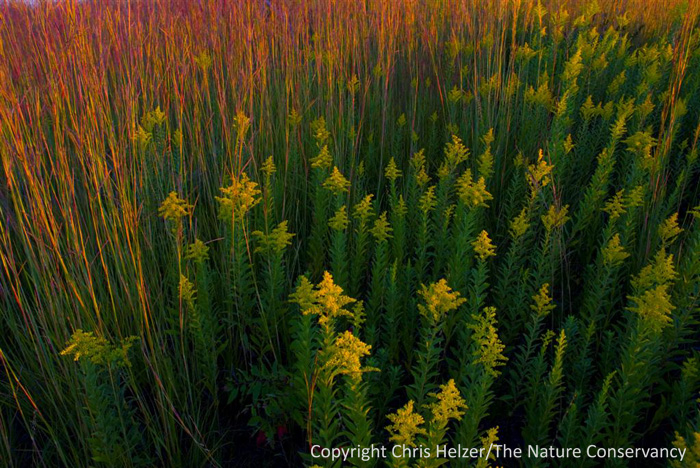
Canada goldenrod and big bluestem at Griffith Prairie (a preserve of Prairie Plains Resource Institute).

Some people mistakenly blame goldenrods for hay fever. That, at least, is an easy illusion to dispel.  The bright colorful flowers and the abundance of pollinating insects crawling all over them clearly indicate that goldenrods are insect pollinated, not wind pollinated like ragweeds and other hay fever-causing species.  So spread the word… goldenrod doesn’t make you sneeze.

Apart from the hay fever myth, though, there are some prairie ecologists who are struggling with how to categorize and treat goldenrod in a prairie plant community.  There are, of course, many species of goldenrod – including some very rare prairie and savanna species.  Most people are fine with categorizing those as species in need of conservation.  I’m talking about some of the taller and more prolific/common species like Canada goldenrod and stiff goldenrod.  Even Missouri goldenrod (which, ironically, is the state flower of Nebraska) gets occasionally thrown into the “down with goldenrod” conversation.

One issue with these goldenrods is that they are very effective colonizers.  Their windblown seeds can disperse widely and can quickly establish in bare soil and/or in places where competition from other plants is light.  And, unlike many other colonizers (ragweeds, hoary vervain, black-eyed susans, and many annual plants) goldenrods don’t typically fade away in the face of competition from perennial grasses.  These characteristics make them a staple plant of old fields – cropfields that are allowed to stand idle and be colonized by whatever species can do so.  That’s an ideal situation for goldenrods, and they can quickly become one of the dominant species in an old field.  Many prairie restoration (reconstruction) projects that attempt to convert those old fields to prairie vegetation have found that simply tilling those old fields and seeding into them doesn’t work well because of overwhelming competition from goldenrods and other old field species that have built up populations and seed banks.  However, that’s not a knock on goldenrod, it’s a failure to properly prepare the seed bed for the restoration project.  When seeding into a site that’s been repeatedly cropped and doesn’t have a history of goldenrod populations, goldenrod is usually much less of an issue.

The colonizing ability of goldenrods gets them in bad with ranchers as well because if cattle grazing continually weakens the dominant grasses in a pasture, space opens up for the establishment of other plants.  Species like goldenrod that are not very palatable to cattle do particularly well in those circumstances.  And, again, once they establish, their ability to survive even when the grass regains its vigor sets them apart from other species like hoary vervain and ragweed, which tend to fade quickly.  Once they’re abundant they look like some kind of noxious weed, and it’s not uncommon for prairies to be sprayed to control goldenrod – a native wildflower.

So, which is it?  Are these goldenrods showy wildflowers that provide valuable resources to pollinators in the fall?  Or are they plants gone bad and in need of suppression?  Maybe both – depending upon the situation.  What I’ve seen in Nebraska prairies is that these goldenrods can look very abundant when they’re blooming, but the prairie community around them maintains its diversity pretty well, and the goldenrod tends to plateau at a certain density and not get to the point where it forms large monocultures.  But I’ve seen restored prairies in places like Illinois where it sure looks like goldenrod is dominating the plant community to the detriment of other species.

Goldenrod… pretty fall flower or aggressive invader of prairies?

If goldenrod needs control in some situations, what’s the best technique?  It doesn’t seem to be suppressed by dormant season fire.  Broadcast herbicide spraying is almost certain to be counterproductive both because it destroys the much of the larger plant community and because goldenrod will almost certainly benefit more than other species from that suppression of competing plants.  The fact that goldenrod is not palatable to cattle might mean that it’s susceptible to repeated defoliation (mowing, etc.) or prescribed fire during the growing season.  Has anyone had luck with that?

I’d like to hear about examples of goldenrod gone bad, successful or failed attempts to suppress it, or passionate defenses of these pretty flowers…  Just leave a comment below.
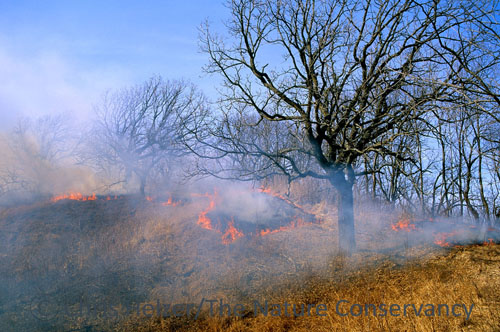
Why is it so hard to keep trees out of prairies? (and why is it getting harder?)

The standard explanation for why historical prairies had so few trees is pretty simple – frequent fires kept them out.  Yes, there were other constraints such as frequent droughts, particularly in western prairies, and there were large browsers like elk and pronghorn that helped, but it was fire – set by both people and lightning – that was the major control on tree expansion. 

Historically, frequent fires would have helped keep small trees out of prairies and savannas, but larger oak trees were pretty tolerant of fire.

However, if that explanation is true, why are there so many prairies, managed with frequent fire, being invaded by native and non-native trees alike, for which the only feasible control method seems to be herbicide treatment? 

I think there are a couple possible explanations.  First, we’re in a relatively wet climatic cycle (geologically speaking) that probably favors tree establishment.  Second, we’re still missing those elk and pronghorn – although you’d think whitetail deer and cottontails would make up for that.  Third, we’ve added some novel species like Siberian elm, autumn olive, and a host of others that may not have the natural controls on establishment that some of the native trees have.  However, could it be that in the western tallgrass prairie and the mixed grass prairies, the biggest explanation is simply that there are so many more trees in the surrounding landscape than there used to be?  I just wonder if the seed rain from those trees is so heavy that it overrides any natural controls prairies have for outcompeting them. 

I don’t have any good data to support this other than observation and logic, so I’d love to hear from others who have other ideas (or data!).  But I have seen several cases where aerial photography shows that prairies, even without much fire, experienced only small increases in tree encroachment for decades.  Then, in the last couple of decades, those prairies have become nearly closed in by trees.  It seems to me that continuous seed rain from the surrounding landscape, supported even more by the few “pioneer” trees and shrubs that made it into those prairies early on, eventually overwhelmed those prairies.  Browsers – including little ones like voles – may only be able to keep up with a certain number of tree seedlings.  In addition, little pioneer trees that got started in the middle of those prairies grew large enough to support perching birds.  Those birds brought in more seeds (along with free fertilizer), and those isolated trees became ever-expanding patches of trees and shrubs.  The result was an exponential curve of tree encroachment.

Sometimes the reasons for tree encroachment are not hard to figure out.

Of course, while tree encroachment may be happening at a faster rate than it did a century or two ago, the other side of the equation is that our smaller, more fragmented prairies are more vulnerable to that encroachment than the historic sea of grass would have been.  A couple acres of sumac shrubland in the middle of a huge grassland is not a big deal, but it’s hard to put up with a couple acres of sumac in a 5 or 10 acre prairie remnant that represents the only high quality prairie in its county.

In some ways the explanations of why tree encroachment is a bigger problem than it used to be are beside the point.  Regardless of why it’s happening, it’s clear that in many (most?) prairies today, keeping trees out has become a bigger challenge than simply determining an appropriate fire frequency.  It requires vigilance and consistent patrolling with herbicide applicators, in addition to management with fire and/or grazing. 

The good news is that there are some tools and techniques available to make herbicide application easier and less harmful to surrounding prairie vegetation.  One of the best techniques I’m aware of is the use of a PVC herbicide wand, which is essentially a long piece of PVC pipe  filled with a sponge stuck in one end.  The wand was originally developed to apply herbicide to small cut stumps to prevent regrowth.  But if you fill it with a 3:1 ratio of crop oil to herbicide (Remedy, Garlon, or other Triclopyr-based herbicide) you can use it as an applicator for the “basal bark” method of herbicide application.  The basal bark technique works by applying that oil/herbicide mixture to the base of young trees, and the oil helps penetrate the thin bark and kill the tree.  It works any time of year – even winter – and is very effective.  We used to use hand and backpack sprayers to apply the herbicide until our clever land steward, Chris Rundstrom, thought of putting the herbicide wand to use instead.  Using the wand saves a lot of repair and replacement of sprayers because the plastic and rubber gaskets and seals in those sprayers get eaten up by the oil.

Basic Instructions for Basal Bark Treatment of Small Trees (see herbicide label for specifics)

– 3:1 ratio of Crop oil: Remedy© (or other herbicides with the chemical triclopyr – check label for instructions).

– Dye if needed.

 Apply to the lower 12” of small trees (less than 3” diameter) with small sprayer or PVC wand.  Just need to get a 2” band wet on one side of smaller trees or 2” ring around larger ones.

 Works on any deciduous tree young enough to have thin smooth bark, including willows, dogwood, sumac, cottonwood, mulberry, ash, Siberian elm, Russian olive, etc.

 Apply any time of year – including winter.  When applying in the dormant season, trees may green up for a week or two in the spring before they die.

Instructions for making a PVC herbicide wand:    http://www.invasive.org/gist/tools/wand.html

Another trick that can work well in some situations is the use of a wick applicator.  An old rope wick – like farmers used to use on soybeans – can do the trick, but there are numerous “roller wicks” available today that can get more herbicide on the plants with less dripping.  A wick application can work well when the trees are fairly dense, taller than the surrounding vegetation, but still flexible enough that a tractor or atv can get through them without tearing up the vehicle or wick applicator.

One example of a roller wick: http://www.agriweld.com/pages/weedwipers.html