Antlion Timelapse

Three years ago, I wrote a blog post on antlions, fantastic little creatures that live along the base of my house (and elsewhere in the world, I’m sure).  I moved to a new house last year, and was happy to find antlion larvae living along its foundation too.  I dug a few up the other day and brought them indoors for our family to watch (we have a praying mantis nymph in the house at the moment too).  I’ll put them back outside soon.

An antlion larva, a compact and efficient killer, with a muscular

An antlion larva, a compact and efficient killer, with venomous mandibles for subduing prey and a muscular “neck” for tossing sand (and insect carcasses) out of its pit.

It’s been fun to feed ants and other small insects to the larvae, and we’ve been able to watch them construct their cone-shaped hunting pits, but the construction is slow enough that it’s hard to see much progress over the course of a few minutes.  To help us get a better feel for how that construction process works, I set up my camera…

My Nikon D300s camera can be set to take a photo at regular intervals and make timelapse videos.  I set mine for a one minute frequency and let it run for about three and half hours.  During that time, the three antlion larvae moved around the bowl a lot more than I’d expected.  You can see for yourself in this 17 second video…

In the video, you can see that one larva constructs a pit near the bottom left corner of the frame. Another larva makes a larger pit near the center.  Near the bottom of the frame, a third antlion seems to start a pit, give up, wander over (and maybe through?) the smaller pit and then strike off toward the top of the frame and beyond.  The larva in the small pit then begins repairs.  I checked in on these larvae now and then while the camera was running, but never would have guessed there was that much action going on because it happened so gradually.  Compressing time with the timelapse process was invaluable.  It was also interesting how sporadically the action happened – as opposed to a fairly continuous excavation process.

Timelapse is a fairly simple, but very powerful, way to see the world.  You can see some earlier timelapse posts here:
Bison in a blowout

The formation of a cattle trail

A wetland “breathing” through evapotranspiration

A Hole New Mystery to Consider

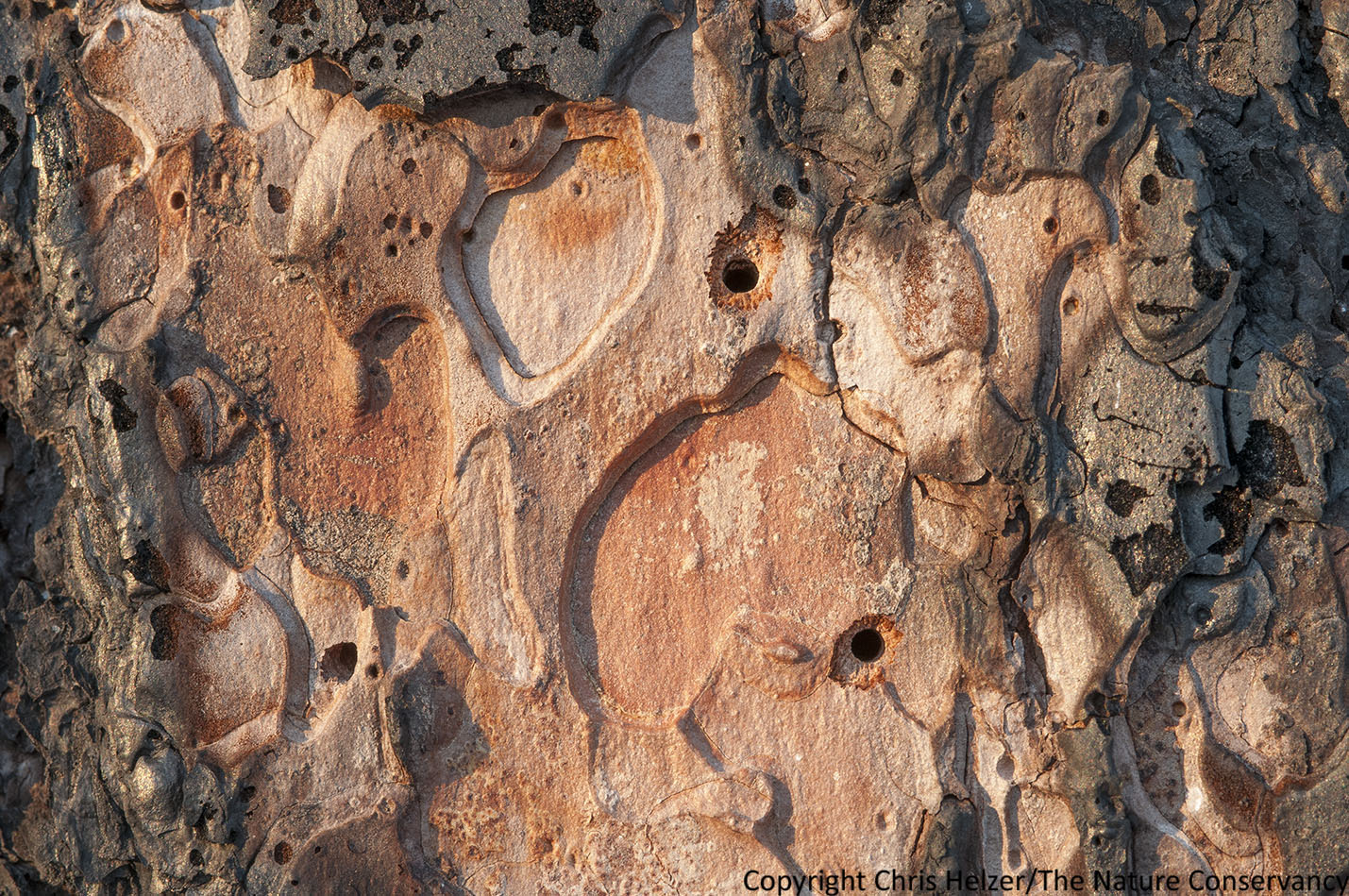
On my last trip to the Niobrara Valley Preserve, I photographed the bark of wildfire-killed pine trees in warm late day light.  I liked both the patterns and the color and was just trying to make some visually-interesting images.  As I was taking the photos, I saw numerous small holes in the trees but didn’t think much about them.  Holes in dead trees are not really unusual, after all.  Upon looking at the photos later, however, I noticed something intriguing – many of the holes seemed to have a funnel shape, or beveled edge, at the surface of the tree.

Beveled

Tiny holes in the bark of a standing dead ponderosa pine tree killed by a 2012 wildfire.  The two near the center of the image have a funnel-shaped or beveled edge to them.  The Nature Conservancy’s Niobrara Valley Preserve, Nebraska.

I couldn’t come up with a good explanation for that beveling, so I did what I usually do when I can’t identify something – I sent the photos to people with more expertise and begged for help.  Ted MacRae was kind enough to respond that except for the flared ends, the perfectly round holes might have been created by adult pine sawyers (Monochamus spp.).  James Trager liked my speculation that perhaps something like a woodpecker might have chipped away at the holes, looking for an invertebrate meal, and added nuthatches and chickadees as other options.  But none of us have a good answer.

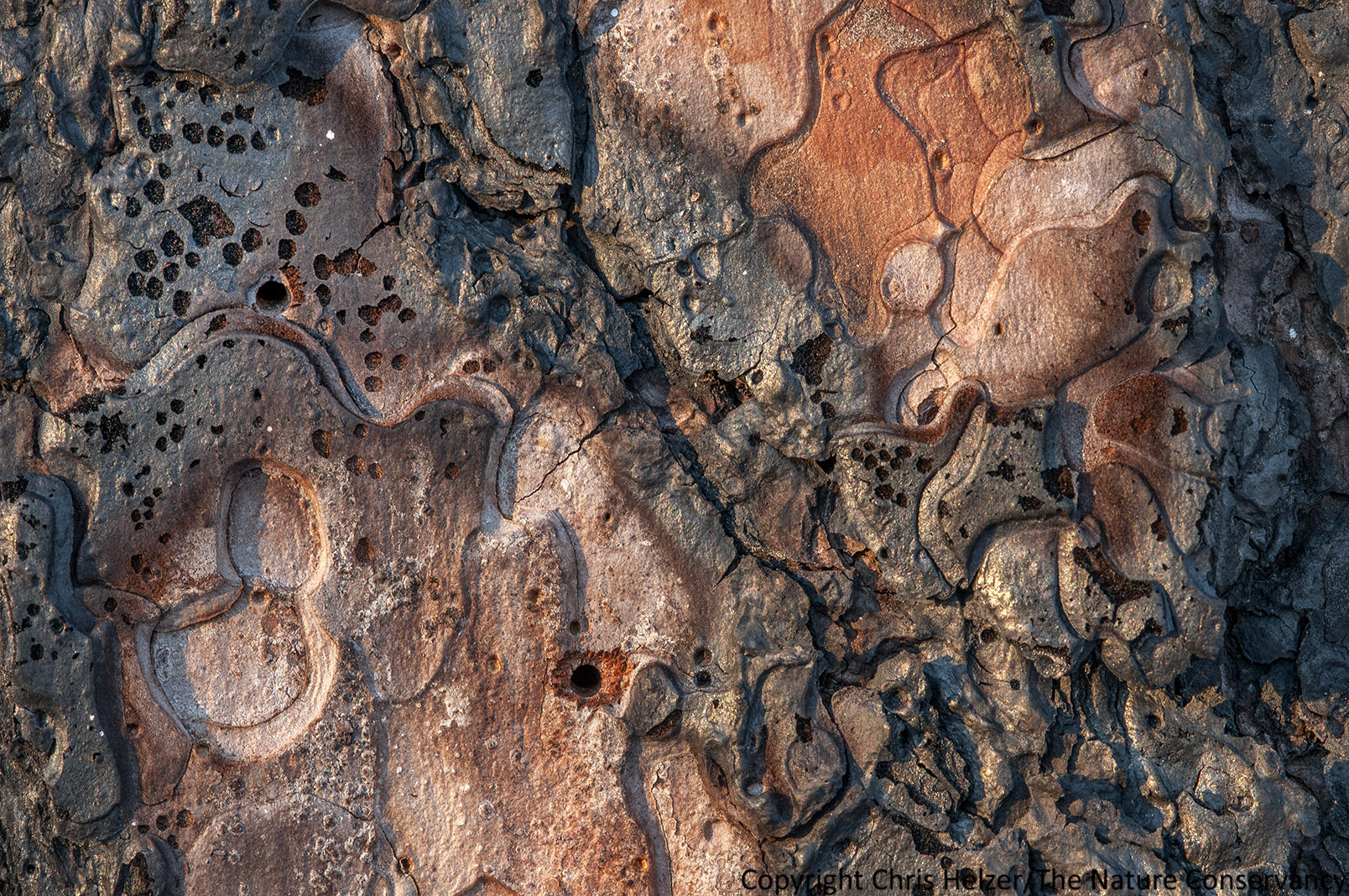
After hearing back from Ted and James, I looked more closely at other photos from that evening and noticed something else that might or might not be a useful clue.  Not only had the edges of some of the holes been chipped (?) away, but there were similar marks elsewhere on the bark.  I’m not sure if those are related to what happened around the margins of the holes or not.  In the photo below, look at the “pitting” – especially in the top left quarter of the image.

More holes in trees.

More holes in trees, along with tiny chipped or pitted marks, both around the insect(?) holes and elsewhere.

Is some creature (bird?  insect?  microbe?)  chipping away at the tree?  If so, why?  And is that creature chipping away at the edges of holes made by beetles too?  And if so, WHY?  Or, are the beveled edges of the round holes a separate phenomenon from the pitted surface of the bark elsewhere?

I guess it’s good for my brain’s health to ponder mysteries like this, and it’s fun to think through all the possibilities.  On the other hand, it would also be fun to KNOW WHAT THE HECK IS HAPPENING HERE, so if you have good theories – or even better, actual answers – please let me know!

I didn’t measure the holes, so I hesitate to give estimates of their size, but they were really small.  Maybe 3-4 mm across?  I didn’t give that info to Ted (but I should have), and I’m wondering now whether the holes were actually too small for pine sawyer beetles.

Help?