Hubbard Fellowship Blog- Marvels in the Mud

This post was written by Evan Barrientos, one of our Hubbard Fellows.  Evan is a talented writer and photographer and I encourage you to check out his personal blog. If you would like to see more of his photographs, you can follow him on Facebook.

April 2nd was the kind of spring day where you triumphantly open every window in the house. I wanted to get out and explore somewhere new, so I drove to the Fort Kearny Hike and Bike Trail. When I arrived, a bored-looking family was slowly rolling down the weedy trail…in a golf cart. I despaired, thinking that I had driven half an hour to look at weeds with joggers huffing by. Nonetheless, I walked down the crowded trail for a couple of uneventful minutes minutes until it crossed over the Platte River. Much to my relief, there was a staircase inviting visitors to explore the sandbar below. I descended the stairs and started exploring the one place no one else was. It would be another three hours until I returned.

I began by walking in the thicker vegetation, hoping to flush some of the first insects of the year. As I did, several small spiders scurried away. I knelt down to look at them and noticed a few gnats mating on the blades of grass. After a long winter with no insects, these gnats were as exciting for me to photograph as Sandhill Cranes.

20160402_nebraska_0605

Once I was on my belly, more details revealed themselves and a story began to unfold. A few feet from the gnats I spotted a muscid fly. I’m grateful that winter had made me so appreciative of even the common insects; otherwise I might not have taken a closer look. I did, however, and noticed that this wasn’t your typical potato salad-sucking housefly. It was devouring one of the gnats!

The calls of sandpipers drew my attention away from the microcarnage and I went over to the open part of the sandbar. There, I found a migratory flock of Baird’s Sandpipers foraging in the mud. I sat and watched them, wondering how they could possibly find enough food in the muck to sustain their 3,700-mile migration from Argentina. When they flew away, I thought I’d try to figure it out. A tiger beetle distracted me and I started stalking the speedy predator on my belly. Each time I would crawl close enough for a decent photo he would dart a few inches ahead. For several minutes this continued until he had led me to the muddy edge of the sandbar. There, with my nose inches away, it dawned on me how much amazing life that mud contained.

With my camera flat on the ground I spent an hour discovering and photographing insect after insect, many of which I had never seen before. I’m no expert, but I know my insect families fairly well. Yet two of these species were so alien I can’t even tell what order they’re in! If you know, please tell me!

20160402_nebraska_0889

These muscid flies reminded me of sandpipers on a much smaller scale. Both patrol the same mudflats, probing the ground for food. The flies, however, let me watch them from inches away.
20160402_nebraska_0823

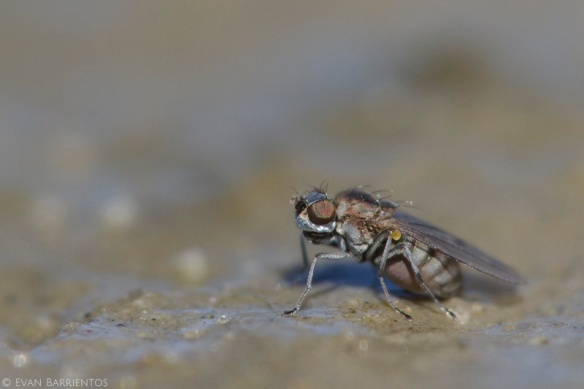
This even smaller fly might be contributing to the sandpipers’ food supply. Occasionally I saw the fly press the tip of her abdomen to the mud, perhaps laying eggs or larvae that the sandpipers would certainly slurp up.

20160402_nebraska_0800

Almost every one of these flies was paired with a mate. Presumably, the male is on top, guarding his female from other males while she tries to go about her life as normal. I don’t know that for sure, but I do know of another species that mates this way.

20160402_nebraska_0755

This mystery insect delicately unfolded her cellophane wings in front of me. I have no idea what kind of insect it is. A beetle?

20160402_nebraska_0915

Another mystery insect. I’ve never seen anything like this!

20160402_nebraska_0919

At first I thought this little jewel was a tiger beetle, but I later learned that it’s a marsh ground beetle (Elaphrus sp.). Never seen one before!

20160402_nebraska_0853

Springtails were the tiniest and most abundant invertebrates present, but finding them in my viewfinder was impossible because of their size. I only managed this photo because the springtail jumped into the frame while I was photographing the flies in the background.

20160402_nebraska_0866

Above the muddy valley, a spider hunted for prey.

After completing my goal of photographing every species I could find in that puddle, I got up, stretched my very sore neck, and walked over to the other side of the sandbar. There, I found a small pool with about a dozen small fish huddled together (later identified by Chris as Plains Killifish, Fundulus zebrinus). I began crawling over to them but stopped when I heard some splashing coming from a trickle of water connecting the pool to a larger one. I went to investigate and realized that the splashing was coming from the fish as they struggled to swim through the shallow channel! Like tiny salmon, fish after fish darted through this passage. I wish I knew more about them, but I can only guess that they were on a reproductive migration.

The killifish were extremely wary and freakishly good at spotting me from underwater. I crawled up to their stream and lay still, waiting for them to swim by. I don’t know how they could see me so easily, but I learned that if I moved even the slightest bit they would panic and turn back. After many frustrating failures, I only managed to record a few mediocre videos of this fascinating behavior. To give you an idea of how quick these fish were (and how hard it was to photograph them), these videos are in slow motion at half-speed.

At this point my knees, neck, and elbows could tolerate no more strain. I walked back to my car smeared with mud and drawing lots of puzzled looks. But that was okay, because that mud had given me an afternoon of joy and wonder. If you ever find yourself bored in nature, I recommend you get off the trail and on your belly.
Patches of Fire and Habitat

It’s been a difficult year for conducting prescribed fires so far – the wind seems to be blowing even harder and more consistently than in recent memory.  And that’s saying something, living in the Great Plains.

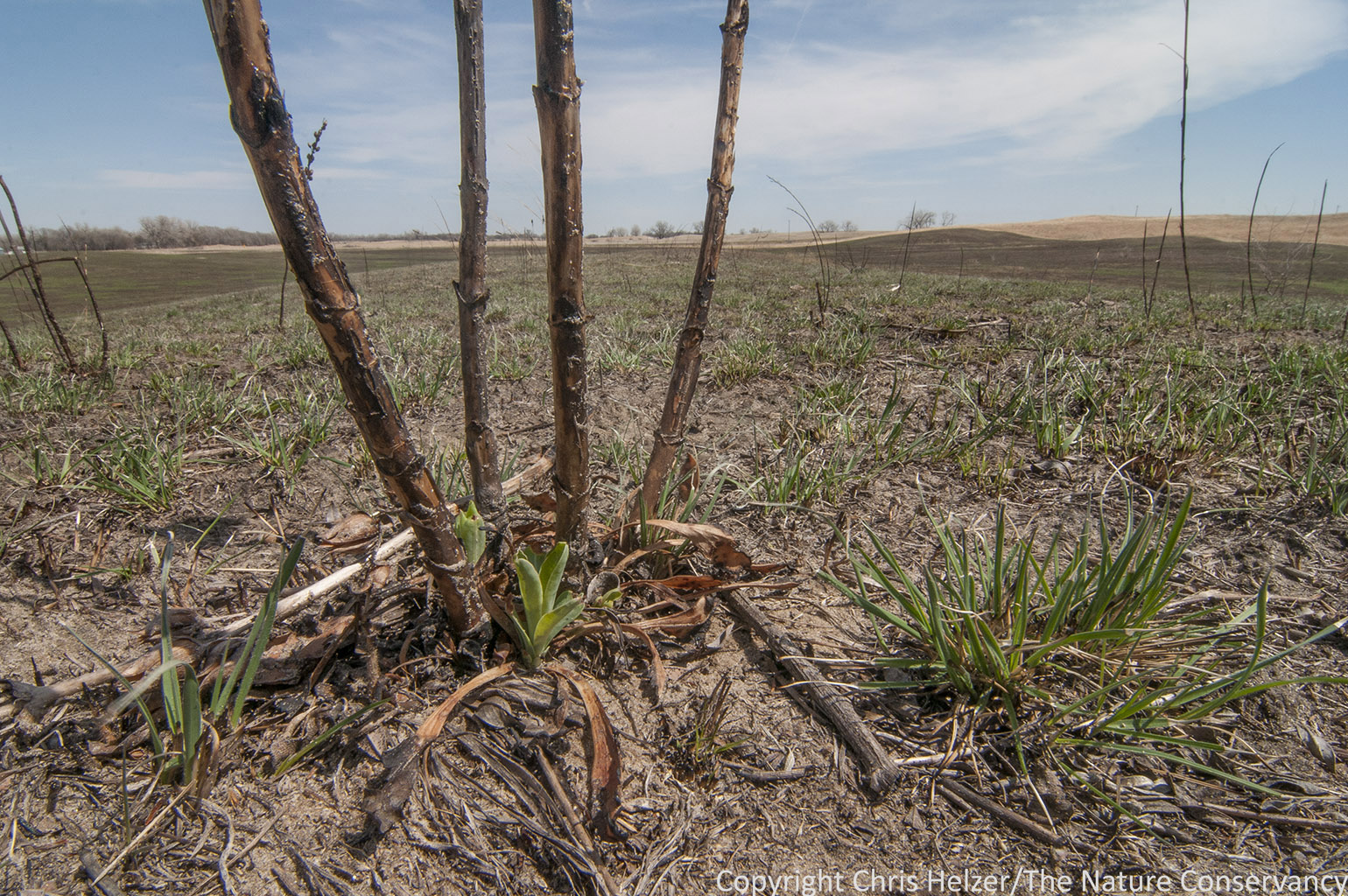
A couple of weeks ago, we were able to pull off one prairie management burn here in the Platte River Prairies.  The fire went well, and this week I took a quick walk through the burned area to see how the regrowth of vegetation was coming along.  It’s been a cold and dry spring, following a dry fall and winter, so plant growth has been slow, but things are finally starting to kick in.  Within the burned area, many plant species are a little behind their compatriots growing outside the burned area, but others are ahead.  Those that are behind are the species that were already starting to grow when the fire came through – those species had to start again, so are behind schedule.  The species that are further ahead in the burned area are those that are taking advantage of the warmer soil and have either germinated or emerged faster than those in the cooler soil of unburned areas.

Regrowth in sand prairie burned a couple weeks ago.  The wildflower in the foreground is shell-leaf penstemon (Penstemon grandflorus).

Regrowth in sand prairie burned a couple weeks ago. The wildflower in the foreground is shell-leaf penstemon (Penstemon grandflorus).

Regardless, plants are growing well in the burned area.  That’s good, because cattle will arrive within the next week or so, and we want the burned area to be particularly attractive to those grazers.  One of the major objectives of our fire was to concentrate grazing in one portion (the burned patch) of the prairie this season, leaving the remainder of the pasture with much less intensive grazing.  Hopefully, the result will support our efforts to create a variety of habitat patches across our prairies, and to shift the location of those patches from place to place each year.

The patch we burned this spring has had no fire and very little grazing over the last couple of years.  Last year, it had tall vegetation and abundant thatch – conditions that favor a certain set of plants and animals, but not others.  This year, it will have very little thatch and the vegetation will be short in stature because of season-long intensive grazing.  Next year, it will begin a multiple season recovery period from that fire and grazing until it is burned again sometime down the road.  (You can read more about patch-burn grazing here.)

Burning a different patch of prairie each year helps ensure that a mixture of habitat types is always available and most or all wildlife and invertebrate species can find the habitat they need.  Our prairies usually have a patch of very short habitat, several patches in some stage of recovery from intensive grazing, and some areas that are tall and very lightly grazed – or ungrazed.  Some animals will follow those habitat patches across the landscape.  Others will go through boom and bust periods within one portion of a prairie, depending upon what conditions they thrive best under.

Because we’re always changing the location of habitat patches, plant species also experience changing conditions from year to year.  This means that some species flourish one year, but may have to wait a few years before those favored conditions return.  In the meantime, other plant species will find success.  Constantly changing conditions help ensure that no group of species becomes too dominant, but that all species can survive and maintain a place in the plant community.  Our long-term data has shown the our plant communities have stable to increasing plant diversity under this kind of management, and we’re not seeing any plant species disappear.

This burned patch makes up between a third and a fourth of a 110 acre management unit in our Platte River Prairies.  Burning only a portion of each unit each year helps ensure good wildlife habitat and changing growth conditions for plants, but also helps avoid catastrophic impacts on species vulnerable to fire.

This burned patch makes up between a third and a fourth of a 110 acre management unit in our Platte River Prairies. Burning only a portion of each unit each year helps ensure good wildlife habitat and changing growth conditions for plants, but also helps avoid catastrophic impacts on species vulnerable to fire.

Another benefit of burning only a portion of our prairies each year is that it helps us avoid catastrophic impacts on plant and animal species that are negatively impacted by fire.  Invertebrates that overwinter above ground, for example, can be destroyed by an early season fire.  Growing season fires can kill animals (invertebrates and vertebrates) that are unable to escape by leaving the area or retreating underground.  These kinds of impacts are somewhat unavoidable, regardless of the season of fire, but by burning only a portion of our prairies, we can try to restrict impacts to a relatively small proportion of the population of each species, allowing the majority of individuals to survive and recolonize the burned patch over time.  Burning an entire prairie, especially in highly fragmented landscapes in which recolonization is unlikely, can result in completely and permanently obliterating vulnerable species from a site.

Hopefully, the wind will pause a few times during the remainder of the spring, and we’ll create a few more burned patches in our prairies.  If not, we’ll try to create patches of short habitat by haying or by temporarily fencing cattle into an area to knock vegetation height down.  We’ve found that all three methods (burning, haying, temporary enclosures) can create a patch that attracts livestock grazing afterward – and therefore pulls that grazing off of other portions of prairie.  There are lots of ways to create patchy habitats, and none are necessarily best.  As long as there is always a mixture of habitat types across our sites, we feel pretty good about our management.

Hopefully, the species living in our prairies feel pretty good about that management too.