How Do You Evaluate Your Prairie?

The most challenging aspect of prairie management may be evaluating what’s happening on the land and what to do about it.  What should you focus on as you walk around a prairie?  Which plant species can tell you the most about the current condition of the prairie community?  How do you know whether changes in the plant community are short term weather-related changes, versus an indication of a long term trend?  What characteristics of wildlife habitat are the most important to monitor?  It can all seem overwhelming.
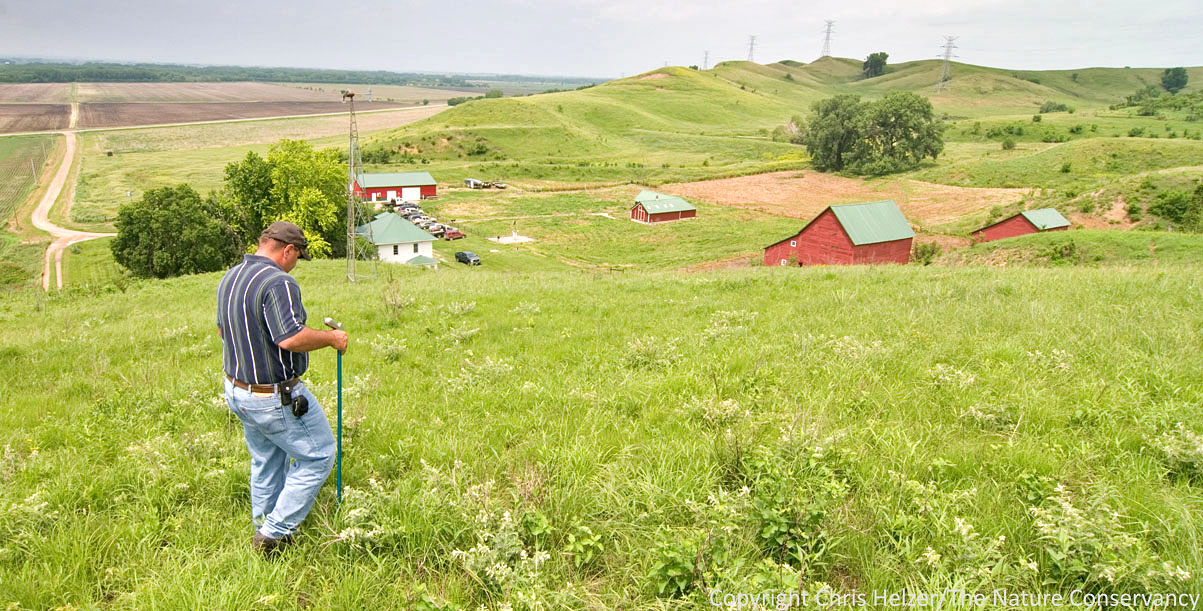
Evaluating prairies and impacts of management is important but can seem overwhelming.  What should you look for as you walk through a prairie?  (Scott Moats at The Nature Conservancy's Broken Kettle Grasslands in northwest Iowa.)

Evaluating prairies and impacts of management is important but isn’t necessarily easy. What should you look for as you walk through a prairie? (Scott Moats at The Nature Conservancy’s Broken Kettle Grasslands in northwest Iowa.)

This is something I’ve been thinking a lot about lately.  One of my main jobs is to help people restore and manage their prairies more effectively.  I try to share tips and techniques gleaned from our work on the Platte River Prairies, as well as from my experiences visiting and collaborating with other prairie managers across the country.  However, suggestions of management strategies are only useful if a prairie manager knows what challenges his/her prairie is facing.  Some managers are good at thinking about wildlife habitat needs but struggle to evaluate plant composition changes.  Others may focus so heavily on invasive species encroachment they ignore the needs of pollinators or grassland birds.  With so many things to think about, what are the most important?

As I walk through the prairies I work with, I pay close attention to (among other things) the abundance and vigor of particular plant species and note the distribution of certain habitat qualities.  My mental checklist is influenced by years of watching those sites respond to weather and management, as well as by the management objectives I’m evaluating.  However, I also enjoy having other ecologists and managers visit our sites because I can learn a great deal from their perspectives.  Because they have a different set of experiences than I do, they notice and evaluate different factors than I do.

This prairie was burned and grazed with a fairly light stocking rate last year.  It has not been grazed this year.  When I walked it this week, I was looking at the vigor of the dominant grasses (still low) and the wildflowers (high).  I also wanted to see if it had maintained the mixed-height habitat structure I was hoping for (it had).

This prairie was burned and grazed with a fairly light stocking rate last year. It has not been grazed this year. When I walked it this week, I was looking at the vigor of the dominant grasses (still low) and the wildflowers (high). I also wanted to see if it had maintained the mixed-height habitat structure I was hoping for (it had).

Because the process of evaluating prairies and their management needs is both important and potentially overwhelming, I want to try to develop some basic guidelines – a kind of checklist for evaluating prairies.  I need help, so I’m reaching out to others, including the readers of this blog, for their input.

What do you look at as you walk through the prairies you’re familiar with?  How do you know whether a prairie you’re managing is headed in the right or wrong direction?  Are there particular plant or animal species that you feel are good indicators of the larger prairie community?  Tell me about your mental checklist…

Please leave any suggestions and ideas you have in the comments section below (if you don’t see a comments section, click on the title of this post and then look again).  I’ll try to synthesize your thoughts and mine and see if we can come up with something useful.  Thank you very much for your help.

To get you started, here are a few examples of items on my personal mental checklist:

How many species of pollinator plants are blooming right now, and how abundant are they?

Are the populations of our most dangerous invasive species increasing or decreasing?

Which plant species are being grazed by our cattle and which are they ignoring?

Are new plants germinating and establishing themselves or is the “canopy” of existing plants stifling new growth?

Are there patches of vegetation structure types present that represent the full spectrum of habitat types? (tall/rank, short/sparse, mixed-height, etc.)
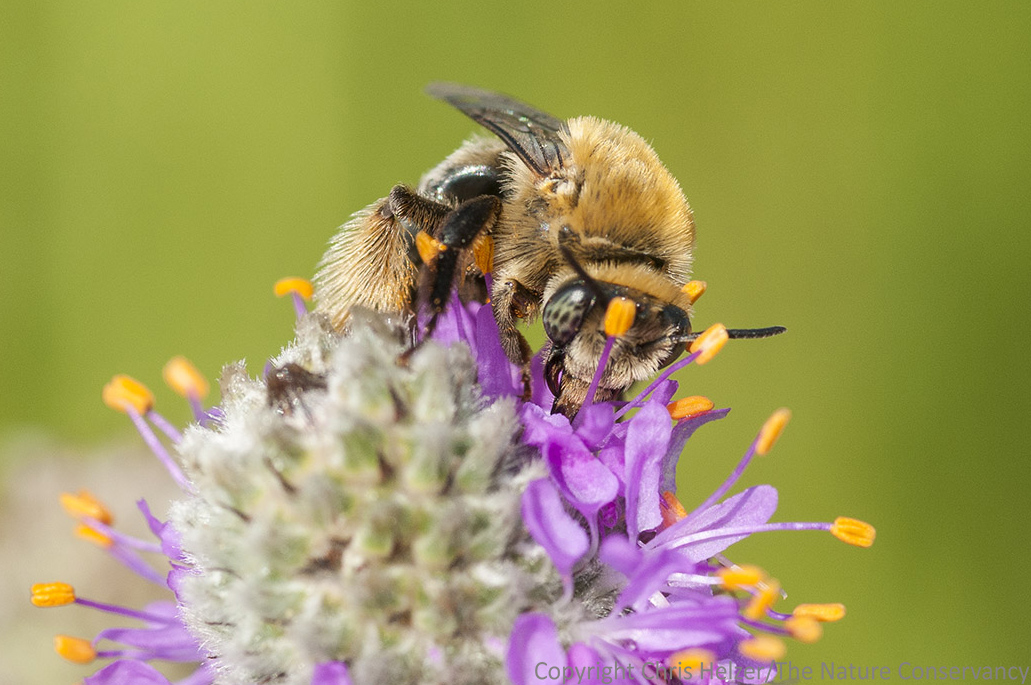
 

if you were a bee, would you find a good selection of feeding options throughout the season?

If you were a bee, would you find a good selection of feeding options throughout the season?


It’s Bee Week!

Thanks to a return visit by Mike Arduser of the Missouri Department of Conservation, it’s bee week in the Platte River Prairies.  Mike came out to our sites a year ago to help us start thinking about our prairies from the perspective of bees and other pollinators.  This year, he made a return visit and we’ve given him a full plate of activities.

Mike Arduser (right) talks about bees with Sam Summers and Anne Stine earlier this week.

Mike Arduser (right) talks about bees with Sam Summers and Anne Stine earlier this week.

On Monday, Mike and I spent the day inventorying bees at several of our prairies, assisted by Anne Stine (Hubbard Fellow) and Sam Summers (TNC volunteer).  We are building upon the initial list of 57 bee species we found in 2012.  Several new species have already been added to the list, and more are likely as we continue to look.

We hosted a pollinator ecology workshop on Tuesday, attended by about 40 people – mostly biologists who assist private landowners with habitat projects or who manage conservation lands.  The objectives were to have Mike help us better understand basic pollination ecology and the needs of pollinator species – particularly bees, and to help us better incorporate bee habitat into our prairie restoration and management strategies.  It was a great day, and everyone had their heads buzzing (sorry) with new information and ideas.

At our pollinator workshop on Tuesday, we spent time talking about prairie restoration and management strategies, as well as general pollinator ecology.

At our pollinator workshop on Tuesday, we spent time talking about prairie restoration and management strategies, as well as general pollinator ecology.

On Wednesday and Thursday, Mike is leading a smaller group of us through an intensive bee identification workshop.  I’m looking forward to peering closely at the faces and private parts of bees through microscopes, and learning to differentiate between Melissodes, Colletes, Lasioglossums, and all the other bees in our prairies.

Less than a month ago, we saw Mike at the Grassland Restoration Network workshop in Columbia, Missouri.  He gave a presentation in which he talked about a variety of pollinator-related topics, including some potential ways to use bees to assess the success of prairie restoration projects.  One of Mike’s suggestions was to see what percentage of bee species in a prairie are specialist pollen feeders (oligolectic bees) and compare that percentage between restored (reseeded) and remnant (unplowed) prairies.

Pollen specialist bees feed only on pollen from one to a few flower species, whereas pollen generalists can feed from a wide variety of plant species.  Specialists tend to be less common in small isolated prairies than in larger prairies, in part because they need a certain minimum population size of their host plants, which can be difficult to obtain in small prairies.  Restored prairies might also lack that population size threshold, especially during the early establishment phase of a new seeding.  In addition, restored prairies that are isolated from remnants might be missing specialist bees simply because the bees in those remnants can’t find them.

According to Mike, a couple of recent surveys in Iowa found that about 20% of the bee species in remnant prairies are pollen specialists.  However, some early data from re-seeded Iowa prairies is showing much lower percentages of specialist bees – especially when those sites are isolated from large remnant prairies. If pollen specialists are not easy to attract to restored prairies, comparing the percentage of specialist bees in restored prairies to the percentage in nearby remnant prairies might be an important way to assess restoration success.

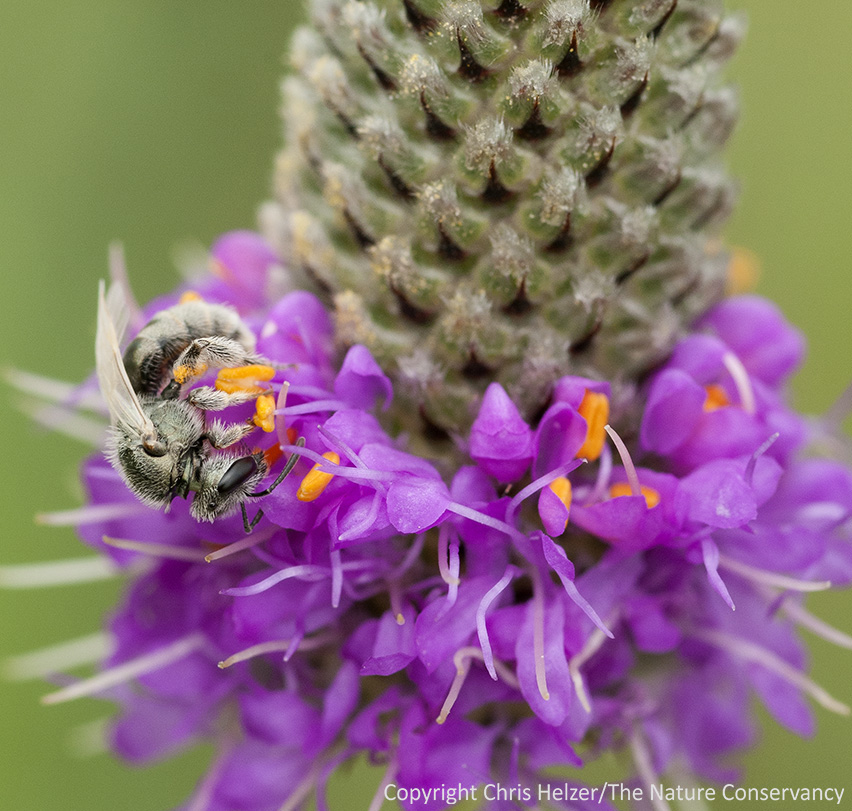
This bee is (probably) Lasioglossum pruinosum, which is a generalist pollen feeder.  It's not suprising to see it in a restored prairie.  Pollen specialist bee species seem to be more sensitive to habitat fragmentation, and may be less likely to occur in restored prairies - especially if those restorations are isolated from large remnants.

This bee is (probably – according to Mike) Lasioglossum pruinosum; a generalist pollen feeder. It’s not suprising to see it in a restored prairie. Pollen specialist bee species, however, seem to be more sensitive to habitat fragmentation, and may also be less likely to occur in restored prairies – especially if those restorations are isolated from large remnants.

Mike suggested that another useful metric could be the number of cleptoparasitic bee species present in a prairie.  Cleptoparasites, or cuckoo bees, are the cowbirds of bees – they lay their eggs in the nests of other bee species.  Because each cleptoparasitic species tends to specialize on the nests of certain species or groups of bees, their presence could another interesting indicator of restoration success.

From our 2012 bee inventory data, I can make some preliminary, and very tentative, conclusions about the number of pollen specialists and cleptoparasites in our prairies.  Of the 38 species we found in remnant prairies last year, 10 (26%) are pollen specialists and only 1 (3%) is a cleptoparasite.  By comparison, of the 47 bee species we found in restored prairies, 12 (26%) are pollen specialists and 7 (13%) are cleptoparasites.

Those data are encouraging, but pretty sketchy because we were really just doing broad inventory work – not collecting data in a way that would allow for a good comparison.  In addition, it clumps all our prairies together, so we can’t look at each one individually.  Anne Stine (one of our two Hubbard Fellows) is going to help remedy that during the next couple months by conducting a short study.  She do some standardized collection of bees from a variety of remnant and restored sites and then compare the percentages of specialists and cleptoparasites between those prairie types.  That should give us a better feel for what’s going on.

In the meantime, it looks like a relatively high percentage of the bee species in our restored prairies are pollen specialists.  That probably reflects positively on both the plant species diversity in those restored prairies and the fact that they are adjacent to remnant prairies – making bee colonization pretty easy.  Since the main objective of our prairie restoration work is to enlarge and reconnect our remnant prairies, those early results are very promising.  …But let’s see what Anne finds before we get too excited.

Now if you’ll excuse me, I have to go learn to tell the difference between Melissodes agilis and Melissodes desponsa.  Wish me luck…