2014 Woodland Burning at the Rulo Bluffs Preserve

I made a trip down to our Rulo Bluffs Preserve last week.  I wanted to get down and see the results of the prescribed fire we conducted earlier this spring.  We’re in a restoration mode at the site, trying to re-open the woodland and increase the amount of light hitting the ground.  The day we burned the site this spring, the relative humidity was very low, so the fire was a little hotter and burned a higher percentage of the unit than we’d seen  in previous burns.  Killing small trees and brush with a nice hot fire was good for our objective.  On the other hand, I worried a little that we might have cooked some of the bigger trees we wanted to keep.

Another panorama showing burned and unburned.  This time, the burned area is to the left and the unburned to the right.

A panorama (four photos merged together) along the edge of the burn unit. The area burned this spring is to the left and the unburned is to the right.

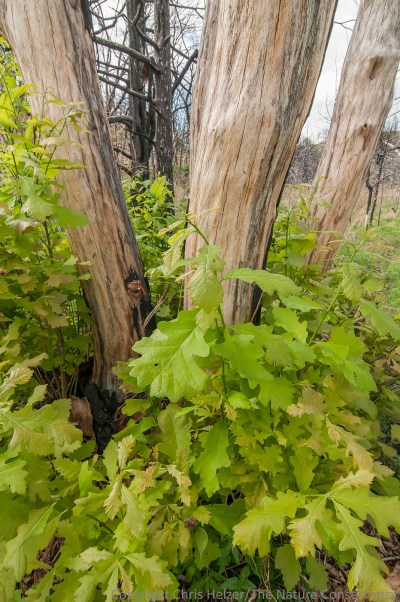
Overall, I was very pleased with what I saw last week.  The fire, combined with some recent “hack-and-squirt” herbicide treatments on smaller trees has done a great job of increasing the amount of light hitting the ground.  At the same time, the majority of larger trees were still alive and leafing out, maintaining a fairly complete canopy – but one that allows for mottled light to hit the ground throughout the day.  We hope to continue annual, or at least very frequent, fires for the next several years to set the woodland back on the trajectory we want.  Then we may back off on the fire frequency a little.  Eventual success will be measured by whether we see an increased abundance of wildflowers, sedges, and grasses on the woodland floor, and – more importantly – regeneration of oak trees, which is crucial for the survival of the woodland itself.

Here are some photos of this year’s spring fire, as well as what I found during my walk through the site last week.

Firebreaks for the fire were mostly created by using a power leaf blower to clear out a narrow trail.  Nelson Winkel is shown here making a final pass around the breaks of the 100 acre burn unit.

Firebreaks for the fire were mostly created by using a power leaf blower to clear out a narrow trail. Nelson Winkel is shown here making a final pass around the breaks of the 100 acre burn unit.  Other members of the crew followed behind, raking out any other debris that needed to be cleared from the breaks.

.

Anne Stine lights down a slope during the fire.

Anne Stine lights down a slope during the fire.

.

The fire burned a little more intensively than most woodland burns we've done at the site, but nothing like a prairie fire - though it burned pretty hot up some of the steeper draws, where leaf litter had accumulated and slopes helped drive the fire.

The fire burned a little more intensively than most woodland burns we’ve done at the site, but nothing like a prairie fire – though it got pretty hot  as it went up some of the steeper draws where leaf litter had accumulated and slopes helped drive the fire.  Crew members patrolled the narrow breaks constantly during the burn, checking the fire, raking leaves and sticks in, and looking for dead trees burning along the edge of the unit that might need to be taken down.

.

This multi-photo panorama shows the largest of the prairies at Rulo Bluffs, along with some of the woodland.  The photo(s) were taken from our neighbor's pasture.

This stitched multi-photo panorama shows the largest of the prairies at Rulo Bluffs, along with some of the woodland. The photo(s) were taken from our neighbor’s pasture during the fire.

.

This area

This area burned fairly completely but there were still small unburned patches here and there.

.

We were able to use ATVs to access some portions of the firebreaks, but others were too steep and/or narrow, and were accessible only on foot.

We were able to use ATVs to access some portions of the firebreaks, but others were too steep and/or narrow, and were accessible only on foot.

.

This panorama shows approximately the same area as Anne is shown lighting above.  The right half of the photo was burned, the left was not.  Note how much more open the burned area is.

This panorama shows approximately the same area as Anne was lighting in the earlier photo. The right half of this image was burned, the left was not. Note how much more open the burned area is.

.

Burned on the left, unburned on the right.

Burned on the left, unburned on the right.  Wood nettles seem to be having a banner year in both burned and unburned areas.  I’m not sure why that is.

.

More wood nettles (and other plants) - this time on a southeast-facing slope that burned pretty hot.  Note the dead (or at least top-killed) small diameter trees.

More wood nettles (and other plants) – this time on a southeast-facing slope that burned pretty hot. Note the dead (or at least top-killed) small diameter trees.

.

Wood nettles were most abundant on lower slopes.  Higher up, mayapples, sanicle, and other plants were more common.  Here, mayapples grow with little company.  That will change as the plant community adjusts to an environment with more light availability.

Wood nettles were most abundant on lower slopes. Higher up, mayapples, sanicle, and other plants were more common. Here, mayapples grow with little company. That will change as the plant community adjusts to an environment with more light availability.  The fire wiped out this year’s crop of garlic mustard.  Hopefully, maintaining a high fire frequency in coming years will help suppress that invader.

.

Here is a south-facing wooded slope that has a lot of bare ground.  Again, this will change over time.  Here, many of the small trees were dead prior to the fire (from the hack-and-squirt treatment.

Here is a south-facing wooded slope with a lot of bare ground. Again, this will change over time as light-loving plants colonize and spread. Here, many of the small trees were dead prior to the fire (from the hack-and-squirt treatment.

.

Columbine was blooming on north-facing slopes - mainly in places the fire skipped.

Columbine was blooming on north-facing slopes – mainly in places the fire skipped.

.

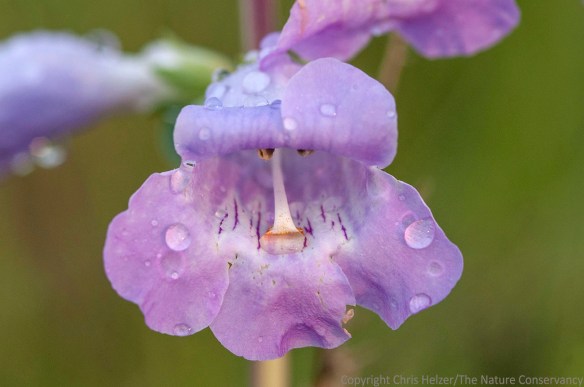
A close-up of columbine.

A close-up of columbine.

.

Yellow ladies slipper orchids seemed to weather the fire just fine.  Of four populations we marked with GPS last year, I found all four and three of them were blooming.  All had been in areas that burned.

Yellow ladies slipper orchids seemed to weather the fire just fine. I found all four of the plants we marked with GPS last year, and three of them were blooming. All  four were in areas that burned.

.

The prairie (left) and neighbor's pasture (right) shown in the earlier photo during the fire.  the prairie greened up very nicely, and the numerous dogwoods were knocked back (temporarily).

Here is the same prairie (left) and neighbor’s pasture (right) shown in an earlier photo (during the fire). The prairie looks vibrant, and numerous dogwoods were knocked back (at least temporarily).

.

Small prairie ridges were greening up very nicely.  Most of the bur and black oaks in those  areas appeared to escape the fire with little or no injury.

The  small prairie ridges scattered across the preserve are greening up very nicely.  Most of the bur and black oaks in those areas appeared to escape the fire with little or no injury.

.

This beautiful spreading bur oak was clearly thriving - as was the prairie around it.

This beautiful spreading bur oak was clearly thriving – as were the prairie plants around it.  The top-killed shrubs will regrow, but frequent fires (and maybe some basal herbicide treatments) should keep them at bay.


Hubbard Fellowship Blog – Anne’s Last Day

Anne Stine’s last day with The Nature Conservancy’s Hubbard Fellowship Program was last Thursday.  Her fellow Fellow, Eliza Perry will be here through the first week of June, but Anne has accepted a full-time position with the Xerces Society which starts next week.  We wish her the very best in her new job and look forward to working with her on prairie and pollinator issues across the Great Plains!

Anne’s farewell post is below.  In addition, the Omaha World Herald featured Anne and Eliza in a front page story this week.  You can see the online version of that story here.

….

It would be hard to overstate how much I’ve had the chance to learn over the past year with the Hubbard Conservation Fellowship in Nebraska. I’ve gained an understanding of the work it takes just to hold your ground against the tide of environmental degradation, and I’ve witnessed the dynamic balancing act that underlies a healthy grassland.

With Chris mentoring Eliza and I, we certainly learned plenty about the natural history of the Great Plains. One of the things I love about ecology is the way it opens your eyes. Before I knew what I was looking at, a walk outside was a pleasant green blur. Now I can pick out the details, and recognize old friends. Knowing natural history enriches your life in a very immediate, concrete way.

Chris and Nelson also taught us about grassland management for biodiversity. They included us in their planning discussions, and explained their decision making. We learned what makes a grassland ready for fire or grazing, and we are getting real experience with the controlled chaos of burn season.

There are also the intangibles. Trilling Sandhill Cranes have provided the soundtrack to my life for the past couple months. I got to help round up bison- TWICE- which is something so incredible it never even ranked as a possibility to me prior to this fellowship. Not to mention all the wonderful conservation professionals I’ve had the chance to meet and learn from.

I’ve achieved both my objectives for this fellowship: I got real experience in land management, and I was hired for my dream job as my next career move.

My advice for the next fellows would be: Dive in. You’ve been given the chance to thoroughly explore a topic of your choosing. Seize this opportunity, and you can truly change the course of your career.

Anne Stine (center) learning about bees from Mike Arduser (right), along with Sam Sommers (left).

Anne Stine (center) learning about bees from Mike Arduser (right), along with Sam Sommers (left).

Now that I’ve completed my Fellowship, I will join the Xerces Society as the Pollinator Conservation Specialist/NRCS Partner Biologist (Central Region), based in Fort Worth, Texas. I would not have gotten this position without the Fellowship. My hiring stems from my independent project, a comparative study of bee communities in restored and remnant prairies on the central Platte River.

I can’t say I knew much about bees before coming to Nebraska. When my little brother heard about my new gig, he couldn’t help but tease me. He reminded me that we had both been (rather terrifyingly) swarmed by bees as children1, and he inquired: “So– I have to ask– you’re not just studying bees so you can figure out a way to kill them all, are you?” I responded: “No, Robert. I am not a super-villain.”

Bees are often treated unfairly. In fact, the world of invertebrates is fascinating. In large part, I have Mike Arduser and Chris Helzer to thank for introducing me to this new area of study. Mike gave an incredible workshop that served as my crash-course in bee taxonomy, and he has continued to be a mentor in all things bees. Chris, always enthusiastic about inverts, also helped prime my interest in native bees.

With Chris helping as an auxiliary net-man, we sampled 8 paired plots (4 remnant, 4 restored) in late summer. We identified 33 bee species total, and counted 26 species in remnants and 20 species in restorations. While we are still in the throes of data analysis, we plan to submit a manuscript of our findings within the next couple months. It is our aim to put forward the diversity of the pollinator community as another measure (in addition to the plant community) of restoration success.

Anne, collecting seeds of Maximilian sunflower.  Platte River Prairies, Nebraska.

Anne, collecting seeds of Maximilian sunflower. Platte River Prairies, Nebraska.

I have so much gratitude for all the help, training, and mentorship I’ve received over the past year. The hiring materials for this fellowship promised “the whole enchilada”, and The Nature Conservancy in Nebraska delivered.

—-

1In the bees’ defense, they were being totally reasonable when I was swarmed. The story still makes me cringe at the irony of it all. I was at a summer camp, being led through the woods blindfolded with other children as part of a ‘trust’ exercise, when we were led over a feral bee hive (by an unwitting camp counselor). After being trampled by umpteen child feet, I am not surprised the bees got tetchy. I did take a lasting lesson from this ‘trust’ game, though perhaps not the one the camp counselors intended…