Photo of the Week – May 5, 2017

During the last week, I’ve been lucky enough to find and photograph two different wolf spiders, so I figured I should probably dedicate a short blog post to them.  The first wolf spider I found was a cute little bugger out in the prairie the other day.  I was out looking for monarch eggs and caterpillars and saw the spider scurry between clumps of vegetation.  Since I had my camera in hand, I stopped and had a visit.  The second spider was in our basement and was considerably bigger (2 inches in diameter with legs).  I took it outside where it could be happier, and photographed it before letting it roam freely in our garden.

This big beautiful wolf spider was in our basement before I put it back outside.

There are a lot of big fuzzy spiders that resemble wolf spiders, but true wolf spiders have a characteristic eye pattern that sets them apart.  If you look at the above photo, you can see that there are two large eyes above a straight row of four smaller eyes.  If you look even closer, you might be able to see two additional eyes behind the big ones that point up and to the sides.  You can see those last two eyes more clearly in the photo below.  The layout of those eight eyes is unique to wolf spiders, so if you ever wonder if a big fuzzy spider is a wolf spider, just look it in the eyes and you’ll know.
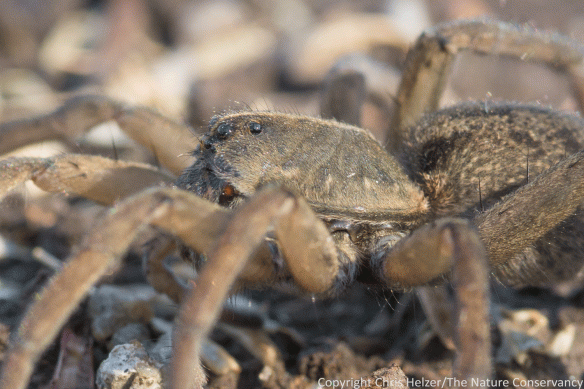
In this photo, it’s easier to see the wolf spider’s non-forward facing eyes.

There are more than 2,000 species of wolf spiders across the world, and they are a fascinating group of creatures.  Although they are free-roaming spiders (they don’t create a web and hang out on it), they still use ambush as their primary means of hunting.  They’ll usually sit quietly and wait for prospective prey to come within striking range. Wolf spiders hunt mostly at night, and their eyes are well-adapted for seeing in low light.  However, wolf spiders are also very adept at sensing and using vibrations to identify their prey.  Their hairy legs aren’t just for looks; they also act as part of a complex system of vibration sensors.  Wolf spiders can distinguish between patterns of wing beats or footsteps to help them determine what kind of creature is coming near.

This small wolf spider was out in the prairie while I was looking for monarch caterpillars.  Its body and legs were about a half inch in diameter.  Note the distinctive eye pattern that characterizes it as a wolf spider and the different kinds of hairs on the legs.

My daughter made me proud the other day by telling me she was able to impress her college friends with some of my favorite spider trivia: the reason spider legs always curl up when they die.  Spiders have flexor muscles on their legs (muscles that pull the legs toward their bodies) but not extensor muscles to push them back out again.  Instead, they use hydraulic pressure to extend their legs.  A fluid called hemolymph is pushed into the legs, counteracting the flexor muscle pressure enough to extend the legs.  It sounds like a cumbersome system, but if you’ve ever seen spiders run and jump, it’s clear that it works very well.  When a spider dies, it no longer has hydraulic pressure in its legs to counteract the flexor muscles so the legs naturally curl up toward the body.

Don’t you just love spiders?  Of course you do.
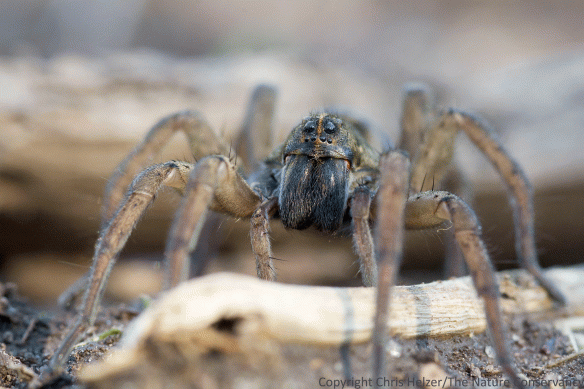
Here’s the big female one more time, just before she turned away to go explore our garden.
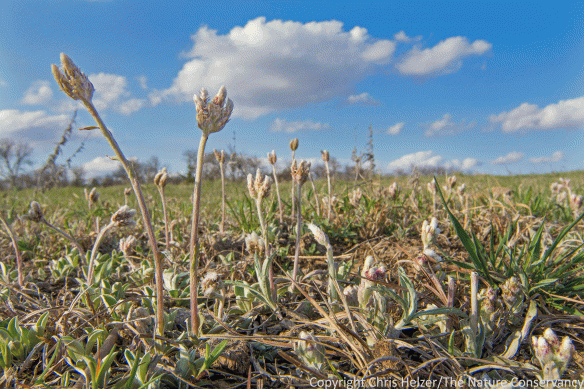
Photo of the Week – April 20, 2017

I’ve been enjoying the early flush of wildflowers this spring, and have been trying to photograph them when I get time.  Because I already have quite a few close-up portraits of most of these species already, I’ve been trying to use a wide-angle lens to show the flowers in a broader context.  It means lying prone on the ground with the camera resting either on the ground or on my hand to get both the flowers and the landscape/sky behind them into the same frame.

Pussytoes (Antennaria neglecta) at our family prairie near Stockham, Nebraska.

Pussytoes are an easy one to photograph because they are allelopathic and hinder the growth of neighboring plants.  That short vegetation helps pussytoes plants compete with others, but also makes it easier me to photograph them without stray leaves and other plant parts getting in the way.  For other species, I’ve been spending most of my time photographing the flowers growing in sites that were grazed hard last year.  The grazing makes photography easier, but the access to light and weakened grass competition also stimulates more of the plants to flower than in ungrazed sites.  I’ve been collecting data on flowering plant numbers over the last several days, and the data confirm my casual observations.  There are many more flowers in prairie patches recovering from grazing than in patches that haven’t been grazed much in the last year or two.

Prairie violets (Viola pedatifida) in the area of our family prairie we grazed most intensively last year.

Carolina anemone (Anemone caroliniana) at Gjerloff Prairie, owned by Prairie Plains Resource Institute.  They are having a great year in the part of the prairie that was burned and grazed in 2016.

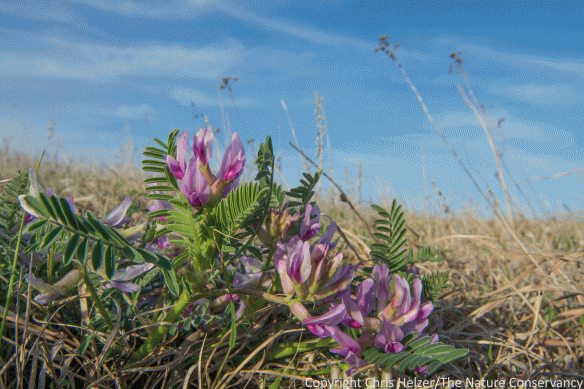
Ground plum (Astragalus crassicarpus) at the Helzer prairie.

More pussytoes at the Helzer prairie, with a little bit of dried manure for flavor.

For pollinator insects, this early spring period can be very challenging because flowering plants are in pretty short supply.  There aren’t many species blooming, and those that are tend to be spread sparsely across large areas.  At least in the prairies around here, last year’s grazing is increasing numbers of available resources for pollinators, including both short-lived and long-lived plant species.  That appears to be particularly valuable this year, given the number of butterfly and moth species taking advantage of strong south winds to make an early migration to Nebraska.  I can’t remember a year when we’ve seen so many of those insects in April, including monarchs (which we’re now seeing frequently), sulphurs, red admirals and many little moths.

Now, here’s a question I hope someone out there can help answer:  Pussytoes flowers are dioecius, meaning that some plants have male flowers and others have female flowers.  My understanding is that pussytoes is pollinated both by wind and by insects.  If the male flowers produce pollen but the females don’t, what attracts insects to move from male flowers to females and complete the pollination cycle?  Do the female flowers produce nectar?  I see mainly flies, and a few bees, landing on pussytoes.  I don’t think those flies could be accessing nectar from deep inside the flower, and I don’t see any evidence of nectar near the top (or in any part) of the flower.  Also, most of those flies and bees seem to be landing on male flowers, and I rarely see them on female blossoms.  Can anyone help me understand why/how this pollination process works?