Hubbard Fellowship Post – Dillon the Prairie Doctor

This post is written by Dillon Blankenship, one of our Hubbard Fellows.

Becoming a Prairie Doctor (or Living in a World of Wounds)

Last weekend I drove back to Arkansas to attend a wedding. It is a sizable drive (approximately nine hours from Wood River), but is manageable with a sufficient supply of snacks and music. The trip went smoothly enough and, with the recent honing of my plant identification skills, I was more aware than ever before of the interesting flora to be seen from the interstate. Of course, much of the scenery included corn and soybeans, but there were also many “wild” plants along the way – goldenrod, sunflowers, hoary vervain. Missouri’s I-29 was lined with Illinois bundleflower.

Maximilian sunflower (Helianthus maximiliani) is a native wildflower commonly seen in roadsides this time of year.

Maximilian sunflower (Helianthus maximiliani) is a native wildflower commonly seen in roadsides this time of year.

Unfortunately, there were a lot of sinister plants to be seen too. Musk thistle, drying up now, sloughed its last seeds into the wind. Old stalks of teasel formed highway-side monocultures. Sericea lespedeza engulfed the road edges and outcroppings as I entered the Ozarks and I was welcomed home by a new patch of Queen Anne’s lace beginning its invasion of the field by my house.

I acknowledge that there are some differences of opinion on exactly how invasive or detrimental some of these exotics are, but given the large amounts of time I have devoted to invasive species control thus far in the fellowship, this sea of weeds was a depressing thing to behold.

It made me think of the oft-quoted line from Aldo Leopold’s Round River essay that, “One of the penalties of an ecological education is that one lives alone in a world of wounds. Much of the damage inflicted on land is quite invisible to laymen. An ecologist must either harden his shell and make believe that the consequences of science are none of his business, or he must be the doctor who sees the marks of death in a community that believes itself well and does not want to be told otherwise.”

These plants were not new to my journey. They were likely there when I first drove to Wood River to interview for the Hubbard Fellowship in February, and they were certainly there when I drove back to Arkansas in June. The difference is that now I can spot these wounds a mile away (I literally see them in my sleep). When I passed them just a few months ago, I had not yet been educated by my mentors at the Platte River Prairies, nor had I invested so many intimate hours into working with these plants (as I spaded and sprayed their cohorts into oblivion).

I am furthering my ecological education on our prairie in many ways – through mastering species identifications, studying the interactions of fire and grazing, working in restorations, conducting wildlife research, and so much more – yet the ever-present threat of invasives continues to have the most pervasive impact on me. I showed some of my friends around the central Platte recently and found myself saying things like, “…and this,” (with a graceful Vanna White arm swing)  “is all Reed canary grass” or “this pretty flower covering the sandbars to the horizon is the nefarious Purple loosestrife.” (editor’s note – we also have many areas that are not completely overrun with invasives…)

Purple loosestrife and reed canarygrass on the bank of the Platte River.

Purple loosestrife and reed canarygrass on the bank of the Platte River.

Even so, now that I am aware of the damages, I do not think I should shirk away in depression or ignore the problem to save my sanity – this assertion goes beyond the scourge of invasive species to encompass all the other wounds out there.  As Leopold continues, you have to know to see, and then you have to study so you can formulate the best prescriptions possible for healing the natural world.

Wish me luck.

A Special Volunteer

Volunteers are a critical part of our stewardship work at the Platte River Prairies.  We don’t have a lot of them, but we’ve been lucky to have some great ones.  All of our volunteers are appreciated, but we have special gratitude for those who commit so much time they are essentially staff – except we don’t have to pay them!  One of those terrific volunteers over the last three seasons has been Sam Sommers, a high school student from Kearney, Nebraska.  When his dad first approached us about Sam doing some volunteer work as a young high schooler, we wondered whether it would be worth our time, but figured that anyone with that much interest deserved our attention.  And man did we get our money’s worth (so to speak)!  He spent the vast majority of three summers working – very hard – alongside our stewardship staff.

Sam Sommers (left) helps last year's Hubbard Fellow Anne Stine and (then) Missouri Dept of Conservation ecologist Mike Arduser with some bee collectionin 2013.

Sam Sommers (left) helps last year’s Hubbard Fellow Anne Stine and (then) Missouri Dept of Conservation ecologist Mike Arduser with some bee collectionin 2013.

Sam is going off to study wildlife biology at the University of Wyoming this fall.  They are lucky to have him.  I could say a lot about how much we appreciate everything Sam has done for us – and we really do – but one of our Hubbard Fellows, Jasmine Cutter, stepped up to do it for me.

By Jasmine Cutter:

When I first got to the Platte River Prairies, I wasn’t sure who I was going to meet when I heard “Sam” mentioned. Based on Eliza’s (former Hubbard Fellow) enthusiasm – “Sam’s the best!!” – and Nelson’s nodded affirmation, I assumed that I was about to meet a celebrity. I have to say, Sam has lived up to the hype. He is tireless, curious, knowledgeable, and a real trouper! Sam is a master of the killstick, a seed-collector speedy enough to rival Chris (editor’s note: ok, he’s really good, but not THAT good), and a tireless thistle destroyer.

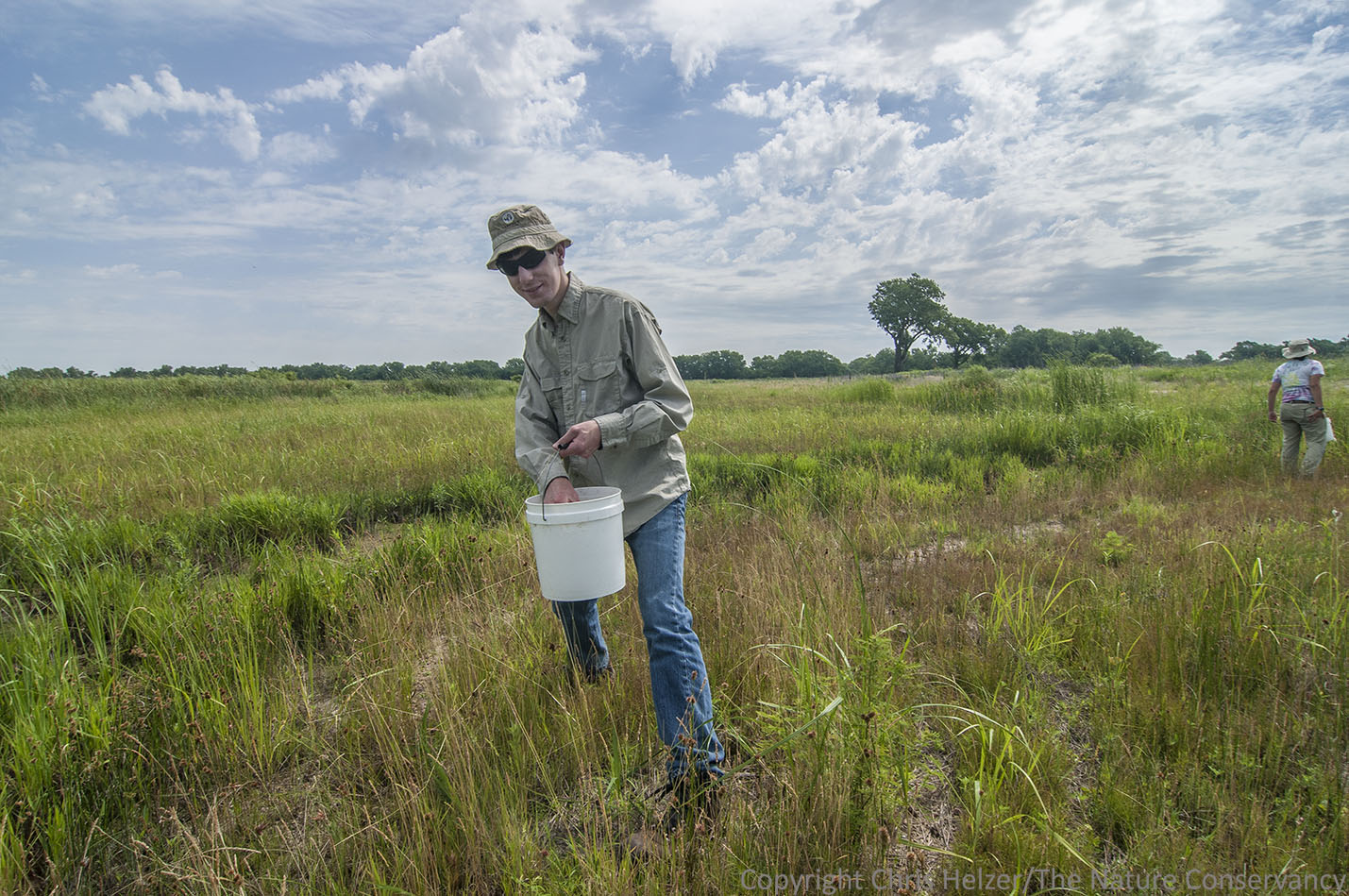
Here is Sam harvesting seeds along a restored Platte River wetland this summer.

Here is Sam harvesting seeds along a restored Platte River wetland this summer.

Coming into our Hubbard Fellowship just as the growing season was starting to take off was pretty overwhelming – long days, many different invasive species to learn, new tools to master, not to mention trying to figure out where all the sites are. Dillon and I often relied on Sam’s seasons of experience working here. His advice and assistance allowed us to operate fairly independently from Nelson, freeing up Nelson to work on other projects. Our introduction to stewardship wouldn’t have been nearly as smooth without Sam’s help.

Really, the thing that impresses me the most about Sam – besides his competency – is his work ethic. He is out here every day dealing with exactly what we’re dealing with: battling the mosquitoes/ticks/chiggers, the sometimes dispiritingly large patches of thistles, the sweaty herbiciding goggles, the heat, the long days… It’s hard to fathom how much more Chris and Nelson have been able to accomplish with Sam here. He has removed hundreds of trees, killed thousands of thistles and other invasive plants, collected dozens of gallons of seeds, and completed myriad other tasks that never would have happened without Sam. With a work ethic like his, I have no doubt that Sam will do great in college – it might even be a restful experience after his stint here. We will greatly miss Sam, and I can’t wait to hear about what he gets up to in the future!

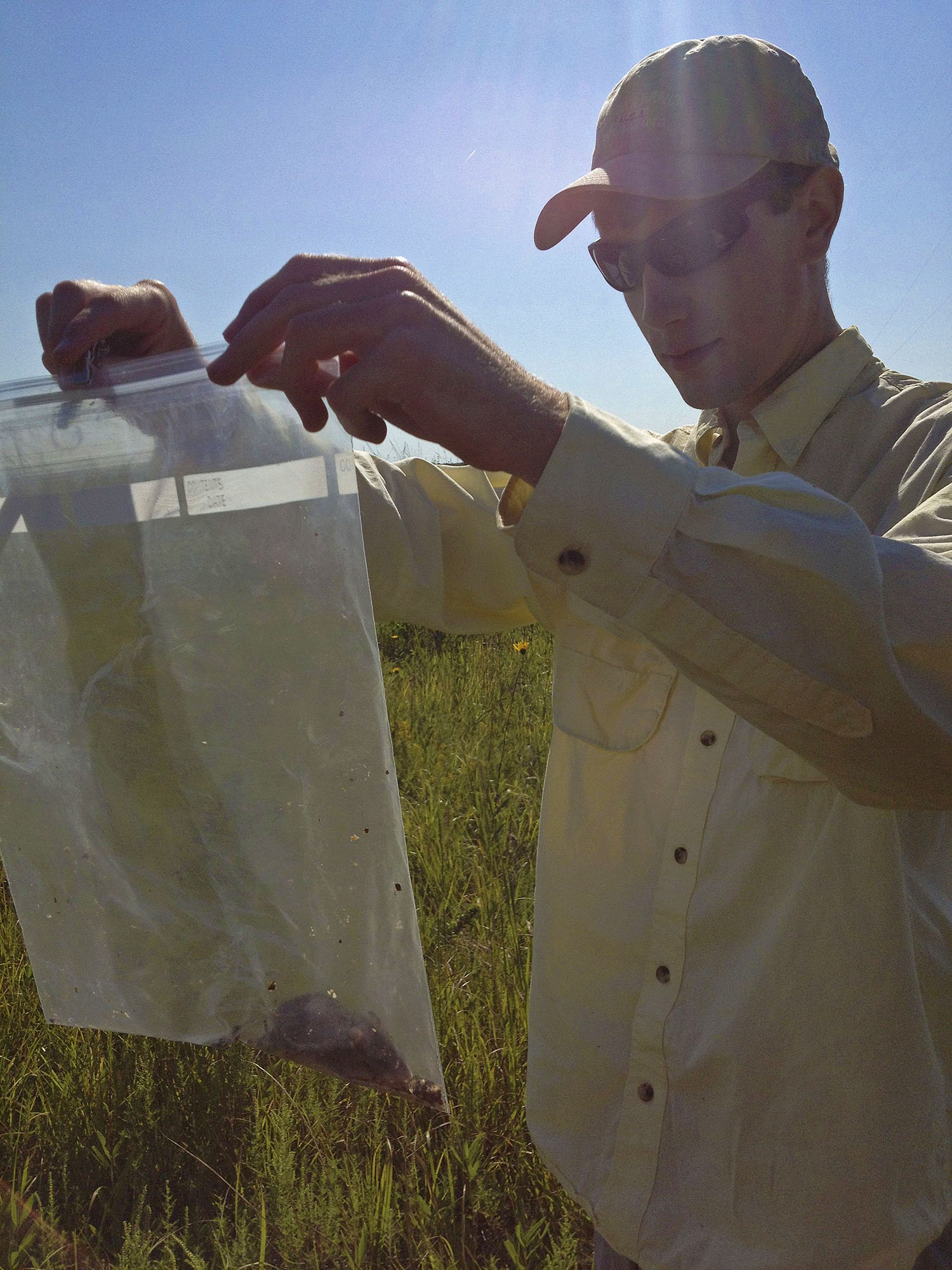
Sam helped Jasmine and Mike Schrad (Nebraska Master Naturalist) with some small mammal trapping this summer.  Photo by Jasmine Cutter.

Sam helped Jasmine and Mike Schrad (Nebraska Master Naturalist) with some small mammal trapping this summer. Photo by Jasmine Cutter.

Sam, THANK YOU very much for everything, and have a great time at college! – Chris H