Watching Wetland Water Levels – Timelapse Photography

It’s timelapse photography time again…  I downloaded more photos from the cameras at our restored wetland in the Platte River Prairies a couple weeks ago, and have been looking through the images for stories.  One theme that stood out in this batch was the variability of the water level in the wetland through time.

This wetland is directly connected to the water table, but is also supplied by a groundwater-fed stream that brings both rainwater and groundwater from about 25 miles west of us.  Platte River flows and irrigation pumping both influence the water table here in the Platte Valley, as does evapotranspiration by plants – and other factors.  It’s a complicated series of events and processes.  However, in general, we expect the water table to be relatively high in the spring and to decline as summer progresses.  I looked at photos from early June and early July (below) and that pattern of summer decline is apparent this year.

June 8, 2014

June 8, 2014.  A panoramic image created by merging photos from two adjacent timelapse cameras.

July 8, 2014

July 8, 2014.  You can click on each photo to see a larger/sharper version of it.

Seeing the pattern of water level rise and fall through weeks and months is interesting, and timelapse photography allows us to watch that pattern pretty easily.  However, it’s also interesting to look at shorter-duration patterns.  I shared one example of that back in December, with a series of images showing daily water level drops due to evapotranspiration.  Today, I’m sharing a second example of short-term water level changes – this time, it’s due to water coming downstream after a rain event.

In the early morning of June 21, 2014, a big storm system moved through our area, dumping between 2 and 4 inches of rain.  The map below shows the precipitation amounts from that storm.

This photo from http://water.weather.gov/precip/ shows rain amounts for our area on June 21.  The black arrow indicates the location of our wetland.

This image from the National Weather Service (http://water.weather.gov/precip/) shows rain amounts for our area on June 21. The black arrow indicates the location of our wetland.

Rainwater from the storm swelled the stream that flows into our wetland, but also created runoff flow throughout the watershed.  The Youtube video below shows the water level changes in our wetland through the day on June 21, 2014, starting at 7am and ending at 8pm.  The changing light conditions from image to image make it a little difficult to see, so you may have watch it several times to get the full effect.  The foreground, the green peninsula on the left, and the little island just left of center are all good landmarks to help see the water level change.

There’s nothing earth-shattering about stream or wetland water levels rising and falling after a big rain event.  On the other hand, it’s not often we get the opportunity to actually see it happen.  Timelapse photography gives us the opportunity to compress time and see natural processes from a different perspective.  For me, at least, that opportunity helps me better understand and appreciate the variability of the earth we live on.

As always, thanks to Moonshell Media for their help with this timelapse photography project.  If you’re interested in exploring timelapse photography for conservation purposes, you can contact them at 402 817 4313 or info@moonshellmedia.com.

2014 Sandhill Crane Migration – Platte River, Nebraska

March is always a busy time on Nebraska’s Platte River.  It’s the beginning of prime prescribed fire season, of course, and a good time to work on fence repair and tree clearing projects.  But there’s no question that sandhill cranes rule the month.

The early morning scene on the Platte River in March.  Note the abundance of feathers floating down the river...

The early morning scene on the Platte River last week.  Note the abundance of feathers floating down the river…

About 600,000 sandhill cranes spend a good portion of late February, March, and early April along the Platte River before heading north to nesting grounds.  It’s one of the greatest migratory phenomena in the world, and it happens right in our backyard.  Because of that, our staff spends quite a bit of time taking groups of people into our viewing blinds where we watch the cranes land on the river at sunset and take off again in the morning.  It’s an important fundraising opportunity for The Nature Conservancy, and a way to show our Nebraska members what we’ve been working on and thank them for their support.  It’s really gratifying to watch the reaction of people as they see the crane spectacle for the first time.

My son Daniel got his first trip to a crane blind on his birthday this year.  It was very cold, but he was still glad to go.

My son Daniel got to take his first trip to a crane blind on his 10th birthday this year. It was very cold, but he still had a great time.

Because I’m in the blinds fairly frequently, I get quite a few opportunities to photograph cranes – though the number of nights and mornings when the light is favorable can be limited.  Also, I’m really not a wildlife photographer, either in terms of my equipment or aptitude.  Despite that, I usually end up with a few decent photos by the end of each season, though not as many as I should.

This year, I also tried to get some video footage of the cranes – something I have even less experience with and aptitude for than wildlife photography!  Also, my only video camera is the video function on my Nikon D300s SLR camera, and I’m still learning to use it.

You can see two of my attempts by clicking on the links below:

Video 1 – Cranes preparing to leave the river on a cold morning.  This 30 second clip gives you a feel for the density, activity, and noise of a crane roost.

Video 2 – Cranes chasing each other around on a sand bar.  There is a lot of jumping and chasing among cranes.  Some of it is courtship and pair bonding, some of it is just posturing.  This clip is about 30 seconds long.


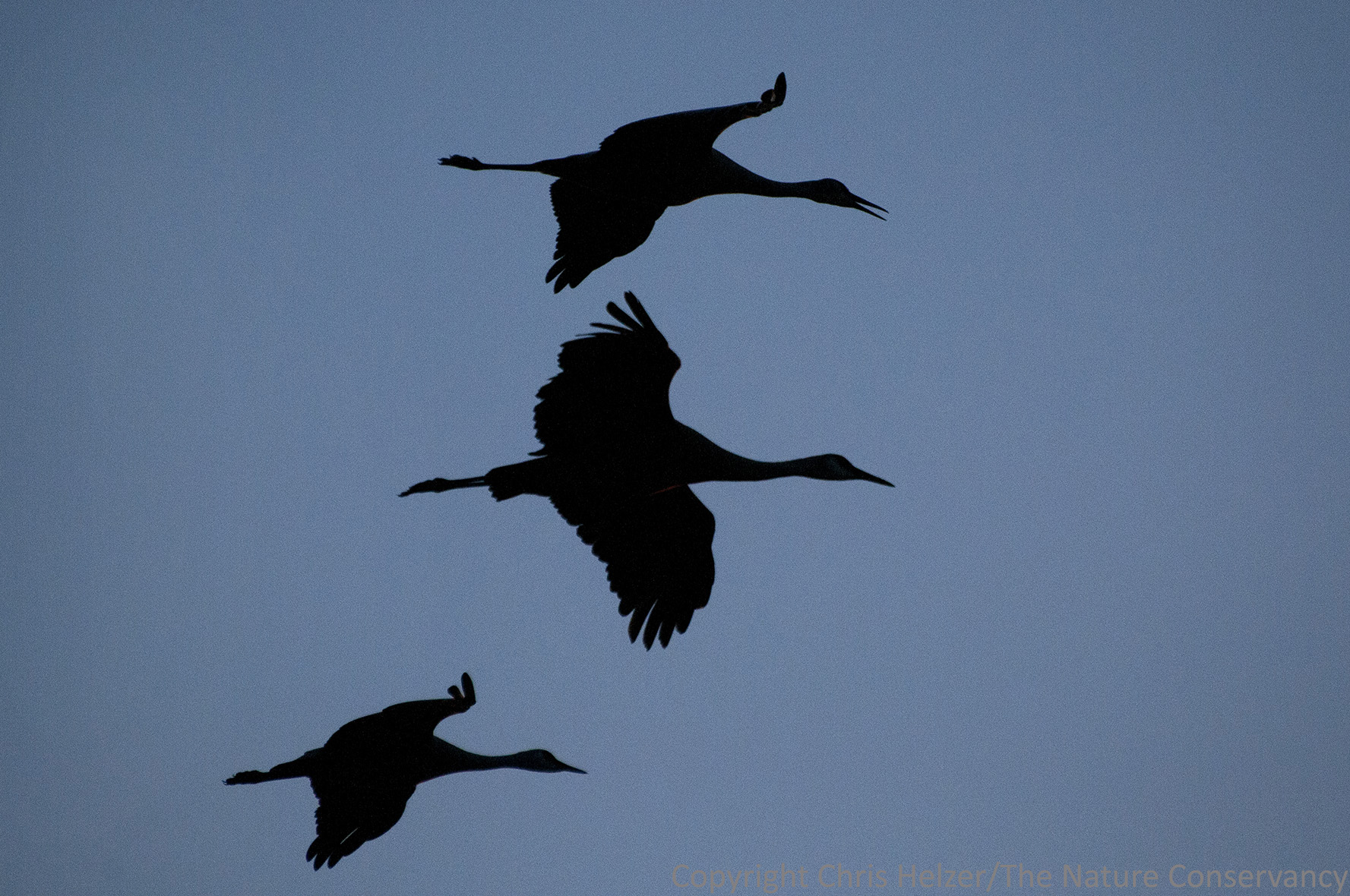
Silhouettes against the evening sky.

Silhouettes against the evening sky.

In the evenings, the cranes often wait to come to the river until it is getting dark, making photography difficult.  In those cases, the best photo opportunities are usually silhouettes of the birds against the sky as they drop into the river.  On nights when the light is nice and our guests are fully engaged watching the big event, I manage to snap off a few shots.  Both close-ups on a few birds at a time and more wider views can be attractive.

Sandhill cranes coming to the river after sunset.

Sandhill cranes coming to the river after sunset.

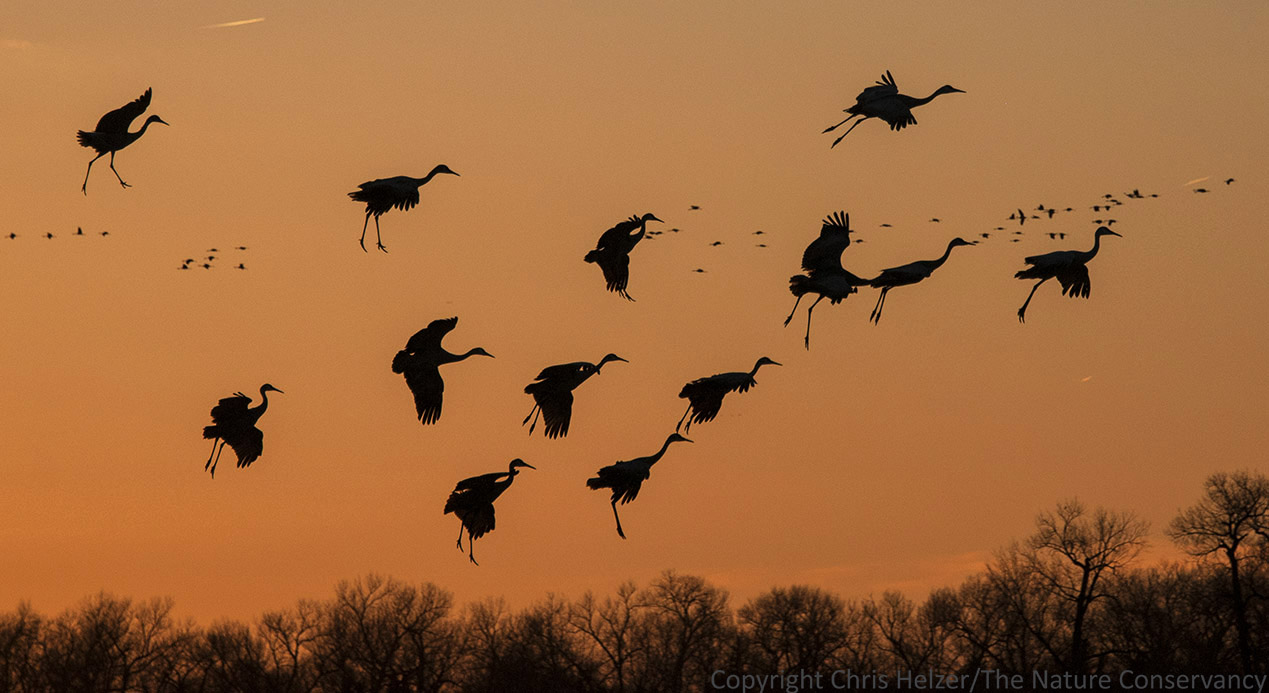
This year, my favorite image was the first shot I took one evening.  The sunset was beautiful and the cranes were parachuting gracefully toward the water as I poked my camera lens out the window of the blind.  The resulting photo reminded me of the theme song to a 1980’s TV show – The Greatest American Hero.

"Believe it or not, I'm walking on air..."   Cranes floating down to the river at sunset.

“Believe it or not, I’m walking on air…” Cranes floating down to the river at sunset.

.

Bonus Coverage

On one of the crane tours I led this spring, I met 11-year-old Jack McDowall and his dad.  Jack is a fellow blogger who is working on a year-long project to photograph and document his bird sightings.  I think many of you would enjoy his photos and the natural history information he includes along with them – including a post from his trip to our viewing blind.  If you’d like to visit his blog, you can link to it here.