
Hubbard Fellowship Blog – Last Day for the Cattle

A guest post by Anne Stine, one of our Hubbard Fellows.  (All photos are by Anne)

Today (Oct. 1, 2013) the lessee came and got his cattle, as per our agreement.  I’ll miss them. It is with some sadness that Eliza and I have been awaiting their removal from the pastures.  We’ve really enjoyed having cattle around.  I like the way they keep an eye on you in the pastures, and the way they prick their ears and step forward before turning tail and scattering.  I like hearing them bellow (pronounced “bell-er”) at each other to keep tabs on calves and herd-mates. Eliza and I agree that our acreage will seem a lot emptier without them.
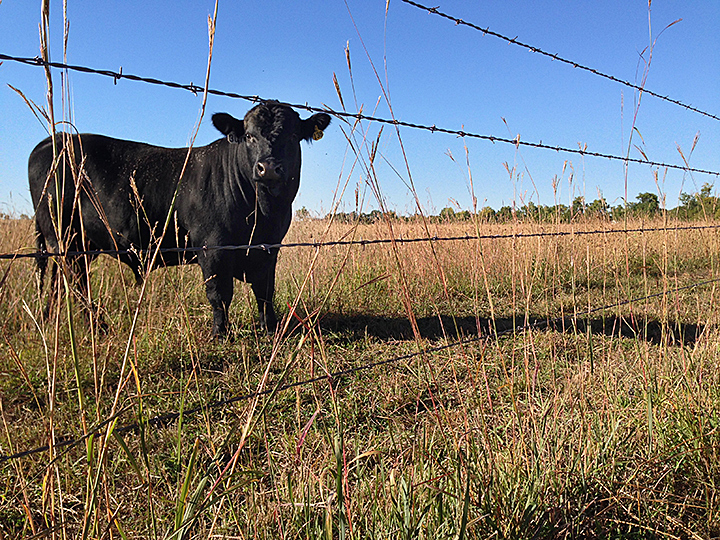
This bull came over to check out my truck.

This bull came over to check out my truck.

It’s funny, because the herds we interact with are a skittish lot, but they are still companionable if you go about your own business without paying them too much mind.  The closest I’ve ever gotten to our lessee’s cattle was when I was harvesting seed from white prairie clover.  At first the cattle were suspicious, but when they saw me hunched over pulling on plants it seemed to put them at ease.  I imagined I looked like I was grazing too.  A cow wandered so close I could hear her huffing and chewing as she snipped grass. I liked being surrounded by the cattle and having them placidly munch around me.

Chris entertaining the cows.  (Editor's note: For the record, I was photographing a management practice, not entertaining cattle.  Not more than a couple of the cows were laughing.)

Chris entertaining the cows. (Editor’s note: For the record, I was photographing a management practice, not entertaining cattle. Not more than a couple of the cows were actually laughing.)

If you step away from your truck cattle will often surround it and start rubbing on it and licking it.  The calves are more curious than their mothers.  They’ll follow trucks and come over to see what you are up to.  I’ve seen cows nose their inquisitive calves away from trucks they were stepping forward to examine.

If I ever have a prairie of my own, I’ll definitely look into leasing out the grass on it.

Goodbye cattle.

Goodbye!

Isn’t it a little late to be nesting?

As you might remember, my Photo of the Week last week was an image of a fledgling meadowlark I’d found in mid-September.  At the time, I’d talked about how surprised I was to see such a young bird so late in the season.  Well, last Friday, Eliza Perry, one of our Hubbard Fellows, called me to say she’d just found a nest full of tiny birds – did I want to come take a look?  Of course I did.

American goldfinch chicks sit in a nest about three feet off the ground in a tall thistle (Cirsium altissimum) plant.  Platte River Prairies, Nebraska.

American goldfinch chicks sit in a nest about three feet off the ground in a tall thistle (Cirsium altissimum) plant. Platte River Prairies, Nebraska.

I’m pretty sure what Eliza found was an American goldfinch nest.  The bills and markings on the birds look right, and we spotted an adult goldfinch nearby.  However, the best supporting evidence was that the nest was located in a thistle plant (a native thistle species, by the way) and had thistle down in the nest cup.  There is a strong tie between American goldfinches and thistles.  Unlike most other bird species which feed their young on insects, goldfinches instead feed them regurgitated seeds – especially those of thistle plants.  In fact, they often delay their nesting until those thistle seeds have ripened.  Here is a link to photographer/naturalist Stan Tekiela’s post on this topic, if you’re interested in learning more about the topic.

These birds are even further behind the meadowlark in their development, and it’s already getting pretty cold overnight, so the nestlings’ chances for survival might seem slim.  Of course, the difference between the meadowlark and the goldfinches is that the goldfinches have adults around to help them.  Both have a challenging fall and winter ahead of them, but nothing others of their species haven’t dealt with countless times before, I guess.

A better view of the nest placement within the tall thistle plant.

A better view of the nest placement within the tall thistle plant.

Thanks to Anne Stine, our other Hubbard Fellow, who graciously helped hold equipment for me as we photographed the nest.  Because of the very bright early afternoon sun, I had Anne hold a diffuser near the nest to reduce the harshness of the sunlight while I held a small flash unit to better illuminate the birds.  We worked quickly and got out of the way so the parents could resume their feeding duties.