Photo of the Week – April 28, 2017

Ten days ago, I wrote about monarch butterflies returning from Mexico and flying much further north than is typical, and some of the risks they face because of that.  Many of you responded with your own similar observations and stories of monarchs across the country.  Since writing that post, I’ve spotted numerous monarchs both at our family prairie and in our Platte River Prairies, and reports to Journey North show monarchs have traveled even further north than we are here.

Earlier this week, my wife got to watch a monarch laying eggs on some small whorled milkweed (Asclepias verticillata) plants in our backyard prairie garden.  A monarch (same one?) came by when I was around too, so I snuck out and tried to get photos of it but it was too cagey.  At the end of last year, Kim and I were talking about how surprisingly fast the couple of small whorled milkweed plants we’d gotten for the garden had spread.  Now we’re worried that we don’t have enough whorled milkweed to support all the eggs that have been laid on them!

A monarch egg on whorled milkweed in our backyard.

Usually, the monarch laid only a single egg per plant, but some plants had as many as three on the same small plant. Hopefully, those caterpillars will be able to make their way to surrounding plants if they overwhelm the ones they start on.

Yesterday, I went walking in our Platte River Prairies, hoping to find some eggs there as well.  I was looking for common milkweed (Asclepias syriaca) but all I found was more whorled milkweed.  Sure enough, I found eggs on some of those plants too, and even spotted a couple tiny caterpillars.  All the plants I found were in prairie patches we’d burned and grazed last year.  I’m guessing the monarchs had the same impression I did of that grazed habitat – it’s sure easier to find tiny milkweed plants when there aren’t a lot of taller plants and thatch hiding them!

This tiny little caterpillar was busily munching away on whorled milkweed in our Platte River Prairies. It was just a couple millimeters long.

Whorled milkweed doesn’t usually get the accolades or attention it deserves.  In our prairies, it is often most abundant in areas where native prairies have been degraded by a long history of overgrazing and broadcast herbicide use (before we acquired the properties).  The plants are relatively small (often less than a foot tall) and have small white flower clusters and skinny seed pods.  When we’re harvesting seeds for our prairie restoration work, we try to get enough seed to ensure the species will establish in our plantings, but probably haven’t always worked as hard as we should at it.

Whorled milkweed is often overlooked and underappreciated, but is certainly proving its worth this spring.

The monarch eggs and caterpillars I found yesterday were in a restored prairie we’d seeded back in 2000.  The patches of whorled milkweed I found were over 15 feet in diameter, and some contained well over 100 plants.  I’m awfully glad now that we took the time to find and harvest whorled milkweed seeds during the summer of 1999, and wish we’d harvested even more.  Nevertheless, the plants that established back in 2000 have spread successfully and are now helping to rear the next generation of monarch butterflies.  When those caterpillars emerge as butterflies, they’ll find themselves in the middle of a large and diverse prairie community, full of flowers for them to feed on.  Eighteen years ago, that same location was a cornfield.  Today, it is giving some way-too-early monarchs a chance at survival.

This plant had both an egg and an already-hatched caterpillar. Hopefully, as it grows, it will find not only sufficient milkweed, but also abundant nectar resources for its adult life. (You can see a larger and more clear version of this image by clicking on it.  Maybe you can figure out what the little white bump is on the caterpillar’s back…  Part of the egg?  Something else?)

Photo of the Week – March 9, 2017

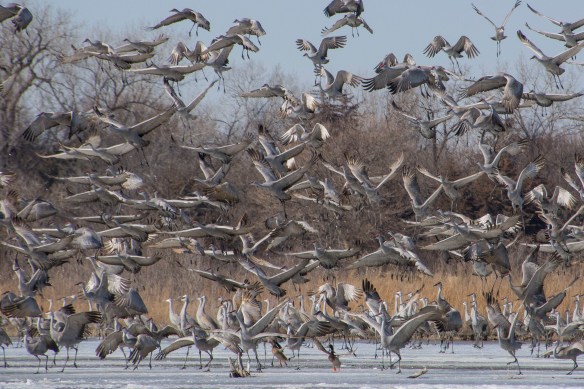
I hope I’ve made it clear through the years that I am really grateful to have my job.  During each March, one of the major perks is access to viewing blinds that allow a front row seat to watch migratory sandhill cranes on their overnight roost.  This morning, I took my wife, two of our kids, and my in-laws out to the Platte River to watch the cranes wake up.

Atticus braved a cold morning breeze in his face to watch cranes dance and loaf around before lifting off to go feed in fields and meadows for the day.

Our viewing blinds aren’t fancy, but they put you right at the edge of the river to watch one of the greatest wildlife spectacles on earth.

Most crane viewing tours I lead each year are for our current or prospective members and donors, and I really enjoy helping people experience one of the best migratory bird phenomena in the world – especially when our guests are seeing it for the first time.  On the other hand, it’s pretty hard to beat sharing that same experience with my family.  Did I mention how fortunate I am?

This morning provided good crane viewing (we had around 1000 cranes in front of the blind and maybe another 10,000 or more within view), but it was far from the most spectacular visit I’ve had.  The cranes weren’t close enough to our blind for me to get fantastic photos, but I played around a little with my camera anyway.  Today wasn’t about photography though, it was about family time in nature, and in that regard, it was pretty near perfect.

You can read more about the crane migration through Nebraska’s Platte River, and see many more photos, in a couple of previous posts here and here.

A couple small groups of sandhill cranes roosting in the river prior to sun-up.

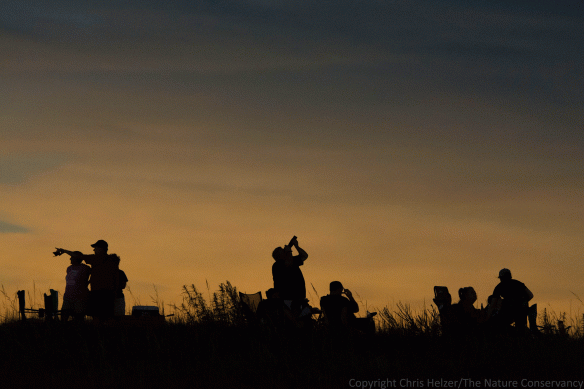
Early morning silhouettes.


PLANT GAME RESULTS

It’s not that I’m competitive, but I’ve decided that I’ll consider it a win when more of you guess a wrong answer than the right one in our Plant Game.  Using that criteria, I won twice this week.  In the first question, Earthsmoke got the most guesses as a fake plant (35%), but it’s actually a real plant (Fumaria officinalis), introduced from Europe, and present (though uncommon) in Nebraska.  The actual fake plant was Lady-of-the-Lake, which I totally made up.  To your credit, that got the second-most votes (32%).

For the second question, the fake plant was Mountain Oats, which sounds real enough that only 32% of you guessed it was fake.  Almost half of you (47%) guessed Raccoon Grape was the fake plant, though, and it’s actually a native vine that grows in eastern Nebraska (Ampelopsis cordata).  Don’t worry, you’ll get plenty of chances to redeem yourselves in the future – but congratulations to those of you who guessed right!