
Photo of the Week – June 29, 2017

Monday night, I spent some time exploring the east bison pasture at the Niobrara Valley Preserve as the sun was going down.  The bison have been concentrating their grazing on the east end of the pasture that was burned in March.  Within that patch, most of the grasses have been grazed, along with the wildflowers they like best.  The sky was pretty spectacular, so I spent time photographing the vibrant green landscape and the bright wispy clouds above it.  When the sun was nearly down, however, I noticed the light illuminating patches of woolly plantain (Plantago patagonica), an annual plant that had just finished its flowering season.  I dropped down to the ground and photographed the backlit plants until the sun finally disappeared.

I ended up with two favorite images from those few minutes.  I like them both for different reasons, so I decided to share them both.

Woolly plantain is not a plant most people would call regal or beautiful, though it certainly has its charm.  Because it’s often overlooked, I like that these photos feature it so prominently.  Woolly plantain is a space-filler, a plant that can’t handle competition.  It grows and flowers only when other plants are weakened enough that it can find spaces between them.  A burned patch of sandy prairie grazed by bison creates perfect habitat for woolly plantain, and these photos celebrate the plantain, the prairie, and all of the processes that link them all together.

…Plus, it was pretty dang cool to be lying on my stomach, watching the sun go down over a huge prairie landscape while a big herd of bison grazed in the distance…
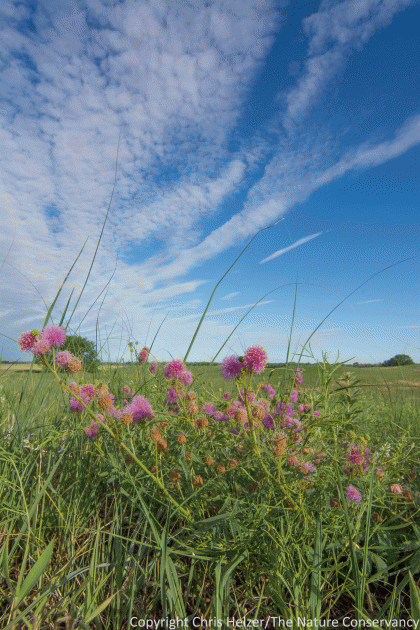
Photo of the Week – June 23, 2017

This is a good year for sensitive briar (Mimosa quadrivalvus) in the Platte River Prairies.  Sensitive briar is a spiny perennial legume that sprawls across the ground in dry prairies and has leaves that fold up when touched or blown about by the wind.  It’s an odd plant, and one that is hard to miss when it’s blooming because each plant has numerous pink flower balls scattered across an area about the size of a large bathtub.

A sensitive briar plant blooming on a sandy hill this year in the Platte River Prairies.

Sensitive briar is named for the sensitivity of its leaves to touch, but it must also be sensitive to moisture conditions or something else.  As I was preparing to write this, I scanned through my field notes because I remembered sensitive briar being extra abundant a few years ago as well.  I was right; I’d noted an extraordinary number of plants back in 2011.  In fact, I wrote a blog post about it!  I don’t have any better explanation this year than I did back in 2011 for why this perennial plant seems to ebb and flow so much in abundance.

This katydid nymph was one of many insects enjoying the abundance (and easily accessible pollen) of sensitive briar this year.

Maybe the ebb and flow is mainly about flowering, and many of our sensitive briar plants just don’t bloom every year.  The only thing giving me pause is an experience we once had with a large plot of sensitive briar plants in our seed production garden.  One year, we thought all the plants had died because they didn’t even come out of the ground that spring.  We wondered if they’d been accidentally sprayed or something the previous year.  Fortunately, we didn’t till the plot up and start over because the next year it was filled with mature sensitive briar plants again!  It’s not that I’m looking for more data collection projects to work on, but it would sure be interesting to mark some plants in our prairies and track them over 10 years or so to see what’s going on…

Just one more fun prairie mystery to solve!