2014 Sandhill Crane Migration – Platte River, Nebraska

March is always a busy time on Nebraska’s Platte River.  It’s the beginning of prime prescribed fire season, of course, and a good time to work on fence repair and tree clearing projects.  But there’s no question that sandhill cranes rule the month.

The early morning scene on the Platte River in March.  Note the abundance of feathers floating down the river...

The early morning scene on the Platte River last week.  Note the abundance of feathers floating down the river…

About 600,000 sandhill cranes spend a good portion of late February, March, and early April along the Platte River before heading north to nesting grounds.  It’s one of the greatest migratory phenomena in the world, and it happens right in our backyard.  Because of that, our staff spends quite a bit of time taking groups of people into our viewing blinds where we watch the cranes land on the river at sunset and take off again in the morning.  It’s an important fundraising opportunity for The Nature Conservancy, and a way to show our Nebraska members what we’ve been working on and thank them for their support.  It’s really gratifying to watch the reaction of people as they see the crane spectacle for the first time.

My son Daniel got his first trip to a crane blind on his birthday this year.  It was very cold, but he was still glad to go.

My son Daniel got to take his first trip to a crane blind on his 10th birthday this year. It was very cold, but he still had a great time.

Because I’m in the blinds fairly frequently, I get quite a few opportunities to photograph cranes – though the number of nights and mornings when the light is favorable can be limited.  Also, I’m really not a wildlife photographer, either in terms of my equipment or aptitude.  Despite that, I usually end up with a few decent photos by the end of each season, though not as many as I should.

This year, I also tried to get some video footage of the cranes – something I have even less experience with and aptitude for than wildlife photography!  Also, my only video camera is the video function on my Nikon D300s SLR camera, and I’m still learning to use it.

You can see two of my attempts by clicking on the links below:

Video 1 – Cranes preparing to leave the river on a cold morning.  This 30 second clip gives you a feel for the density, activity, and noise of a crane roost.

Video 2 – Cranes chasing each other around on a sand bar.  There is a lot of jumping and chasing among cranes.  Some of it is courtship and pair bonding, some of it is just posturing.  This clip is about 30 seconds long.


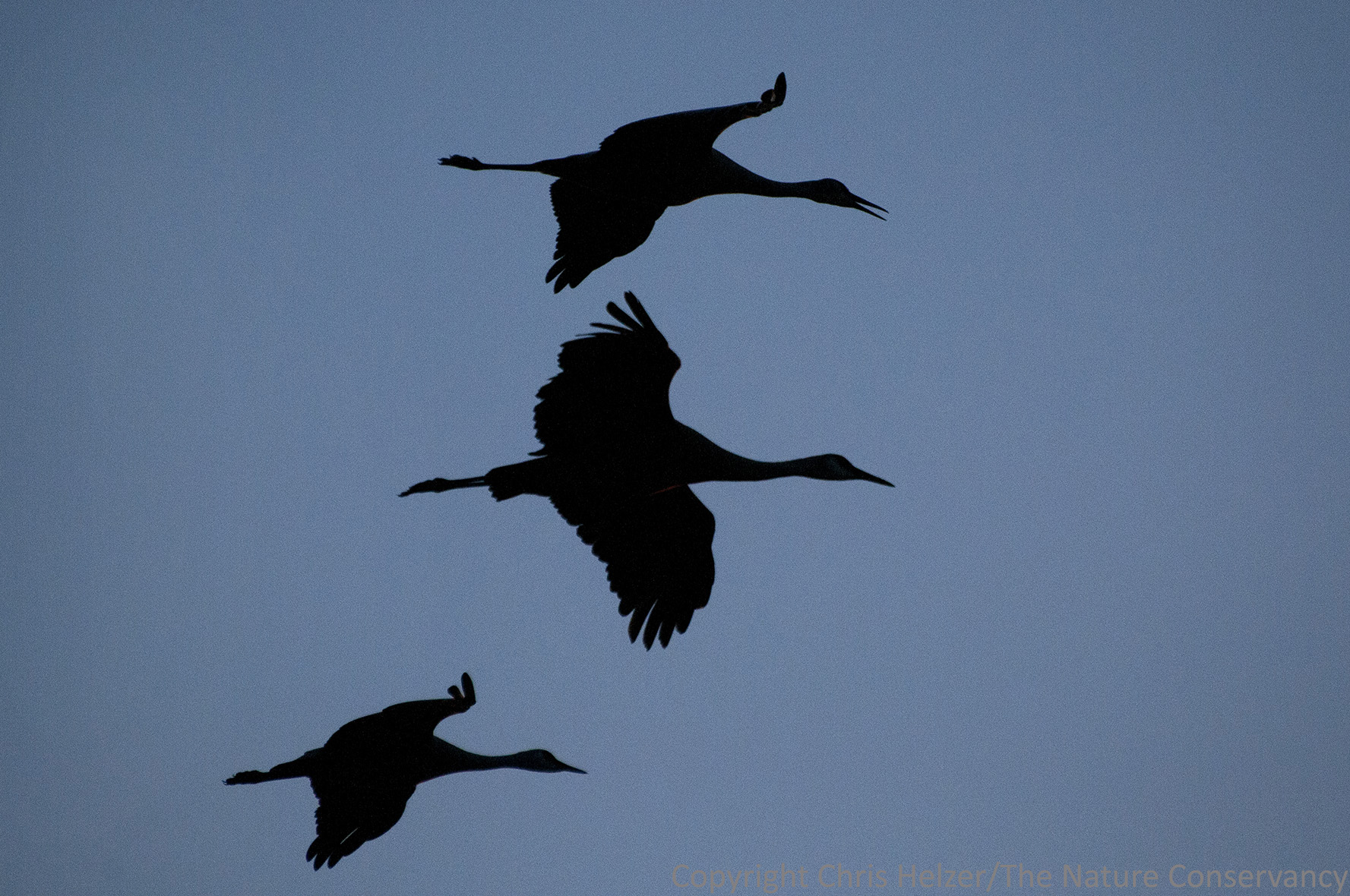
Silhouettes against the evening sky.

Silhouettes against the evening sky.

In the evenings, the cranes often wait to come to the river until it is getting dark, making photography difficult.  In those cases, the best photo opportunities are usually silhouettes of the birds against the sky as they drop into the river.  On nights when the light is nice and our guests are fully engaged watching the big event, I manage to snap off a few shots.  Both close-ups on a few birds at a time and more wider views can be attractive.

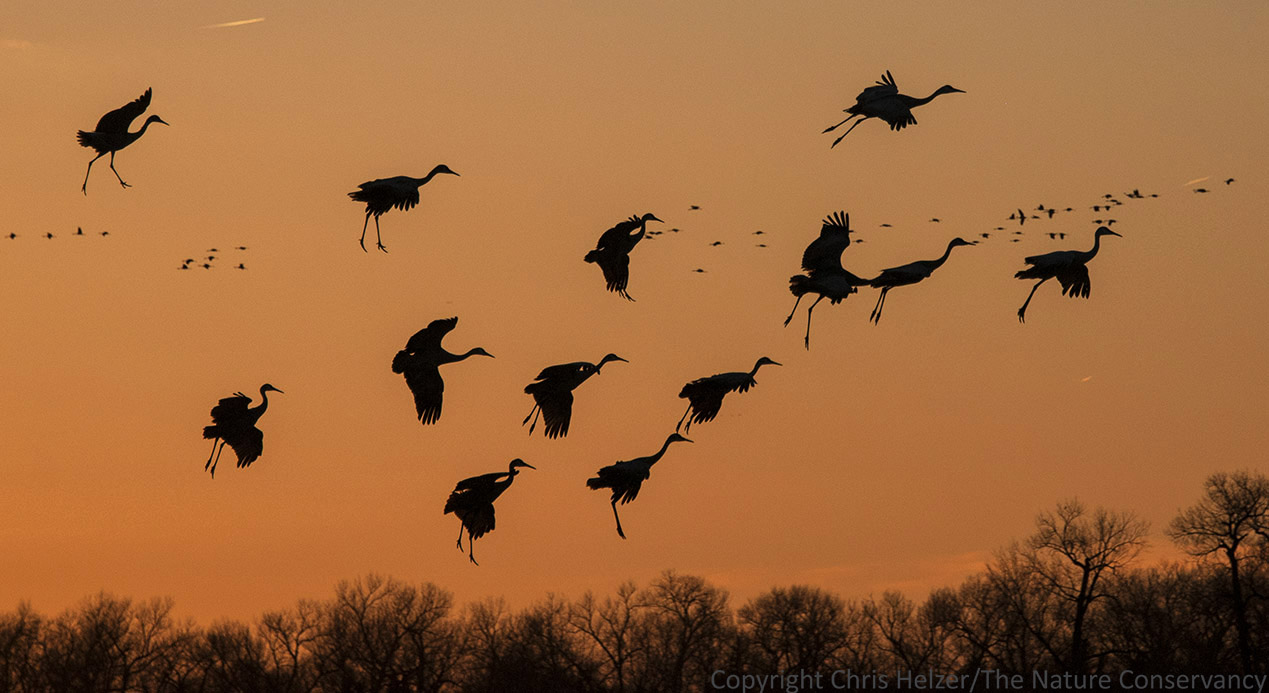
Sandhill cranes coming to the river after sunset.

Sandhill cranes coming to the river after sunset.

This year, my favorite image was the first shot I took one evening.  The sunset was beautiful and the cranes were parachuting gracefully toward the water as I poked my camera lens out the window of the blind.  The resulting photo reminded me of the theme song to a 1980’s TV show – The Greatest American Hero.

"Believe it or not, I'm walking on air..."   Cranes floating down to the river at sunset.

“Believe it or not, I’m walking on air…” Cranes floating down to the river at sunset.

.

Bonus Coverage

On one of the crane tours I led this spring, I met 11-year-old Jack McDowall and his dad.  Jack is a fellow blogger who is working on a year-long project to photograph and document his bird sightings.  I think many of you would enjoy his photos and the natural history information he includes along with them – including a post from his trip to our viewing blind.  If you’d like to visit his blog, you can link to it here.


Hubbard Fellowship Blog – March 2014

This is a guest post by Eliza Perry, one of our Hubbard Fellows.

After a few months with very little fresh air, we have been busy getting ready for the crane and burn seasons here on the Platte. Anne and I have been trucking along with our research project reports, but I’m thrilled to be using my body again. We have been learning and hearing about the crane migration and spring burns for nine months now, and they are both finally here! I thought I’d share what we’ve been doing to prepare for these events.

CRANE BLIND PREP

Anne takes down old weathered burlap off the front of a blind. We cover the outside of the blinds with burlap and cut peepholes at different heights so that we can watch the birds without them knowing. Photo by Eliza.

Anne takes down old weathered burlap off the front of a blind. We cover the outside of the blinds with burlap and cut peepholes at different heights so that we can watch the birds without them knowing. Photo by Eliza.

.

Nelson shows me that to get the best views, we need to cut all of the vegetation that can be seen from any angle inside the blind. Photo by Eliza.

Nelson shows me that to get the best views, we need to cut all of the vegetation that can be seen from any angle inside the blind. Photo by Eliza.

.

We used a beaver blade (weed whacker with a chainsaw chain on the bottom) to cut down the vegetation in front of the blinds. Photo by Eliza.

We used a beaver blade (weed whacker with a saw blade on the bottom) to cut down the vegetation in front of the blinds. Photo by Eliza.

.

Nelson sweeps cobwebs, bird poo and old nests off of the blind interior. Photo by Eliza.

Nelson sweeps cobwebs, bird poo and old nests off of the blind interior. Photo by Eliza.

.

BURN UNIT PREP

Burn breaks are essential for conducting prescribed fires. We mow a 20ft swath around each burn unit and then rake these areas to keep fires contained and away from property lines. By mowing and raking, we are removing the majority of fuels that a fire needs to burn, which allows us to control where and how the fire moves. I went to mow our Miller property and encountered thousands of cranes getting their protein fix from insects and earthworms right inside of our burn unit. We decided to continue with our work anyway. The birds lifted off right in front of me. Photo by Eliza.

Burn breaks are essential for conducting prescribed fires. We mow a 20ft swath around each burn unit and then rake these areas to keep fires contained and away from property lines. By mowing and raking, we are removing the majority of fuels that a fire needs to burn, which allows us to control where and how the fire moves. I went to mow our Miller property and encountered thousands of cranes getting their protein fix from insects and earthworms right inside of our burn unit. We decided to continue with our work anyway. The birds lifted off right in front of me. Photo by Eliza.

.

Nelson sharpens the blades on the shredder after several days of mowing.  Photo by Eliza.

Nelson sharpens the blades on the shredder after several days of mowing. Photo by Eliza.

.

FIRE REFRESHER

Land management professionals from various agencies and organizations got together at the Whooping Crane Trust for an annual fire refresher course. In this photo, Nelson is giving a presentation on fire equipment and safety. Photo by Eliza.

Land management professionals from various agencies and organizations got together at the Whooping Crane Trust for an annual fire refresher course. In this photo, Nelson is giving a presentation on fire equipment and safety. Photo by Eliza.

.

Everybody practiced deploying a fire shelter. Fire shelters are a last resort for surviving intense radiant or convective heat in an entrapment situation when a fire becomes inescapable. Actual fire shelters are made with layers of aluminum foil and fiberglass, but they can each be used only once so these green tarp replicas are used during trainings. Photo by Chris Helzer.

Everybody practiced deploying a fire shelter. Fire shelters are a last resort for surviving intense radiant or convective heat in an entrapment situation when a fire becomes inescapable. Actual fire shelters are made with layers of aluminum foil and fiberglass, but they can each be used only once so these green tarp replicas are used during trainings. Photo by Chris Helzer.

.

We also participated in sand table exercises, in which a moderator gives a team of professionals with different levels of field experience a burn plan and written scenarios to work through by constructing a burn unit on the sand table, given different variables (wind direction, terrain, etc.). It was really helpful for newbies like Anne and I to work with more seasoned firefighters to learn how to respond safely to various conditions. Photo by Eliza.

We also participated in sand table exercises, in which a moderator gives a team of professionals with different levels of field experience a burn plan and written scenarios to work through by constructing a burn unit on the sand table, given different variables (wind direction, terrain, etc.). It was really helpful for newbies like Anne and I to work with more seasoned firefighters to learn how to respond safely to various conditions. Photo by Eliza.

.

In order to complete the certification for becoming a Type 2 firefighter, we had to pass either the “arduous” or “moderate” pack test, which involves walking 3 miles in under 45 minutes carrying 45lbs or walking 2 miles in under 30 minutes carrying 25lbs (respectively). We wore weight vests to distribute the weight evenly on our upper bodies. It was great team bonding, but most of us were pretty sore the next day. From right to left, Anne Stine, Eliza Perry, volunteer firefighter Anne Troyer, Mardell Jasnowski and Nelson Winkel. Photo by Chris Helzer.

In order to complete the certification for becoming a Type 2 firefighter, we had to pass either the “arduous” or “moderate” pack test, which involves walking 3 miles in under 45 minutes carrying 45lbs or walking 2 miles in under 30 minutes carrying 25lbs (respectively). We wore weight vests to distribute the weight evenly on our upper bodies. It was great team bonding, but most of us were pretty sore the next day. From right to left, Anne Stine, Eliza Perry, volunteer firefighter Anne Troyer, Mardell Jasnowski and Nelson Winkel. Photo by Chris Helzer.

.

The Platte River Prairies crew hosted our own field day to practice using each of the hand tools and slip-on water pumps before we begin burning regularly. We learned techniques for laying wet lines and mopping up using both the truck and ATVs. Laying a wet line refers to spraying water (or foam or other fire retardant) ahead of the igniter along the inside of the burn break for an extra layer of protection; mopping up in this case means following behind the igniter and making sure the fire does not cross into the burn break. We will also need to master backing up ATVs with 200 gallons of water in tow. Here, Anne lays a wet line and I’m trying to stay at an appropriate distance in the truck. Photo by Chris Helzer.

The Platte River Prairies crew hosted our own field day to practice using each of the hand tools and slip-on water pumps before we begin burning regularly. We learned techniques for laying wet lines and mopping up using both the truck and ATVs. Laying a wet line refers to spraying water (or foam or other fire retardant) ahead of the igniter along the inside of the burn break for an extra layer of protection; mopping up in this case means following behind the igniter and making sure the fire does not cross into the burn break. We will also need to master backing up ATVs with 200 gallons of water in tow. Here, Anne lays a wet line and I’m trying to stay at an appropriate distance in the truck. Photo by Chris Helzer.

.

SANDHILL CRANE VIEWING TOURS

I HAVE NEVER SEEN ANYTHING LIKE THIS IN MY WHOLE LIFE. It is absolutely breathtaking to see and hear thousands of these beautiful creatures all together. I have been leading tours most nights and a few mornings this past week, and on three of these occasions the birds were right in front of our blind. I found that I really enjoy watching the antics of just one bird at a time, bending gracefully to poke around in the sand or within their feathers. Their gait and coloring give them an especially regal appearance. They strut around among their companions and make the most beautiful racket I’ve ever heard. Several Nebraskans have told me crane calls signify spring to them. I like that much better than mud, the only indication of spring in Maine. Check out Anne Stine’s recent post for a more in-depth description

I HAVE NEVER SEEN ANYTHING LIKE THIS IN MY WHOLE LIFE. It is absolutely breathtaking to see and hear thousands of these beautiful creatures all together. I have been leading tours most nights and a few mornings this past week, and on three of these occasions the birds were right in front of our blind. I found that I really enjoy watching the antics of just one bird at a time, bending gracefully to poke around in the sand or within their feathers. Their gait and coloring give them an especially regal appearance. They strut around among their companions and make the most beautiful racket I’ve ever heard. Several Nebraskans have told me crane calls signify spring to them. I like that much better than mud, the only indication of spring in Maine. Check out Anne Stine’s recent post for a more in-depth description of her crane viewing experiences.  Photo by Eliza.

.

A slightly crooked shot by Eliza.

A slightly crooked shot by Eliza.

.

Sunset over the Platte River. Photo by Eliza.

Sunset over the Platte River. Photo by Eliza.

.