
Happy New Year! It sure is nice to start 2013 with some moisture on the ground. Let’s hope we get some more…
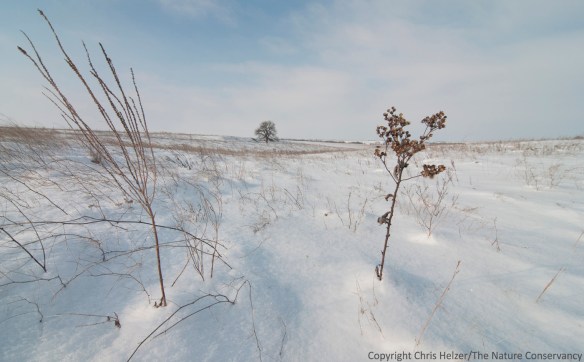
A welcome snowfall in late December will help a little to replenish soil moisture, but it’s still awfully dry around here. Helzer family prairie, near Stockham, Nebraska.
Ecologically speaking, the biggest local story in 2012 was the dry weather. In fact, our nearest “large” city, Grand Island, Nebraska had its driest year on record. The precipitation total came in just under 12 inches for 2012, breaking the previous record of 12.01 inches from 1940. The average annual rainfall for Grand Island is about 26 inches, so 2012 precipitation was less than half of normal. That’s pretty dry.
Back in 1940, the famous prairie ecologist, J. E. Weaver, was looking at the effects of about a decade’s worth of drought. At the time, he and others assumed that many of the drastic changes they were seeing in prairie plant communities would be permanent. In fact, quite a few prairies were plowed up in the early 1940’s because the owners figured that if the prairie grasses were dead, they might as well try to grow something else.
Fortunately, Weaver was wrong about the drought-stricken prairies in the 1940’s. The plant communities he thought were irrevocably changed, and the plant species he thought would disappear rebounded nicely in subsequent years. It’s hard to know whether 2012 was a dramatic, but short, dry spell or the beginning of another long drought for our part of the state. Either way, it’s good to know that prairies and their inhabitants will survive, one way or the other.
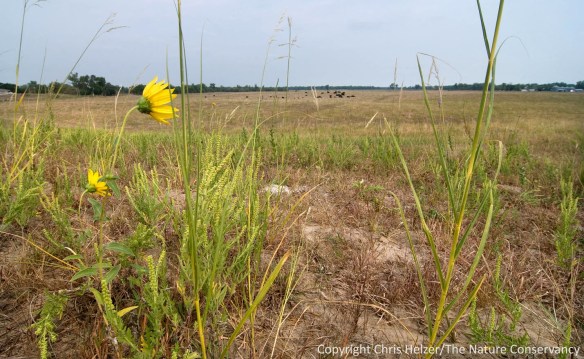
The drought of 2012 left most of our prairies dry and crispy by mid-summer. However, not all plants were affected equally, and some – like annual sunflowers – were able to flourish. Other species entered dormancy early to conserve energy and moisture for the future.
As we enter 2013, the local long-range forecast is for average rainfall through the early growing season. That would be great. However, because we’ll start out with a significant deficit in soil moisture, our prairies will show the impacts of 2012 for quite a while yet. And, of course, long-range forecasts are notoriously inaccurate, so we may not get the rains we’re hoping for anyway.
It’s easy to feel a little down during droughts – especially for those of us who rely on prairies for income as well as for enjoyment. Trudging through crispy brown grass day after day can take a toll on the psyche. However, since we can’t change the weather, the best strategy is to just sit back and watch prairies exhibit their most defining attribute…
…resilience.
I hope you have a tremendous and intriguing 2013. As always – thanks for reading.
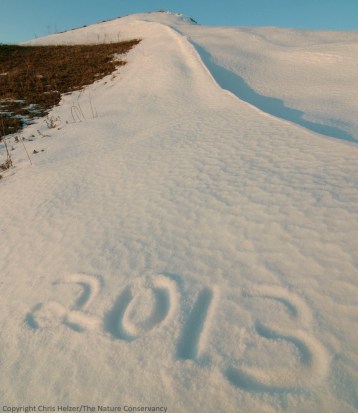
2013 is off to a good start – with snow on the ground. Let’s hope that moisture keeps coming.
(Here’s a link to another interesting paper by Weaver, written in the mid-30’s before the worst of the drought had happened. Even at that time, he was already using terms such as “destruction” to talk about what was happening to prairie plant communities.)
.

 The Prairie Ecologist