This post is written and illustrated by Katharine Hogan, one of our Hubbard Fellows.
In November, I visited the Valentine National Wildlife Refuge on Highway 83 south of the town of Valentine. There had been a burn several weeks previously at the refuge, and I enjoyed a little time wandering around and observing the effects of the fire on the vegetation and exposed sandy soil. In patches, some brave grasses had re-sprouted in defiance of the cooling autumn temperatures. In other areas, the patchy fire had not burned hot enough to do more than singe the thicker sunflower and forb stalks, and everywhere the rodents had wasted no time in churning up the exposed sand, leaving clean, cool piles in stark contrast with the surrounding black ash from the burned vegetation.
I had only been walking around for a few minutes when I came across something that, though strange at first, eventually astonished me in its scope across the landscape. I noticed a patch of flower stalks with some threads of spider silk, strung out from stalk to stalk, not forming an actual web but nonetheless running roughly parallel, using the burned stems as support. Upon further examination, however, I realized that this was not an isolated occurrence within the burn, and that this same patterning of silk strands stretched off in both directions across acres and acres of the burned vegetation.
Although these pictures don’t and can’t really accurately represent the scope of this phenomena, I was able to capture a couple that show, if nothing else, the impressive amount of silk that had been put out for some unknown reason by, one must guess, some very industrious arachnids.

The lighting makes it somewhat challenging to see, but the density of the webs can be best seen in the upper center of the photograph, and extends outwards from there. Photo by Katharine Hogan.
My knowledge regarding spiders and their habits is utterly basic. I have a high appreciation for them as fascinating creatures and as ecological players, but my ongoing efforts of understanding have simply not focused on them, focusing instead on plants in part because plants don’t, you know, suddenly relocate on you for inscrutable reasons. At the time, I could only wildly guess as to what caused this phenomenon to occur. Apparently it involved a presumably large number of arachnids deciding more or less in tandem that changing location was a really good idea, but why? And what type of spiders? Were they moving towards or away from something? Was this movement related to the recent fire? What about the decreasing autumn temperatures and daylight?
I did a little digging and came up with a couple potential situations that could describe at least in part what I saw. As always, I would welcome the insights of readers of this post with a better idea of what’s going on! I would love some help in solving this web of mysteries.
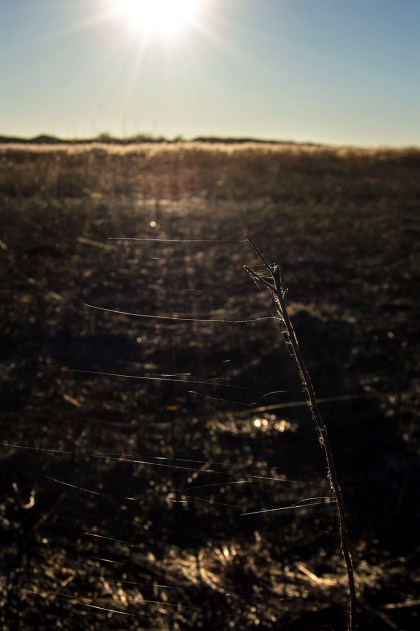
This was a typical amount of silk on each of the thousands of plants across the section of the burn.
I found references to spiders of two families that sometimes exhibit tendencies that could explain silk strands such as these. Jumping spiders (family Salticidae) leave “safety lines” of silk behind them as they jump between plants; however, this does not explain the massive amount of silk, nor why it was all aligned in the same direction across the landscape.
The other possible explanation I found was with regards to spiders, not exclusively but predominantly of the genus Erigone, that, according to a 2005 article in the Bulletin of Entomological Research, will sometimes display what is called “mass ballooning”, where large numbers of spiders in tandem migrate short distances across landscapes, leaving behind “spectacular amounts of silk on the ground” (J.R. Bell et al.). The reasons for this behavior are still largely not understood, but hypothesized explanations have included sudden changes in temperature, humidity, and other factors largely dependent upon the microclimate of the population in question.
Several other studies during the 70s and 80s also supplied some evidence that the propensity of spider populations to balloon was correlated with the “predictability” or stability of their habitats. In the case of Greenstone (1982), populations that selected for habitats subject to more frequent change, e.g. open spaces near water sources, were more likely to balloon than species that favored prairie habitats. If habitat changes are positively correlated with the likelihood of a spider population ballooning, could this suggest the recent prescribed burn as a causal factor in the event whose aftermath I witnessed at the wildlife refuge?
I honestly don’t have a clue. Other interests and appreciations aside, I am very much a “plant person” and feel uncomfortable coming to any conclusions regarding a group of organisms about which I know so fabulously little. I do know, however, that the scope of the phenomena I witnessed was truly impressive, and thus I gained a little more appreciation and awareness of the unseen lives of the tiny critters around us. As always, input on the matter would be much appreciated. If any of you readers have any insights on the matter, please let us all know in the comments! Thanks!
Sources cited:
Bohan, David A., et al. (2005) Ballooning dispersal using silk: World fauna, phylogenies, genetics and models. Bulletin of Entomological Research 95, 69-114.
Greenstone, M.H. (1982) Ballooning frequency and habitat predictability in two wolf spider species (Lycosidae: Pardosa). Florida Entomologist 65, 83–89.