Photo of the Week – March 10, 2011

It’s fire season!  Or, at least, it’s the season that many of us start conducting prescribed fires in prairies.  For various reasons, March and April tend to be the months during which the vast majority of prescribed fires take place.  Here in Nebraska, we missed the last big snowstorm that came through, so if the current weather forecasts hold, we hope to start sending smoke into the air next week.
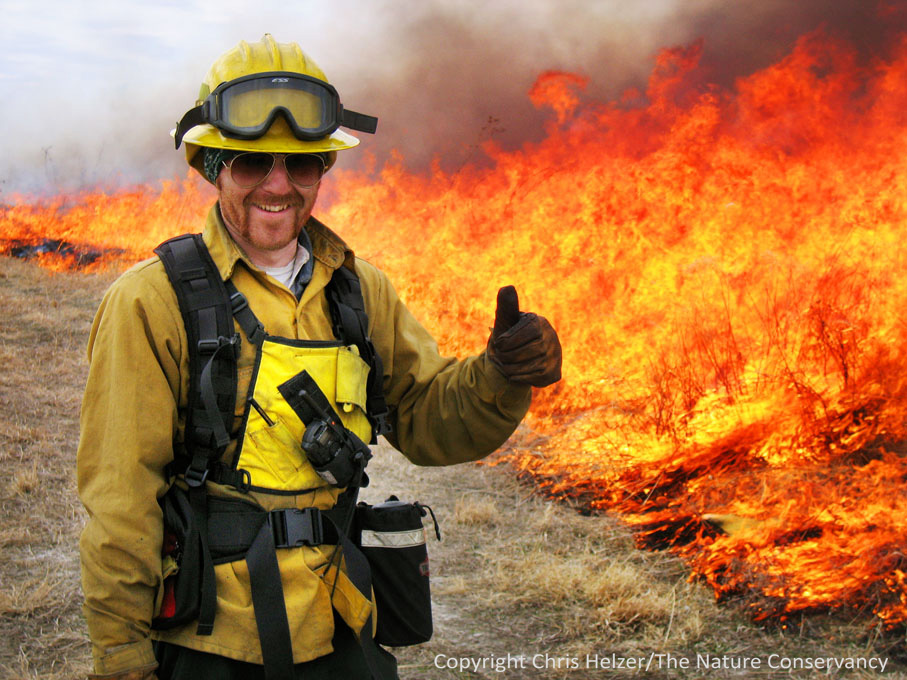
Our technician Matt is enjoying the opportunity to light things on fire. ...sure he is - he's not in charge! I still enjoy prescribed fire season, and feel a sense of accomplishment when we finish one, but it was a lot more fun when I wasn't the burn boss.

Before each spring fire season starts, we get together with local partners and hold a refresher course to go over safety procedures and generally remind ourselves that prescribed fire is a complicated and dangerous undertaking.  One of the most useful – and goofy – parts of that refresher course is the sand table exercise, where grown-up biologists from multiple agencies and organizations play make-believe in sandboxes.  We lay out hypothetical prescribed fire situations, complete with roads, houses, people, equipment, and hazards, and then run through various scenarios to give everyone a chance to think about how they’d respond in real life.  Once you get over the initial silliness of the idea, it’s actually very useful.

Staff from the Nature Conservancy and partner organizations and agencies participate in a sand table exercise to simulate prescribed fire scenarios.

Because prescribed fire is not something to take lightly, it’s important to make sure the objectives are being met when a fire is conducted.  The success of a fire shouldn’t be measured by the percentage of a grassland that turns black, but by whether or not objectives for habitat manipulation, plant community impacts, etc. are met.  Remember that prescribed fires can be conducted during any season of the year, and that it can be good to shake up the timing – and other aspects – of your fires to ensure that you don’t always favor the same species (at the expense of others).  See an earlier post on this subject here.

Above all – be safe out there!

Sandhill Cranes on the Platte River

For those of us living and working on the Central Platte River in Nebraska, the birds that signify spring’s arrival are much bigger than robins.  The annual arrival of sandhill cranes (we usually see the first ones around Valentine’s Day) lets us know that winter is coming to a close.  When the last crane leaves in early April, the first wildflowers in the prairies aren’t far behind.  This spring, the skies along the river are already criss-crossed with formations of flying cranes, intermixed with the ducks and geese of numerous species.  If you’ve never seen this unique phenomenon, you’re missing out on one of the greatest wildlife events in the world.  Come out to the Platte and start your spring right!

Every March, more than half a million sandhill cranes - the entire mid-continent population - converge on the Platte River in central Nebraska. Each bird spends about three weeks feeding and building fat reserves for the rest of their northern migration and the grueling nesting season.

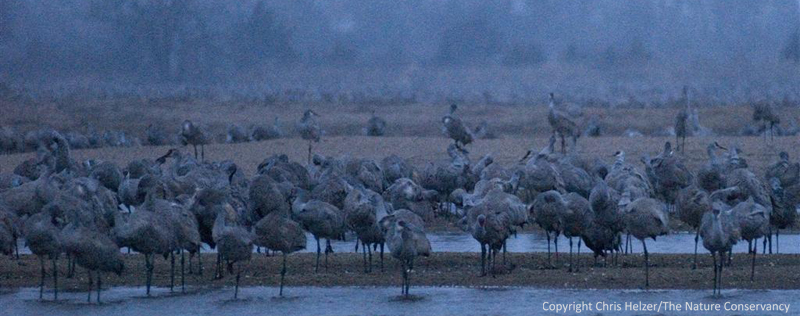
In the evenings, the cranes come to the river itself to roost overnight. They favor broad channels with abundant bare sandbars where large groups of cranes can congregate in large noisy masses of up to 50,000 or more. As the sun starts to go down, wave upon wave of sandhill cranes drop gracefully into the river like so many floating dandelion seeds.

Not surprisingly, this wildlife spectacle draws bird watchers and nature enthusiasts from around the world. Crane watchers can drive rural roads to watch the cranes in the fields and meadows during the day, and stand on riverbank platforms (or reserve space in viewing blinds) to see them come to the river at night. Besides cranes, visitors to the Platte in the spring can also see millions of ducks, geese, and other waterbirds.

The cranes spend the night standing on bare sandbars or in shallow water. Their noisy calls eventually subside enough that they get some sleep, but it's rare that the entire group is quiet for long - and any disturbance (real or imagined) can quickly set the birds to calling and shuffling nervously about again.

In the morning, the cranes leave the river and head to nearby meadows and cornfields to feed. On some mornings, the birds seem reluctant to leave their roost, choosing instead to loaf, feed, and even bathe in the shallow water. Other mornings, a foraging eagle or roving coyote can push an entire roost site into flight simultaneously, and the sound of many thousands of wings creates a deafening noise.

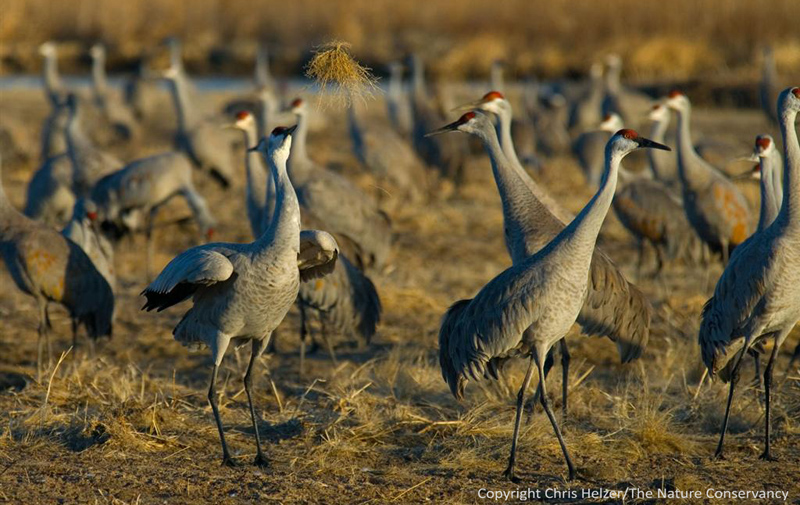
Besides the important task of feeding, cranes spend much of their day - in meadows and along the river - socializing.

Courtship behavior is common during the day, and can include elaborate dances with much leaping and ducking of heads, as well as stick tossing.

As March comes to a close, cranes start heading north to breed - mostly in Canada, but also as far north as Siberia. They usually leave on sunny days with a nice south wind to carry them. Cranes can average 35 miles per hour and travel 200-300 miles per day (up to 500 with a good tailwind). In the fall, they pass through the Platte in small scattered groups (we usually just hear them flying overhead) - providing us with just a quick glimpse of them, but a reminder of what we'll see at the end of the coming long winter.

To learn more about how and where to see sandhill cranes in Nebraska, visit this or other websites.  If you come out, feel free to stop and stretch your legs at the hiking trails through our Platte River Prairies.

To see the best portfolio of sandhill crane photos in the world, visit Michael Forsberg’s website and look for his book “On Ancient Wings“.