Photo of the Week – November 14, 2013

Last week, I took a short early morning trip out to my family prairie.  As the sun came up, its light was caught beautifully by the fuzzy seeds of various prairie plants, particularly stiff goldenrod (Solidago rigida) and dotted gayfeather (Liatris punctata).

A stiff goldenrod seed is ready to fall from a seedhead.

A stiff goldenrod seed is ready to fall from a seedhead.  Helzer prairie, near Stockham, Nebraska.

Species with fuzzy parachute-style seeds trade distance for time.  Their seeds can be carried far from the plant, giving them a chance to colonize new areas.  However, because the seeds have to be light weight, they tend to have short shelf-lives, and can’t survive for very long – they will either germinate quickly or die.  Bulkier seeds often have the ability to survive for years in the ground and then germinate when favorable conditions appear – but they don’t typically travel very far from their parent plant.  Life is a series of tradeoffs!
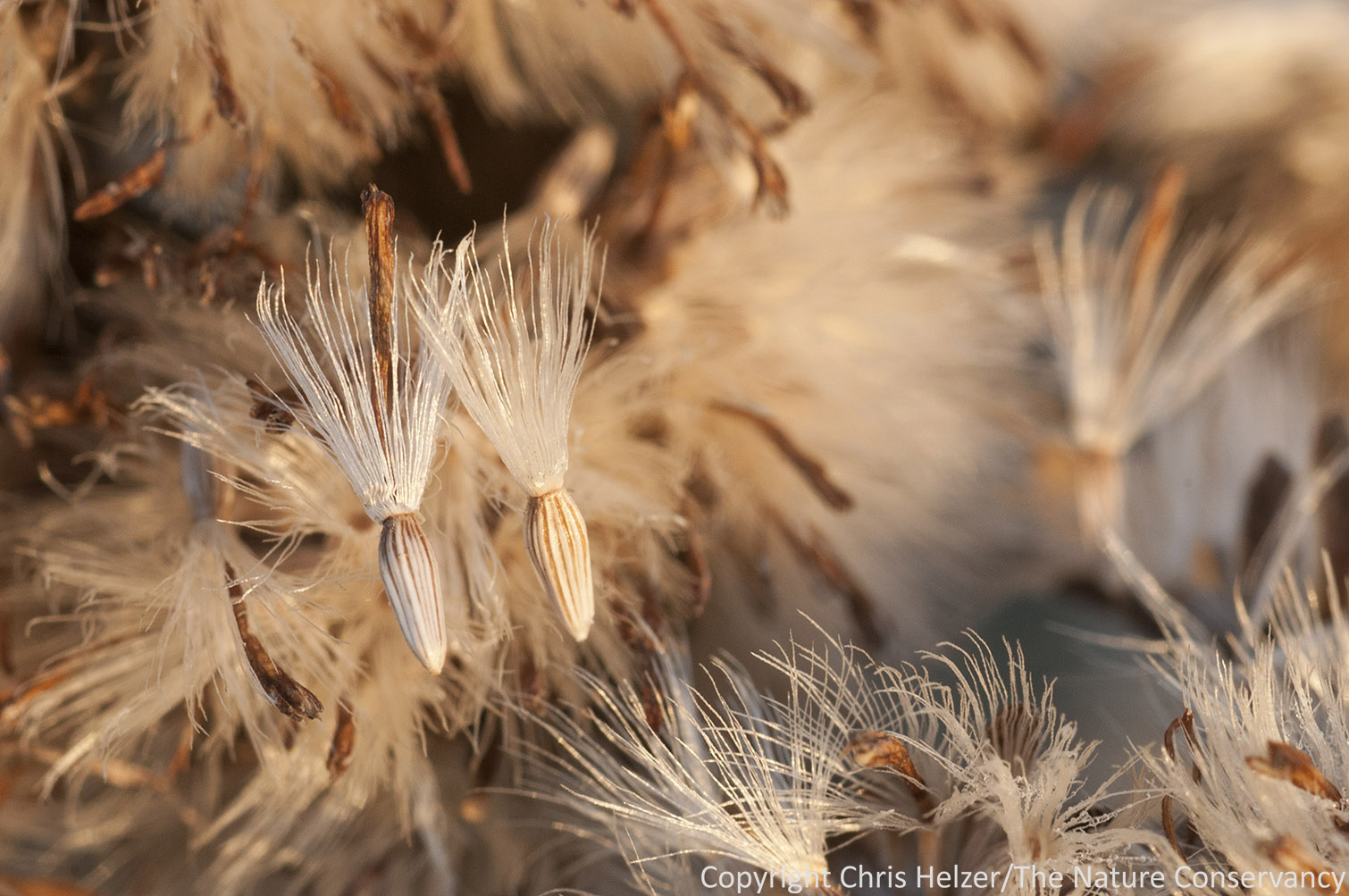
More goldenrod seeds.

More goldenrod seeds.

.

And more.

And more.  In this photo, the contrast between the brightness of the seeds and the shadows behind the plant were such that the camera couldn’t capture it all, resulting in a black background behind the correctly-exposed seeds.

.

Even after the petals (and even the seeds) fall, goldenrod flowers are still very attractive.

Even after the petals (and even the seeds) fall, goldenrod flowers are still very attractive.

.

Dotted gayfeather also has short-lived, high-flying seeds.  However, once a new plant is established, it puts down deep roots (literally - as deep as 10-15 feet).

Dotted gayfeather also has short-lived, high-flying seeds. However, once a new plant is established, it puts down deep roots (literally – as deep as 10-15 feet).

.

More dotted gayfeather seeds.

More dotted gayfeather seeds.

The Great Thing About This Blog

Ok, here’s something I really love about this blog.  There are more than 1,400 people who subscribe, and quite a number of others who check in regularly.  That group of readers includes quite a few experts in various natural history and biological fields, which means that just about any question I pose can be answered.  And quickly!

Anne Stine posted some photos of insect eggs this afternoon, wondering what they might be.  It took less than THREE MINUTES for the first response to come back – including a link to more information.  A second response that confirmed the first came three minutes after that!  (A big thanks to Karen and Paul for being on-the-spot and helpful!)  Ah, the power of an intelligent and networked group of biologists!

On the other hand, having a large group of readers who are biologically-informed also means that when I post something about never having seen an otter in Nebraska, there is NO SHORTAGE of people who are just tickled pink to share happy stories of their own sightings… Gee, thanks.

P.S. – Anne’s mystery insect eggs belong to a native species of praying mantis.  Just so you know.