I often think one of the biggest issues we face in grassland restoration and management is that we’re a little too stuck in the past. This expresses itself in various ways, but I think it’s a nearly universal issue with everyone involved in prairie ecology and stewardship. To one degree or another, we’re all looking backward. Let me explain.
An obvious example of what I’m talking about appears in prairie restoration (reconstruction) when someone’s goal for a prairie planting project is to create a prairie that looks like it used to look a few hundred years ago. I hear this a lot less than I used to, which is good, given the numerous problems with that goal. However, even those of us who claim to be focused on more practical objectives can slip up sometimes. It just feels good to recreate something from the past, especially when the past must have been so great!
The same romanticism for the old days affects our management, too. Regardless of what our plan says (you’ve all got a clear, written management plan, right?), most of us can’t resist glancing around and wondering what a particular site must have looked like “back in the day”. It’s real easy to for the resulting mental pictures to start influencing the way we evaluate the condition of a prairie and the direction we try to push things through stewardship actions. We don’t really think we can get back to what it used to be, and yet…
I see the impact of those “history goggles” all the time, both in my own head and during conversations with other prairie people. One of the more frequent appearances comes during thinking or talking about plant community composition. “Oh,” someone will say, “that wildflower used to be much more common before European settlement.” Or, similarly, “Those grass species never used to be as prominent when these prairies were surveyed in the 1920’s”.
Don’t get me wrong – historic plant community composition can be helpful. It’s nice to know how things have changed because it helps us understand why, or at least helps us ask the right questions. Answers to those questions can guide us as we devise management strategies. Where we get into trouble is when we use past conditions as explicit targets for today’s stewardship.
Our prairies live in a different world than prairies of old. Habitat fragmentation, rising atmospheric CO2 rates and nitrogen deposition, climate change, and invasive species are just some of the major factors that have changed within last century or two. We should expect prairies to adapt to those drastic changes. After all, adaptation is one of their best features!
History goggles also come into play when we think about prairie management tools and tactics. How many discussions have you been in that center on the historic frequency and/or season of fire in prairies? As with plant composition, understanding when and how fires burned in the past can be helpful, but yesterday’s fire frequency shouldn’t automatically be today’s fire frequency. See above for some of the major differences between historic and present-day prairies.
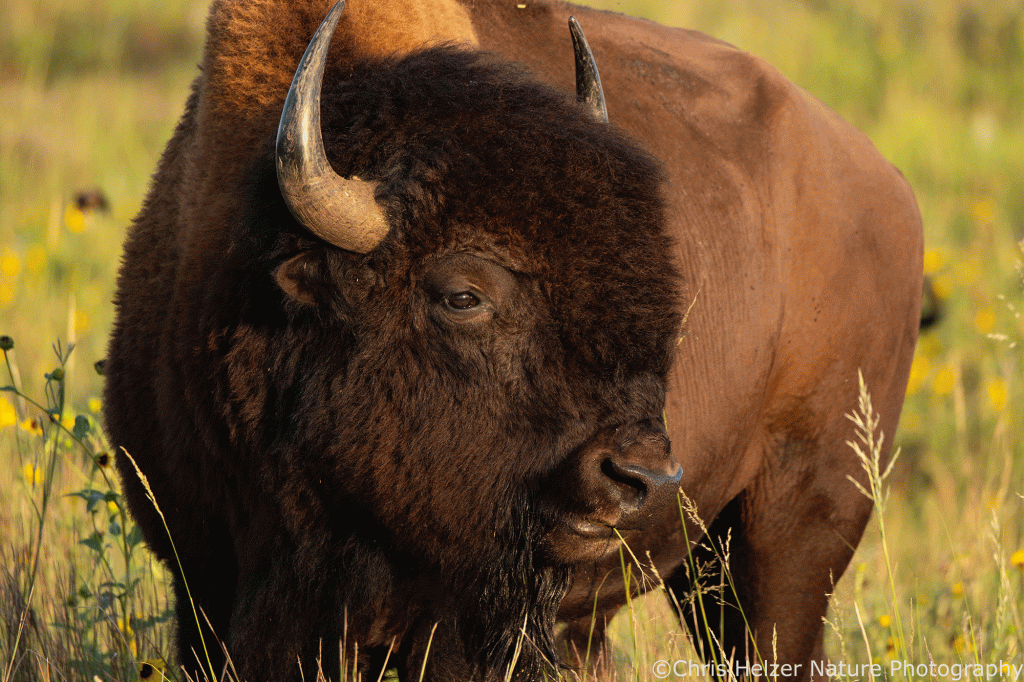
People who apply grazing to grasslands often wear very thick history goggles. If I had a nickel for every time someone’s tell me their particular grazing strategy mimics what bison used to do, I’d be swimming in nickels. I don’t want to swim in nickels. Even if your approach somehow perfectly mirrors what bison used to do (and it doesn’t), why would that be the best approach for today’s prairies, which aren’t what they used to be? That applies, by the way, to whatever grazing animal you’re working with – including bison.
There are lots of great reasons to put bison in prairies, cultural, ecological, and otherwise. Expecting them to eradicate smooth brome and reverse climate change, though, is going to lead to some big disappointment. That doesn’t mean bison (or cattle, for that matter) can’t play important roles in today’s prairies. In many grasslands, especially larger ones, they can manipulate habitat structure, combat the dominance of grasses, and create lots of wonderful messiness. They can’t (or won’t), however, turn back the clock.
We’ve got to cast off our history goggles and look forward if prairie conservation is going to succeed. Restoration and management strategies need to be built on creating future prairies, not past ones. That’s an uncomfortable, even scary, prospect though, isn’t it? We don’t have any reference points in the future, after all. It’s easier to look back (or guess) at what used to be and try to aim there.
I don’t have the answers to this dilemma. I do have ideas.
Prairie communities really are good at adaptation. Because of that, I think we should be looking for ways to facilitate and guide prairies as they adjust to new conditions. One way to do that is to help them maintain the resilience they need to adapt. We do know something about how to do that. (Remember, ecological resilience doesn’t mean natural communities don’t change. Instead, it’s a measure of their capacity to adapt.)
The ecological resilience of prairies relies heavily on two factors: habitat size/connectivity and biological diversity. The first helps the second persist and the second provides the redundancy of function that means there are species to fill crucial roles no matter what’s a prairie has thrown at it. Making prairies bigger and better connected comes through restoration (reconstruction) efforts that build new grassland habitat adjacent to and between existing habitats. We have lots of evidence that prairie species respond well to that kind of restoration.
There are lots of thoughts about how to manage for biological diversity in prairies, many of which seem to work well. There isn’t a single best way to do it, and the effectiveness of practices and approaches can vary by geography, soil type, prairie size, and many other factors. The key is to focus on the diversity of the plant community, as well as the more difficult to measure communities of animals, fungi, bacteria, and others.
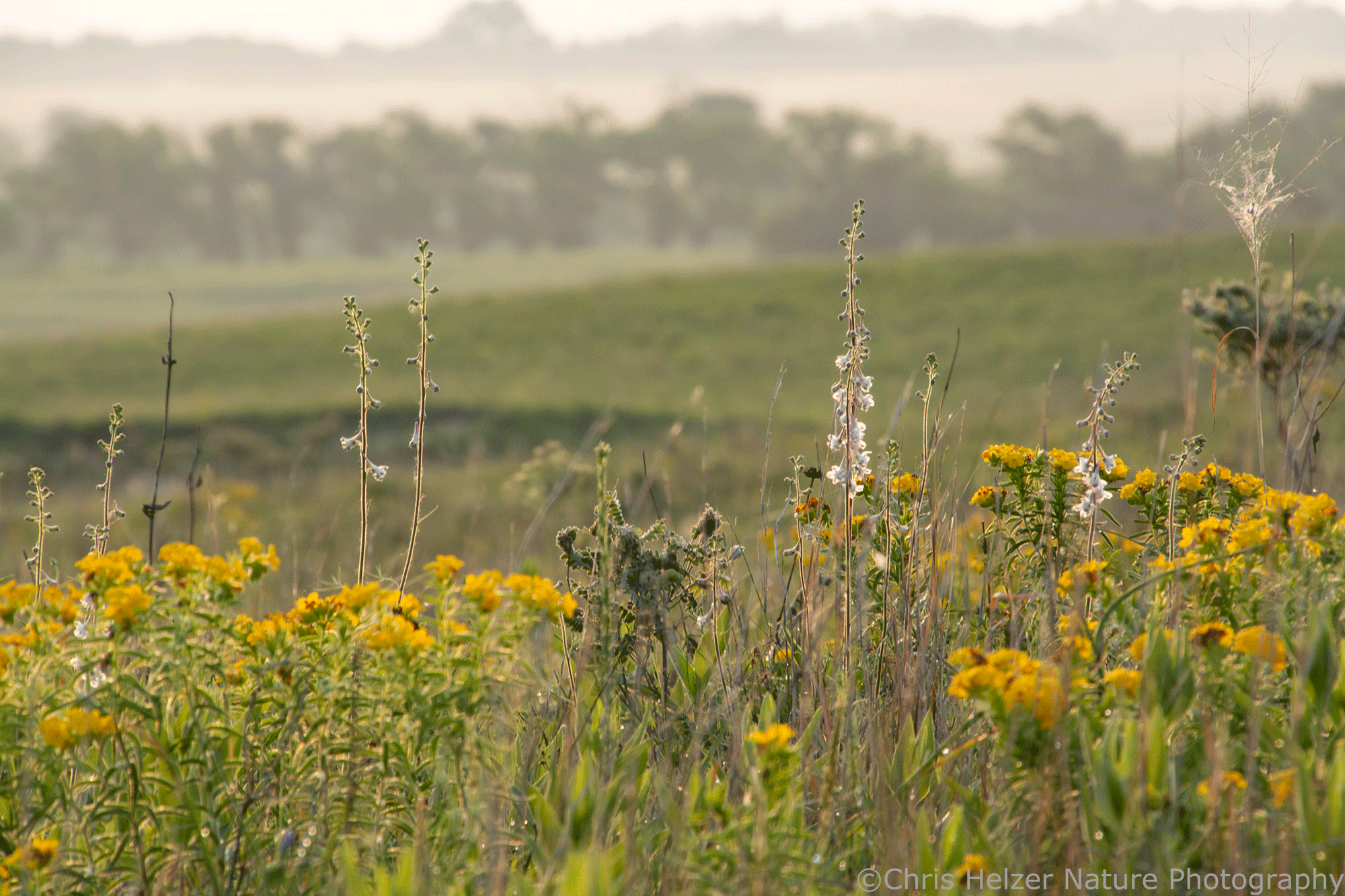
This is where I think it’s most important to push past our reliance on history. It’s tempting to judge plant species, for example, by whether we think they used to be part of the plant community at a particular site, or how abundant they might have been. We’re getting to the point where that may not be very relevant anymore. That includes non-native plants, by the way.
Now we’re getting into really uncomfortable territory for some folks but let me be clear that I’m not proposing we stop preventing the appearance or spread of all non-native plants in prairies. What I am proposing, however, is that the native or non-native status of plants might not be the best metric to apply. Many of us have already started down this path by looking at natives like Canada goldenrod, for example, as a species that can be problematic if it’s allowed to run rampant. Why do we care? Because in some places, it can become dominant enough that it suppresses the diversity of the plant community. That’s a bad thing for ecological resilience.
Non-native plants that have the same potential to suppress diversity need to be targets for management action. However, some non-native plants don’t suppress the diversity around them – they add to it. I think that’s ok. The immigration of new species into prairie communities is inevitable, so fighting it seems fruitless.
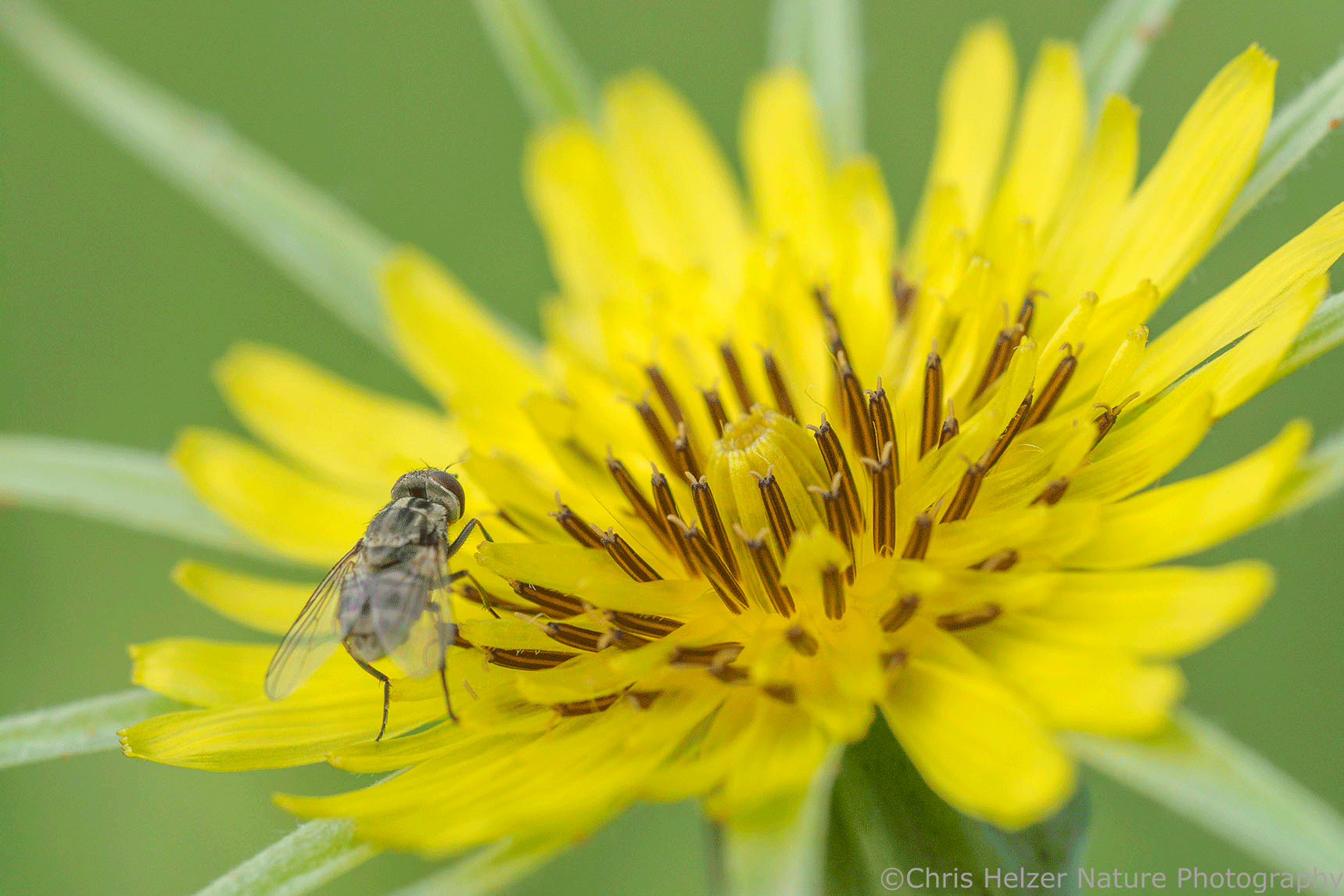
In many places, woody plants – native and non-native – are becoming more abundant in prairies. Their success is driven largely by rising CO2 levels, which prairie managers have no control over. That means that in some cases, we’re just going to have to figure out how to manage for biodiversity in shrubby prairies. We don’t know enough about how to do that yet. Instead of pouring all our limited resources into resistance, we’d be smart to start learning about how to manage the height and density of shrubs and see how plant and other communities respond.
I could go on, but I think the key point is that focusing on ecological resilience, and thus biological diversity, gives us a target to aim for as we look forward. We can evaluate the success of our management strategies by whether they lead to increased or decreased plant and animal diversity. If our prairies are maintaining their diversity, they should have a good chance at adapting to whatever is thrown at them.
It’s hard to turn away from history as our reference point for success. You know what else is hard? Failure. It’s frustrating to try and try to restrain prairies from moving away from what they used to be. Why are we subjecting ourselves to that frustration? Let’s see if we can learn how to support our favorite ecological communities as they flex their adaptation muscles and find ways to thrive in this new world.
 The Prairie Ecologist
As a landowner who sometimes gets overwhelmed by what needs to be done on my property (especially as I get older), this is a very helpful way to think about how to prioritize both areas of land and tasks that need doing. Thank you for providing this reminder to keep looking ahead and focus on the long term!
I used to restore deciduous forest on the East Coast and grappled with these ideas and dilemmas all the time. However, because forests don’t “turn over” as quickly as grasslands and prairies, I always felt a strong incentive to “get it right,” since the ecosystem I was establishing likely would be in the state I was creating for hundreds of years (barring a fire or tornado).
Chris, this hits so many dilemmas and concerns that it’s a bit overwhelming, but I think that central to it all is: enlarge and diversify the freaking island! Thanks for emphasizing that point. My concern now is to decide how and how much to try to enlarge and diversify the genetic base of each species. How much time and energy should I expend finding, gathering and propagating selections that I haven’t gathered from my own prairies? I’m not sure, but it seems intuitively right to try.
Nice essay my friend. I will try to find some time to reply. Mostly in agreement.
Great stuff. Thank you for this perspective. I can let go of “the perfect prairie” but still agonizing over sweet clover invasion.
Thanks for this, Chris. In our stewardship efforts, I always tell folks that 1) everything we do is triage (we assess challenges, evaluate resources, align goals, and prioritize…and somethings are always left undone) and 2) we hedge our bets by promoting as much native biodiversity as possible. We definitely have more questions than answers…but instead of being bogged down in analysis paralysis…we do what we can with the knowledge we’ve got. Adapt and move forward. Share lessons learned.
I don’t know how much “weeds” come into play on the prairies, but I’m a big fan of their resilience and ability to transform human wastelands.
Thank you for this. I have been knocking my head against the historical wall for a long time, grappling with the idea that not everything not there “originally” should be banished–and the impossibility of that. “It’s frustrating to try and try to restrain prairies from moving away from what they used to be. Why are we subjecting ourselves to that frustration?” Why indeed?
One of your best writings yet, Chris. Thanks, Russ in Iowa.
I teach the topic of The Land Ethic in Texas Master Naturalist classes, and so much of your article will be very helpful to me in my presentations. And the comments people have left have more good information that I can use too! Thank you!
Good post Chris. Prairies have never stayed absolutely the same even from one year to the next. Weather, animal migration, fire, all change things in the short term. And if you go back far enough, much of the northern prairie was covered by ice, and even farther back shallow seas. There was no “perfect” point in time. As you said the best we can do is trying to protect as many pieces of the natural world as we can so that the ecological engine keeps running. We can’t return to the past or even remain in the present, we just need to try make sure that things are better in the future than they would have been without us.
Exceptionally well stated and this guidance is applicable in so many regions; the “status quo” challenges are the same. Thanks for verbalizing and sharing your thinking. I’m not working landscape scale like you but this is relevant to urban/suburban landscape “restoration, i.e. replacing lawns with resilient biodiversity appropriate to the site and climate change (attempts at creating the connectivity in microscale?).
Many native insects, birds, and plants are faced with extinction. The prairie supplies a refuge for them. Supplying them with needed land is critical.
But that critical land cannot be overran with noxious invasive plants.
It’s a battle.
Thanks for your excellent, through provoking essay. Stewardship in our rapidly changing world is such a daunting challenge. It would certainly make our lives easier if we could simply “restore” our habitats to be like they were in some perfect, unchanging past.
I couldn’t agree MORE. If I had a dime every time I witnessed a debate about what county a specific plant belongs in according to how is was back in 1805… with all the invasives and climate change rapidly happening its like discussing where you should put the toaster on the kitchen counter whilst your house is on fire. These days when I manage anything I think about biodiversity and Resiliency first. Hopefully when I’m gone from this Earth some of what I managed will survive on its own…
You talk about ‘getting into really uncomfortable territory’ when you talk about natives vs non-natives. Chris: it’s precisely when you get into really uncomfortable territory that your blog and your message sing and we listen and we learn. And not only about non-natives and grazing, but about fire, and thank you for including fire – something you’ve done before. I believe it’s welcomed by those of us who believe the huge tool called ‘fire’ is not something to play with, especially because we’ve been looking back to ‘pre-settlement’ conditions for guidance while wearing goggles.
An excellent, thoughtful piece.
I am mixed with this post. I do believe that there is change in management needed, especially because these are very dynamic systems. What I have a harder time swallowing is thinking that using the tools from thinking how prairies functioned in the past shouldn’t be tried – or the lack of value in them – or that they are not as useful in consideration. My brain goes to Traditional Ecological Knowledge, and if we say we can’t use history goggles in management, then than to me means you don’t take TEK into consideration. I’ve seen presentations on the lack of beaver in an area, TEK shows the story between beaver and trees and moose, and when the beaver are allowed back (not as trap happy), there is function regained in the system. I think it is a blend of TEK and how these prairies functioned with the changes being seen. I know that we live where ice sheets once sat, and to believe that these landscapes will never change is unrealistic. How do we work to do habitat management to restore function knowing that these lands will change? That to me is the bigger question.
Jessica, thank you for this thoughtful response. I’m definitely not saying tools from the past shouldn’t be considered or tried, and that certainly includes TEK. My broader point is that we need to be adapting what’s worked in the past to the current world, which has changed dramatically and rapidly. In some cases, the tools might be the same, but the way we use them might need to be different. And/or some tools or approaches that were sufficient on their own in the past might now have to be combined with others. Also, your last point is exactly right – we need to focus on restoring (and maintaining) function on land that is changing.
I work at a land trust in Central Michigan. Our habitat types and archetypes are definitely different than what you’re dealing with but I think we are also sometimes hampered by a focus on the past. I recently finished up preserve management plans (PMPs) for two recently acquired preserves. One of the required elements in the PMP is a paragraph and map detailing the pre-settlement vegetation – we don’t have a single property in our portfolio that retains its pre-settlement vegetation. Every single parcel was logged, burned, and/or farmed at some point in the last 150 years. So why are we so focused on the past ideal? It’s more important to me that we are working toward a viable solution that limits invasive species, supports native plants, and provides suitable habitat for as many native animal species as possible. If at some point, providing we don’t screw up the job too much, we’ll have a return to old growth (150+ years old) on some of our properties but I won’t be around to see it.
I think having the conversations about what goggles we are looking through is important enough that I shared this post with my board of directors. I just want to get them thinking.
Thank you for this perspective. You’ve provided new insights for management as we continue to work on stewarding our prairie pasture forward.
P.S. Restoration feels good – sharing, welcoming an increasingly diverse community of life into the landscape – reciprocity at its best!
I appreciate you raising this, Chris! Lots to think about here. I’m grateful for your thoughtful post.
Pingback: Welcome new readers! (And thank you to the rest of you!) | The Prairie Ecologist
Pingback: Prairie Pet Peeves (Part 1) | The Prairie Ecologist