Photo of the Week – March 26, 2015

Despite snide comments from certain friends, I do – now and then – take photos of subjects other than insects and plants…

As I write this, the annual sandhill crane migration phenomenon is taking place on Nebraska’s Platte River.  The river valley abounds with tall gray birds feeding in crop fields and meadows and the sound of calling cranes fills the air.  I haven’t had a lot of time for crane photography this year, but have managed to pull the camera out of its bag a few times.  A couple weeks ago, for example, I was in a riverbank viewing blind with a group of birdwatchers, watching cranes coming in to their river roost against a rose-colored post-sunset sky.  The muted light made photography difficult, but I managed a few photos, including the one below.

Sandhill cranes landing on the Platte River, where they will roost overnight.  Because of low light levels, this photo was taken with an ISO of 2000, making it relatively grainy.

Sandhill cranes landing on the Platte River, where they will roost overnight. Because of low light levels, this photo was taken with an ISO of 2000, making it relatively grainy.

After the light and color faded a little more that evening, I decided to try a short video.  If you have never been to the Platte River during this time of year, this will give you a tiny glimpse of what it’s like to watch cranes coming to the river in the evening.

Watching cranes drop into the river at sunset is fun, but I prefer to visit them in the early morning as the roosting birds start to wake up and get ready for the day.  We have to sneak into the blind well before daylight and it’s often difficult to tell how many birds are on the river until the growing light slowly reveals their shadowy outlines.  On a good morning, we may have 10-20,000 birds or more within view as the sun comes up.  The sight and sound of those birds is astounding.  As the sun rises and the air warms up, the activity level of the birds increases, and we get to see a great deal of social behavior – preening, pair-bonding and courtship “dancing”, and aggressive posturing.  The short video below documents that kind of increasing activity through one morning this spring.

I am grateful to have a front row seat to an annual ecological phenomenon that draws birdwatchers and nature lovers from around the globe.  The sound of sandhill crane calls is a pretty great soundtrack to my spring.  The only regret I have is that the majority of crane-watchers never get to see the Platte River Prairies during the summer when – though we have no cranes around – our grasslands are teeming with the sights and sound of birds, insects, flowers, and generally spectacular prairie life.  Please come visit!

Flying cranes silhouetted against the dusk.  The Nature Conservancy's Platte River Prairies, Nebraska.

Flying cranes silhouetted against the dusk. The Nature Conservancy’s Platte River Prairies, Nebraska.  March 2015.


Photo of the Week – March 19, 2015

Proof that I’m a biologist:  While driving along a gravel road near our shop this week, I stopped and backed up to see if I’d seen a small snake or just a piece of debris in the road…

A redbelly snake (Storeria occipitomaculata) found in Hall County, Nebraska.

A redbelly snake (Storeria occipitomaculata) found in Hall County, Nebraska.

I’m glad I stopped.  It turned out to be a redbelly snake, a species found in only a few counties in Nebraska.  I think it’s the third one I’ve found in our Platte River Prairies, dating all the way back to when I was working out here as a graduate student in the early 1990’s.

Not a lot is known about the habits or habitats of redbelly snakes in Nebraska.  When I got home with some photos, I contacted herpetologist Dan Fogell to confirm the identity of the snake and learn more about it.  Rather than getting a lot of information from Dan, he instead peppered me with questions about where and when I found the snake because he’s trying hard to gather data and better understand the species.

ENPO150315_D004

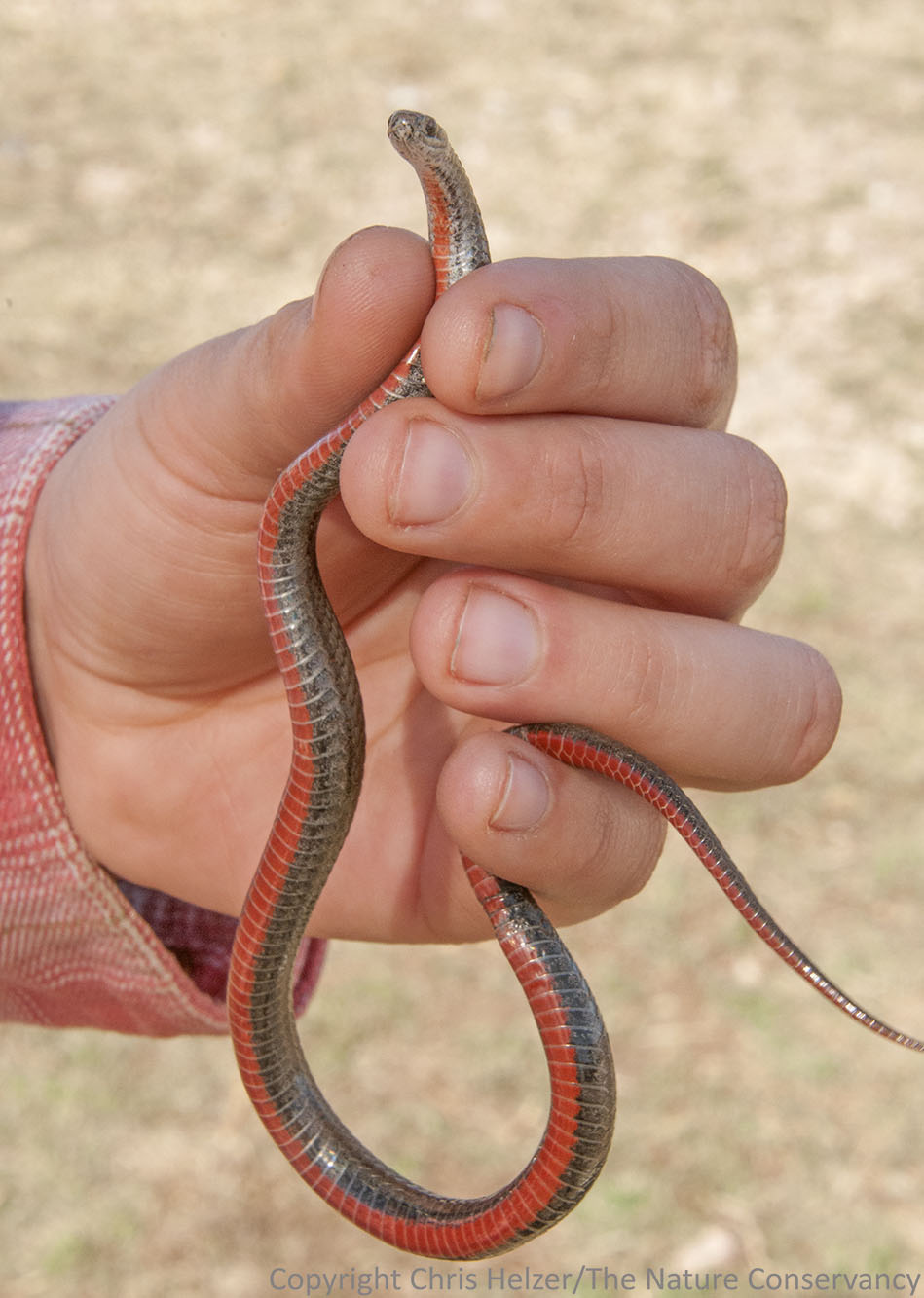
This was a big snake (for a redbelly). It was close to 11 inches in length, which is about the maximum size for this species.


Jasmine (one of our Hubbard Fellows) held the snake to show the colorful underside it is named after.

Jasmine (one of our Hubbard Fellows) held the snake to show the colorful underside it is named after.

This particular snake was on a gravel road between two crop fields when I happened upon it.  The road ditches were full of old matted-down smooth brome grass.  It didn’t seem like particularly friendly habitat for wildlife.  Was the snake living in those ditches?  Or traveling to other habitat?  There was a small woodlot a couple hundred yards away, and a stream across the cornfield to the north…  We released the snake where we found her, so whatever habitat she’s looking for, I hope she finds it.

ENPO150315_D010

There are a lot of species we just don’t know much about – not just tiny invertebrates, but also relatively large (and beautiful!) vertebrates.  It’s another reminder of how important the collection of basic natural history information is.  Conservation is difficult, but even more so when we don’t even know much about the species and natural systems we’re working to conserve.

I’m grateful that I had the opportunity to see and admire this snake.  I hope my kids get the same chance.