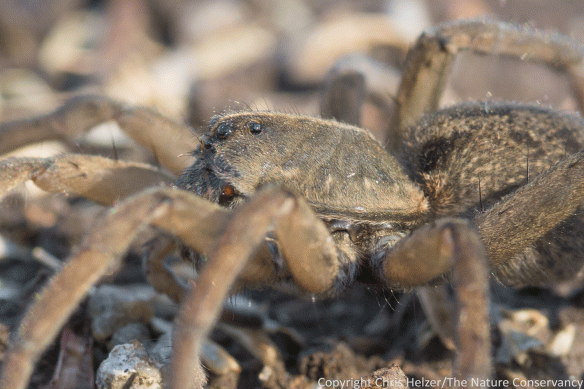
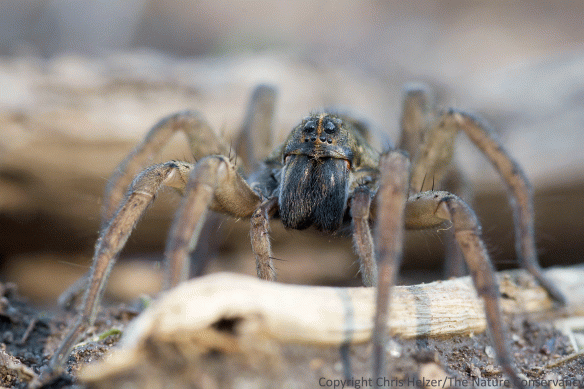
Mark your calendars if you’re interested in attending either or both of our Platte River Prairies Field Days this summer. The first will be on Thursday July 6, and will be focused on plant identification. We’ll have several instructors on hand to lead field-based plant identification sessions in various habitats, including upland sand prairie, mesic prairie, and wetlands. The second field day will be August 5, and will feature a wide range of topics covering prairie ecology, restoration, and management, pollinators and other invertebrates, and more. Both days are free and open to the all ages. Look for more details as the time grows near.
Now, a (minor) technical photo quandry I’m hoping you can help me with…
When photographing small flowers and insects, depth-of-field (the depth of an image that is in focus) is a challenge. At close range, a camera can only bring into focus a narrow range of the image (front to back). Deciding what needs to be in focus and what can be a little fuzzy is a constant issue, and I often try taking the image a few different ways so I can decide which I like best later. When I’m photographing a small creature, I almost always make sure the eyes are in focus, regardless of everything else, because as viewers, our eyes are always drawn to the eyes of other creatures.
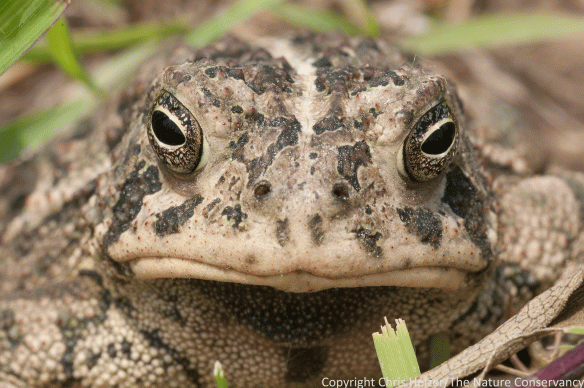
The eyes of this Woodhouse’s toad are both sharply in focus, but the tip of her nose/snout is a little out of focus – but not enough to be distracting.
When photographing the toad above, for example, I made sure the eyes were sharply in focus, even though i knew that would mean that the part of the toad closest to the camera (the center of its mouth) would appear slightly out of focus. Because the toad was relatively large, the out-of-focus part was only a little soft and not at all distracting, making it an easy decision to prioritize the eyes being sharp.
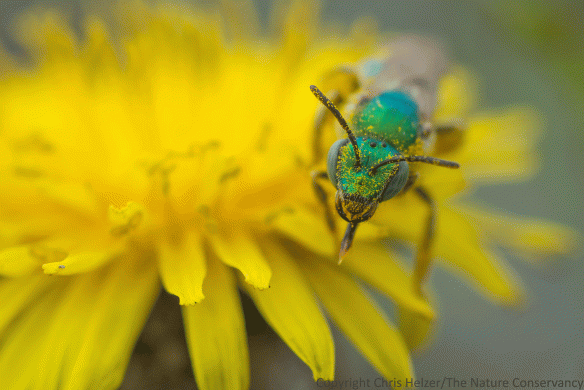
Bee Photo #1
The other day, I was photographing a cute little green bee (Agapostemon sp.) on a dandelion flower. I took quite a few photos, playing with the depth-of-field. When editing the images later, I came up with two I really liked, but neither had the entire face of the bee in focus. In the first photo (above), the front green portion of the head was in focus, along with much of the antennae, but eyes were a little soft. In the second photo (below), the eyes are in focus, but more of the parts of the bee closer to the camera are not. The second photo shows off the tongue and mandibles a little better, as well as the three simple eyes on the top of the bee’s head.
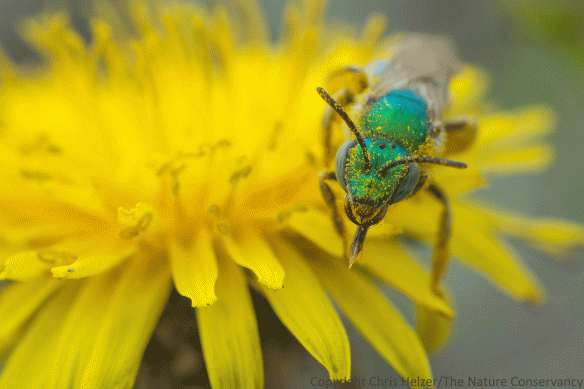
Bee Photo #2
Below, you can see cropped versions of both photos and compare them. Again, the one on the left has the green part of the head in focus, while (all 5 of) the eyes are more sharp in the photo to the right. If I follow my typical rule, I should like the second image better, but I’m not sure I agree with that in this case. My question for you is this: as the viewer, what is the focal point in the photo? The big compound eyes? The point where the antennae meet the head? Something else? That focal point needs to be sharp, regardless of whatever silly rule I usually follow.

Here is a side by side comparison.
Ok, I know this is kind of splitting hairs, and the difference between these two photos is pretty slight, but I’ve had other situations in which the decision about whether to focus on a little critter’s eyes or another part of its face is more difficult. I’m hoping to find out whether what I see as the focal point of these bee images is the same as what others see. That will help me make future decisions with other images.
Thanks for your help.