The Problem with “Calendar Prairies”

I think I first heard the term “calendar prairie” from my friend Bill Whitney of Prairie Plains Resource Institute.  He was talking about the mental image many people have of prairies that comes from seeing photographs of grasslands full of big showy flowers in books, posters, and calendars.  The term, and its implications for prairie management, has stuck with me over the years. 


An example of a "Calendar Prairie" photo. The Henry C. Greene Prairie at the University of Wisconsin-Madison Arboretum.


Unrealistic Expectations

There are a couple of dangers associated with people holding a mental image of what a prairie is supposed to look like.  The first is that it’s easy for people to have unrealistic expectations for prairies.  I’m a photographer, so I know firsthand that flowery photos don’t always represent an accurate picture of the prairie in which the photos were taken.  Photographers are often drawn to the biggest patches of showy flowers, and by creative use of perspective they can make those patches look even showier than they look in real life.  The result is usually a beautiful photograph that someone familiar with the prairie might not recognize.  To be clear, I’m not saying this kind of photography is a bad; on the contrary, attractive photographs have been extremely important for building the public’s interest in prairies. 

However, photos dominated by big showy flowers have the potential to be counterproductive as well.  For example, I worry that someone whose only vision a prairie comes from a “calendar prairie” image will be disappointed when they first see a prairie in person.  Regardless of how wonderful that real-life prairie is, it’s unlikely to live up to the photograph(s) that person has seen.  If that happens, it’s possible that a possible prairie enthusiast might instead feel duped and decide that prairies aren’t their thing after all.

For people that are already prairie enthusiasts, or perhaps prairie owners/managers, calendar prairies can become an unfair standard by which they measure the prairies they’re familiar with.  I’ve been in some astonishingly showy tallgrass prairies, where photos full of big flowers are easy to take just by pulling out a camera and shooting randomly.  However, not all prairies look like that – nor should they – and the ones that do don’t usually look like that all season long.  There are numerous conditions (including topography, soil moisture, soil texture, management history, etc.) that determine the appearance of a prairie’s plant community.  Using a calendar prairie image as the standard by which all prairies is judged is obviously naïve – much like a young woman using a movie star as the standard by which she judges her own identity.  The value of a prairie can be judged in many ways, including by its habitat value for a wide range of animal and insect species, many of which do not rely on big showy flowers.  In fact, the biggest value of an individual prairie is its very individuality – its unique combination of species composition and habitat attributes makes a unique contribution to the larger prairie conservation mission.  (Read my earlier post on this topic.)

This is not to say that all prairies are perfect the way they are.  Most (all?) prairies can be improved, but goals for improvement should be based on increasing the value of those prairies for biological diversity – not on making them look more like a photograph.

Effects on Management

The second danger of a calendar prairie image is that it can affect the way a prairie is managed.  Prairie managers sometimes form a mental picture of what they want their prairie to look like.  Sometimes that picture is based on an unrealistic idea of what prairies should look like.  Other times, it’s based on a fond memory of what their prairie looked in a previous season.  Either way, the problem occurs when that manager tries to make the prairie look like that mental picture all the time.  Rather than managing the prairie in response to threats such as invasive species, or in ways that allow different plant and animal species to gain an advantage each year, the prairie gets the exact same management treatments every year.
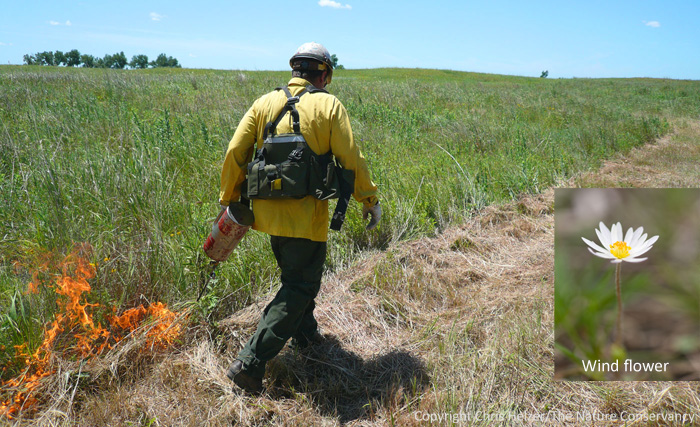
A summer fire on The Nature Conservancy's Platte River Prairies. We've seen very interesting and positive responses from summer fires, with and without grazing. For example, I've been managing this prairie for more than 10 years and have only seen wind flower (Anemone caroliniana) twice - both times it was growing in the portion of the prairie that had been burned the previous summer.


When a prairie gets the same management each year (e.g. early spring fire or summer haying) some plants, animals, and insects that are favored by that management and others are not – year after year.  Eventually, those species that are put at a disadvantage each year can disappear from the prairie.  Sometimes the strategy seems successful to the manager because the plant community appears the same each year; they always see the same big showy flowers blooming, for example.  However, other plant species may be slowly fading away.  More importantly, many animals and insects that have specific requirements for habitat structure will have a difficult time surviving in a prairie that provides only a single habitat structure type across the entire prairie each year.  Even those animals and insects that thrive may become more at risk from predation because the number of predators and their focus on particular prey species can both grow when their food source is consistently available in the same place and abundance each year.

 In a large contiguous grassland landscape, individual parcels of land that are managed the same way every year may not be a big deal – as long as there is variety among parcels.  If the Brown prairie is managed with annual late-spring fire, the adjacent Smith prairie is managed with annual summer haying, and nearby prairies are managed with other strategies, the conglomeration may retain good biological diversity, even if each individual tract of land contains a relatively narrow set of species.  However, when neighbors manage in similar ways, or when isolated prairies are managed in ways that decrease the number of resident species over time, the entire landscape can lose diversity.  If that happens, it’s unlikely that the diversity will recover because there are no places for the lost species to recolonize from.

 Ideally, every prairie would have multiple management treatments applied to various parts of it each year.  For example, a portion might be burned, a portion idled, and a portion grazed, with those treatments shifting from place to place each year – not necessarily in a predictable manner.  In a prairie managed that way, most or all plant species are likely to find favorable conditions in which to grow and bloom every few years – something that is critical to their long-term survival.  Animals and insects in a prairie that has multiple management treatments across it have a good chance to find suitable habitat each year by moving to the portion of the prairie that is most favorable in that year.

Light grazing on a restored Platte River Prairie - cattle are grazing the grass but leaving most wildflowers ungrazed. Periodic grazing can certainly change the appearance of a prairie, but plants that are grazed recover quickly. In the meantime, the grazing can provide different habitat structure and opportunities for plant species that are normally suppressed by dominant grasses.

 Some prairies are small enough that splitting them into multiple management units is not feasible.  In those cases, just shaking up the management so that it’s not exactly the same each year can be important.  Idling a different portion of the prairie each year – even if those portions are small – can provide a refuge for some of the plant and animal species that might not do well under the management applied to the majority of the prairie.  However, when prairies are both very small AND isolated from other prairies, some insect and animal species will simply be unlikely to survive long-term, even with good non-repetitive management.  In those cases, the management objectives may need to be altered – those sites could be treated more like museum pieces than prairies.

 Regardless of a prairie’s size, repetitive management over time can limit its biological diversity.  Prairies evolved under chaotic conditions; fires, grazing, outbreaks of herbivores, and drought came and went, and prairie animals and plants developed strategies to adapt.  Not only can prairie species survive management that changes year to year, they can thrive on it.

 Conclusion

Relying on idealistic visions of what prairies should look like (Calendar Prairies) creates an unrealistic image of what prairies really are.  Prairies evolved as dynamic natural communities that changed in appearance from day to day and year to year.  Rather than selling the public and ourselves on the idea that prairies should consistently look like showy flower gardens, we should celebrate and facilitate their changeable nature.  Real prairies are much more interesting (and valuable) than flower gardens anyway.

Lessons from the Grassland Restoration Network

I’ve been involved with high-diversity prairie restoration (reconstruction) since I joined The Nature Conservancy in 1997, learning the basics from Bill Whitney at Prairie Plains Resource Institute.   We’ve now planted over 1,500 acres of Platte River cropfields to prairie vegetation, using seed mixes of between 150 and 230 species.  Those restorations are being used to enlarge and reconnect existing remnant grasslands along the Platte River.

About 10 years ago, I started reaching out to other sites doing similar work.  Gus Nyberg, then at the Kankakee Sands Restoration in Indiana, and I set up a reciprocal visit between our projects, during which I took some of my staff (and Bill Whitney) to Indiana and the Kankakee staff came to Nebraska.  That experience was really valuable for all of us, and convinced us that we needed to do it more often – and to include as many others as possible.  Thus began the Grassland Restoration Network.

The Grassland Restoration Network (GRN) is a loose affiliation of projects and project staff engaged in the restoration of diverse native grassland communities.  The Network was formed in 2003 by The Nature Conservancy and a wide variety of other conservation organizations, government agencies, and private landowners.  There are three major objectives of the GRN:

  1. Facilitate communication and cross-site learning among large-scale grassland restoration sites.
  2. Identify and close critical knowledge gaps regarding grassland restoration and measures of restoration success.
  3. Foster a “grassland restoration culture” that increases the quantity and quality of grassland restoration.

Grassland Restoration Network workshop participants discuss restoration strategy in a restored Nebraska prairie in 2009.

The Network sponsors annual workshops that are hosted by various restoration projects around the country.  In addition to tours, workshops include presentations and discussions on topics including seed harvest/planting, invasive species control, long-term management, and research and evaluation strategies.  Those workshops have been attended largely by people working in the central United States, but have also included participants from the Pacific Northwest, long-leaf pine ecosystem in the southeast, and even other countries, including Canada and The Netherlands.

GRN workshops differ from other conferences in that the Network focuses on the use of high-diversity restoration as a tool for increasing the ecological viability of prairie ecosystems.  For example, we try to enlarge or reconnect small and/or isolated prairies through the conversion of adjacent cropland to high-diversity grassland communities.  In other words, we are trying to defragment the prairie landscape to increase the effective population sizes of prairie species (plants, insects, vertebrates) and benefit the whole ecosystem.  Success in those cases is measured not only by the establishment of plant species in seedings, but also by whether or not those seedings have increased the viability (long-term sustainability of ecological function) of the remnant prairie(s).

Bringing together people working toward this particular objective has had several benefits.  It has increased communication between sites to the point that we know what each other are doing and are learning from their experiences.  We have also identified common challenges and research questions, and have started several joint research projects to try to address those.  Finally, we have been able to take advantage of the size and experience of the group by collecting a number of “lessons learned” regarding the logistics and mechanics of doing prairie restoration.

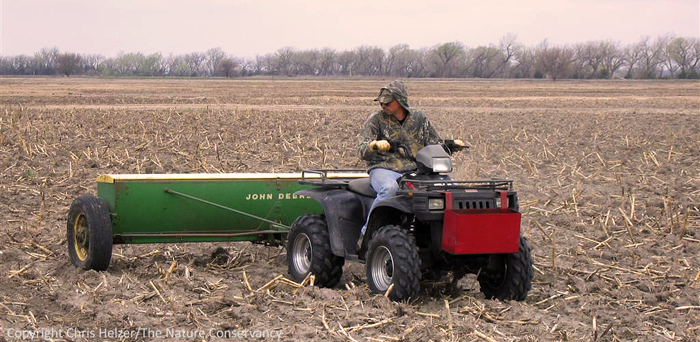
Most large-scale prairie restoration sites have found that broadcasting seed (rather than drilling) is the most efficient and effective planting technique.

Several of us who have helped facilitate the Network have summarized many of those lessons in a manuscript that will be published in the upcoming Proceedings of the 22nd North American Prairie Conference.  The organizer of that Conference, the Tallgrass Prairie Center at the University of Northern Iowa, has graciously given me permission to post a PDF of that manuscript here, even though the Proceedings have not yet been published.  (click here to download – GRNLessons2010)

The manuscript covers a wide variety of subjects, including seed harvest and cleaning, planting, invasive species control, and overall project planning.  It also includes a selection of the most pressing research questions facing prairie restoration, as identified by Network participants.  If you’re interested or involved in prairie restoration work, I hope you’ll find the manuscript helpful.

Here is a selection of some of the broader lessons learned, excerpted from our manuscript:

1. Match your methods to your objectives.  The biggest key here is to define specific objectives.  Why are you doing the restoration project?  If your primary objective is to create grassland bird habitat, plant species diversity may not be all that critical, but the particular plant species you select may be.  If, on the other hand, you’re trying to enlarge a small remnant prairie so that all of the plants, insects, and animals in that prairie can have larger population sizes, the species diversity and composition of your seed mix becomes much more important.  (It’s also important to be sure you’re evaluating your success based on those same objectives.  If you’re interested in enlarging a prairie, be sure to measure the response from insects and other organisms – not just plants.)

2. Start slow, and increase the scale of restoration over time.  Many restoration projects, especially those trying to restore hundreds or thousands of acres, feel like they need to start restoring large portions of the total right away.  In almost every case where this has been done, the project manager has regretted it later.  Because every site is different, it’s important to start by spending a few years doing small scale seedings in order to build up a database of seed harvest sites, test the effectiveness of techniques, and gauge the level of invasive species suppression that is needed.  Be sure to experiment with a variety of strategies (seeding method, seeding rates, site preparation, etc.) during those first years so that you can learn as much as possible.  Once you feel like you’ve got a handle on effective strategies, you can start ramping up the scale of the effort exponentially.  This approach helps avoid initial large seedings that fail to produce the anticipated results, and that become management headaches down the road.

3. Restore a site over multiple years, rather than all at once.  This is related to number two, but applies to any site, regardless of scale.  Anyone who has spent many years restoring prairies knows that every seeding is unique.  The relative establishment of plant species, the response of weedy species, and many other factors vary year to year – often for reasons we can’t yet define.  Make that variability a positive thing.  If you have 100 acres to plant, seeding 20 acres a year for five years can produce five unique prairie communities that complement each other and increase overall heterogeneity and diversity of habitat and species composition, rather than one large seeding that looks pretty much the same across the whole site.  Another approach is to “checkerboard” a seeding; break each year’s seeding effort into several locations, scattered across the larger site, and fill in more blanks every year.

4. If you want plant diversity, maximize that diversity in your initial seedings – don’t plant a low diversity mixture with the idea of coming back later to add diversity.  It is much more difficult to enhance the diversity of an established prairie restoration than it is to establish that diversity during the initial seeding process.  Attempts to do so tend to have inconsistent results at best.

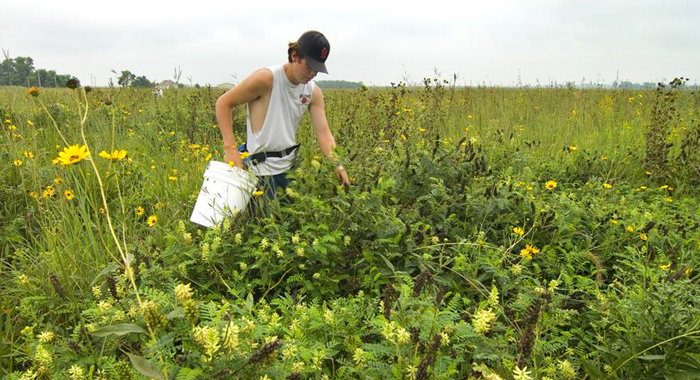
Efficient seed harvesting is an important part of prairie restoration when trying to maximize both acres and species diversity.

5. Adapt your technique as you go.  Even if you start small and figure out some apparently effective methods before attempting larger seedings, it’s still important to continue experimenting.  Including a couple small experimental plots (1 acre or so in size) within each year’s restoration work, in which seeding rate or other treatments are varied, can provide tremendous information that can help refine your techniques over time.  Collecting data from those plots can be as simple as visual observation of differences or more intensive, but without those experiments, you’ll never know whether or not you could be doing better restoration work.

6. Develop a plan, and capacity, for dealing with invasive species before you start.  Invasive species are expensive to fight, but the success of that fight is the difference between restoration success and failure.  In fact, when a restoration effort is designed to benefit an adjacent remnant prairie, a seeding full of invasive species can actually put the remnant at greater risk than before.  There are two factors that should drive the number of acres you plant each year: the amount of seed you can harvest to obtain the desired species composition in the seedings, and the number of acres on which you can deal with invasive species.  This is one of the great advantages of starting small – you can evaluate the threat posed by invasive species on small seedings before jumping into large seedings that could overwhelm your available resources.  It’s better to do high-quality, but small, seedings than mediocre (or worse) large ones.

7. Finally, one of the most interesting facets of prairie restoration is that there are many ways to do it successfully.  It is a field full of innovation and creativity, and it’s wonderful to see varying approaches to common problems.  However, through polling participants, we’ve found that there seems to be one set of restoration techniques that is universally successful, regardless of geographic location or other factors.  Excepting extraordinary circumstances, a dormant season broadcast seeding onto Roundup Ready soybean stubble will always establish a diverse prairie plant community.  This doesn’t mean that the Network is prescribing that specific technique – in fact many of us have had great success with other techniques.  But we think it notable that we could identify at least one combination of techniques that consistently produces successful prairie establishment.

Whether you’re creating prairies for educational, historic, aesthetic, or ecological reasons, it can be a rewarding (if challenging) experience.  Because every site responds uniquely to prairie restoration, much of what works for you will likely be learned through experimentation.  However, there is also much to learn from others who have been doing similar work in other places.  I hope this partial summary of that information will help you.

The 2011 GRN workshop has not yet been planned.  Stay tuned to this blog for updates about the date and location.