
How Should We Be Preparing Prairies for Climate Change?

When I wrote my recent book on prairie management, I included a very short section at the end on climate change.  Essentially, my advice to prairie managers was that managing prairies for biological diversity would help them be resilient enough to absorb climate change impacts.  I still think that’s good advice, but it leaves out some other options.

One of the purposes of this blog is to allow me to expand upon the ideas from my book, so I’m taking this opportunity to do that with the issue of climate change.  In this case, I asked for help from John Shuey, Director of Conservation Science for the Indiana Chapter of The Nature Conservancy.  John is a good friend and someone I have tremendous respect for, and I can always count on him to cut through the fog and address issues directly.

What I like most about his ideas is that they are all things we can actually DO RIGHT NOW.  One of the frustrating things about climate change is that it’s hard to design strategies when we don’t really know what climate conditions will be like in the future.  But John suggests strategies that would be good ideas regardless of what the climate does.  It feels good to have a map to follow, and this one points in the right direction – even if we don’t know exactly where we’re going.

Prairie Ecologist:

“What do you see as the major threats to prairie and savannah conservation from climate change in your state?”

Shuey:

“Well, most models predict three key changes in Indiana’s climate change future.  It will likely be hotter, with a slight increase in precipitation, and there will be more frequent severe weather events such as tornados, straight-line winds and ice storms.   The increase in precipitation will be during the dormant season with predicted decreases during the summer.  All that basically translates into three perceived threats: increased drought stress, increased fire frequency and intensity, and increased severe weather damage such as flash flooding and blow downs.”

Cardinal flower and other moist-soil-dependent plants may be particularly sensitive to increases in drought stress.


Prairie Ecologist:


“The central United States went through the Xerothermic Period between 8,000-5,000 BP, which was considerably warmer and drier than our present climate.  Does the fact that our prairies have already survived that period give us hope for the next phase of climate change?”

Shuey:

“Based on paleobotanical data, expanses of grassland and savanna dominated much of Indiana during the Xerothermic Period, and wooded communities increased in abundance as climates became cooler and moister.  Species compositions in today’s prairies will undoubtedly shift in response to climate change, but appropriate native species should be present at many sites to moderate those changes.  Some species will increase in abundance and others will decrease – even disappear from sites altogether.  The key for biodiversity conservation is to design strategies that will allow those changes to happen while minimizing species loss and preserving ecological functions.  For example, we can help to ensure that the full range of habitat conditions will persist in our conservation areas by designing restoration projects now that meet the future needs of species most at risk from climate change.”

.

Prairie Ecologist:

“Fortunately, prairies are pretty resilient communities, but we’ve put a lot of stress on them already – especially in landscapes where prairies are small and isolated from each other.   How does that habitat fragmentation affect our conservation options?”

Shuey:

“The concept that ‘species will have to adjust northward’ as climate changes is very problematic in a landscape that is among the most developed in the world.   Even if it is theoretically possible for species to respond to warming trends by moving northward, fragmented landscapes like those in Indiana will not permit much movement between conservation sites.

Because of that fragmentation, we need to do as much as we can to make habitat patches as internally resilient as possible.  This can be done by maximizing the both the size and physical variation (e.g. slope, aspect, and soil moisture) of our natural areas.  We can increase the size of, and even reconnect, fragmented habitats through restoration of adjacent areas where that’s feasible.  Larger habitats can hold larger populations of species, which gives them a better chance of survival.  In addition, larger sites usually provide more variation in topography and hydrologic gradients, which can increase the chance that species will find the conditions they need to survive somewhere in the conservation area.  For example, shady microhabitats on north facing slopes may partially mitigate the impacts of regional increases of the evapotranspiration rates (a.k.a. drought stress).  Some of the rare species found on these slopes today may not make it through the changes, but those microclimates will likely still be loaded with locally rare species in the future.  Sadly, some of those ‘rare’ species may be abundant today but restricted to narrow ecological creases decades from now.

It’s also important for natural areas and to contain multiple examples of each habitat type, especially those most at risk from climate change – e.g. things like wet prairies and other moist habitats.  This accomplishes two things; it maximizes habitats that are likely to mitigate drought impacts, and it creates a repeating mosaic of ecological gradients that is more likely to support metapopulations (multiple populations interacting with and supporting each other) of species pushed to the brink.  As we design conservation areas and engage with private landowners in priority landscapes, we need to preserve as many examples of each habitat type as we can within regional landscapes. ”
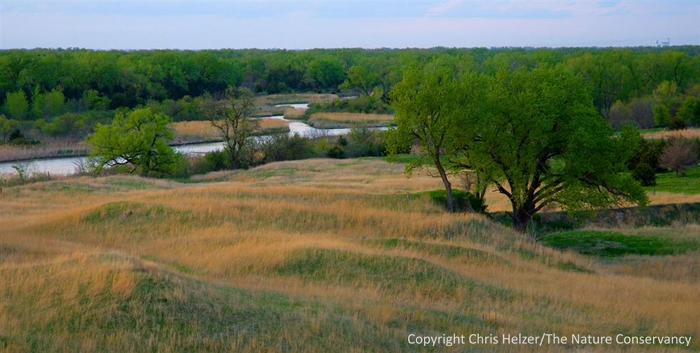
Prairies that include a range of habitat types (wet to dry, shady to sunny, etc.) provide species more opportunities to find appropriate habitat as climatic conditions change. (Griffith Prairie - Prairie Plains Resource Institute)

Prairie Ecologist:

“Talk more about wet prairies and other natural areas that rely on the proximity to groundwater or other hydrological features for their survival.  Increasing drought stress sounds like a big deal for those sites…?”

Shuey:

“First, it’s important to know that many of our wetland systems in Indiana, such as bogs and fens, functioned though the Xerothermic Period in essentially the same manner as they do today.  These sites are literally the source of the pollen records used to re-create paleoclimates such as the Xerothermic.  It seems likely that their water budgets were reduced, and wetlands were probably smaller relative to their presettlement extent in Indiana, but they still survived.

It will be very important to protect groundwater and surface water inputs to natural areas wherever possible.  Groundwater diversion, especially for irrigation, is already a concern at some of our most important sites, and needs to be addressed.  If we really do get more precipitation during the dormant season, that might help recharge surface aquifers.  However, increased droughts may counteract that, so we will need to help develop policies that help moderate surface and groundwater depletions and encourage wetland restoration and protection.

River flows will probably become more flashy because of increased storm intensity.  The prevalence of channelized streams across the Midwest means that most run-off from big rains is lost quickly downstream.  This creates unstable streambeds and increases non-point source pollution in rivers.  It also means that most of that water is not captured in wetlands where it can provide habitat and help contribute to groundwater recharge.  Implementing the increased use of two-stage ditches may be one way to help moderate flood damage while still preserving a more natural stream flow regime.

Finally, restoration of areas adjacent to wetlands and low prairies provides opportunities to improve hydrologic conditions in two ways.  First, wetland restorations in formerly cropped areas can complement the hydroperiod of nearby natural wetlands.  New wetlands can be designed to stay wet longer – or dry up sooner – depending upon what may be missing (or predicted) in existing sites.  That full range of hydroperiod conditions is particularly important for successful breeding by reptile and amphibian populations.  Second, restoring portions of the landscape surrounding small natural wetlands can help buffer them from the impacts of diversion ditches and other hydrologic alterations.”
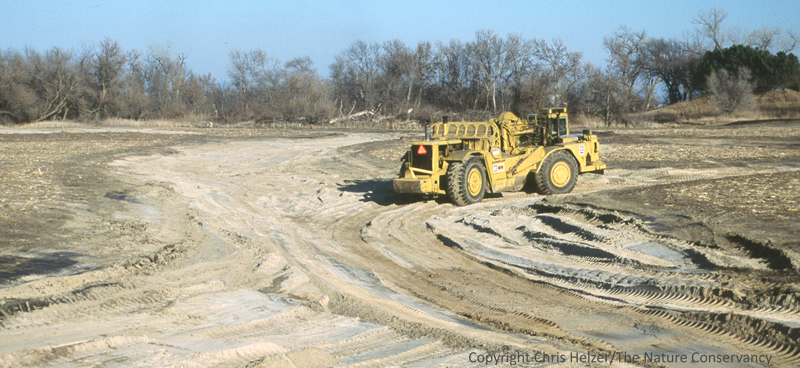
Prior to converting this Platte River cropfield to prairie, we tried to restore the kind of hydrologic gradients appropriate to a river floodplain wet prairie. Not only did that increase the diversity and resilience of that restoration, it also provided complementary habitats to the existing remnant prairies adjacent to it. (The Nature Conservancy - Nebraska)

Prairie Ecologist:

“Are there other things we need to be thinking about relative to climate change?”

Shuey:

“Three things come to mind.  First, invasive species will be moving into new areas as they, too, adjust to the changing climate.  Unfortunately, invasives are more likely to be able to move around fragmented landscapes than many of our native species, and we need to be prepared for that.  I think that the struggle to manage native grasslands will intensify in the future, and that we can never let our guard down.

Second, we tend to focus on the losers when we discuss climate change.  It’s important to remember that there will be interesting winners as well.  For example, in southern Indiana we are focusing heavily on small glade and barrens habitats surrounded by dense forest.  I expect these glades and barrens – which, structurally, are just prairies that grow on very thin soils and bedrock – to thrive!   We are aggressively restoring these habitats to their pre-fire suppressed condition so that they will be poised to take advantage of future harsh growing season droughts.

And finally, it’s important to remember that the predicted changes are PREDICTIONS.  We have to be flexible in our strategies as we move forward.   My guess is that I understand perhaps half of the future impacts to our sites – enough that we can take good ‘no regrets’ actions (productive strategies regardless of climate change) for the future.  But we’ll need to continue adapting strategies as we learn more.  If we are still following my current prescriptions 10 or 20 years from now we’re probably not paying attention to either changes on the ground or model refinements.”
Why Every Prairie Really is Unique – and Why it Matters.

Confirmation that every prairie has its own unique composition of plant and insect species, and discussion about why that’s important for conservation.

Several years ago, I helped assemble a group of partners to begin some pilot research on what kinds of impacts habitat fragmentation may be having on the tallgrass prairies in southeastern Nebraska.  While those prairies are greatly fragmented compared to the extensive Nebraska Sandhills or Kansas Flint Hills prairies, there are still many blocks of hundreds to thousands of acres of prairie embedded within a matrix of cropland.  Those grassland complexes include a mixture of hayed prairies, grazed prairies, and Conservation Reserve Program (CRP) fields.  As conservation organizations consider the best ways to ensure continued survival of those important grasslands, many of the most pressing questions revolve around whether or not the prairie landscape is intact enough to support a functional ecosystem.

We still have a long way to go before we know much about the “functioning” of the southeast prairies, but we have collected enough data to know one thing:  every one of those prairies is unique.  While that not exactly earth shattering news, especially to biologists who have inventoried numerous prairies, it’s really very important.  To be more specific about what we’ve found, each prairie appears to have its own individual “signature” of plant and insect species compositions.  In other words, each has a mixture of species that is similar to, but also very different from, other prairies – even among prairies that are managed much the same way and that appear very similar from a distance.

For example, over the last couple of years we have done vegetation surveys in 24 hayed prairies as part of a couple of insect research projects.  We selected the 24 sites because we believed they were very similar to each other in plant community but varied in size and degree of isolation.  In other words, we tried to pick sites with identical plant communities.  Boy did we fail.  To be fair, the graduate student that selected the sites did so by driving gravel roads in April and May, and one hayed prairie looks a lot like another from the road at that time of year.  But we did try…

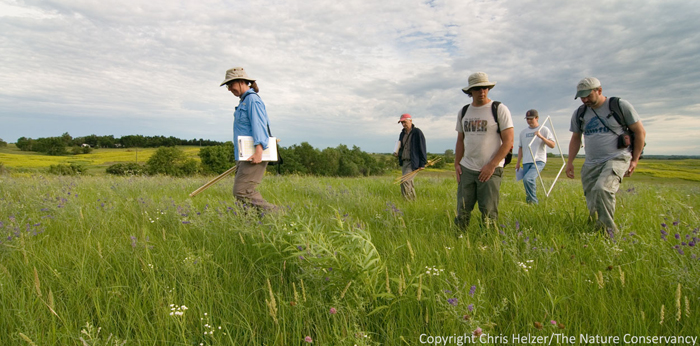
Staff from the Illinois Natural History Survey assisting with vegetation inventories in hayed prairies. Southeast Nebraska - Pawnee County.

There were some strong similarities among the prairies.  Most of them had had abundant cool-season grasses, but also strong representation from warm-season native grasses.  In addition, all of them had a good diversity of plant species – most averaged between 20 and 25 plant species per square meter.  Many of the more common wildflowers were found in all, or nearly all, of the prairies, and in similar amounts – including species like stiff sunflower (Helianthus pauciflorus), heath aster (Aster ericoides), black-eyed Susan (Rudbeckia hirta), pussytoes (Antennaria neglecta), and wild alfalfa (Psoralidium tenuiflorum).  Finally, the majority of the prairies had apparently been inter-seeded at some time in the past with non-native legumes such as red clover, sweet clover, and others, and those species were moderately to very abundant in those prairies – although not to the extent that they seemed to have an impact on overall plant diversity.

However, the differences among the prairies were as obvious as the similarities.  For example, of the 24 prairies, prairie phlox (Phlox pilosa) only appeared within our sampling plots (50 1m2 plots at each site) in three of them – but it was very abundant at those three sites.  Why is it abundant at a few sites and rare or missing from others?  Prairie blazing star (Liatris pycnostachya) showed a similar pattern.  Other important wildflower species – those considered to be among the core species of tallgrass prairie plant communities – only appeared in the data from about half of the sites.  Those species included compass plant (Silphium laciniatum), purple prairie clover (Dalea purpurea), hoary puccoon (Lithospermum canescens), and wild strawberry (Fragaria virginiana), among others.  To be clear, these data don’t indicate whether or not species were absent from an entire site – only that they were absent from the 50 1m2 plots we sampled from at each. Regardless, we saw significant differences in the relative abundance of those species from site to site.  Other important species that varied wildly in abundance among the prairies included prairie dropseed (Sporobolus heterolepis) and eastern gamagrass (Tripsacum dactyloides).  Those two species were in most of the prairies, but appeared in nearly 100% of the plots in some prairies and in only one or two plots in others.

Prior to initiating our research project that used those 24 hayed prairies, we did some broader surveys of prairies that included both hayed and grazed prairies to assess the degree of variety within plant and insect species at those sites.  (The grazed prairies, by the way, reflected many different kinds and intensities of grazing, but are lumped together here for simplicity.)  Because it was pilot data, we did some quick inventories of plants at each site, trying to list all the species we could find.  Not surprisingly, there were some stark differences between grazed and hayed prairies in their plant compositions.  In a few cases that variation could be explained by site conditions (such as rocky or steep terrain) because those conditions clearly made grazing more feasible than haying – in those cases plant species may have been responding to the site rather than the management.  In most cases, however, it was clear that the plants were responding to management.  Plant species like false gromwell (Onosmodium molle), tall boneset (Eupatorium altissimum), partridge pea (Chamaecrista fasciculata), and hoary vervain (Verbena stricta) have life strategies that allow them to thrive under grazing because they are less palatable to grazers than their neighbors and/or can respond more quickly to the space opened up by grazing.  Those and other similar species were found almost exclusively at grazed sites.  On the other hand, there were species like New Jersey tea (Ceanothus herbaceus) and golden alexander (Zizea aurea) that were found much more often at hayed sites than grazed.  While the majority of plant species were found across the entire range of site types, their relative abundances showed that most responded much better to either the hayed or grazed conditions.

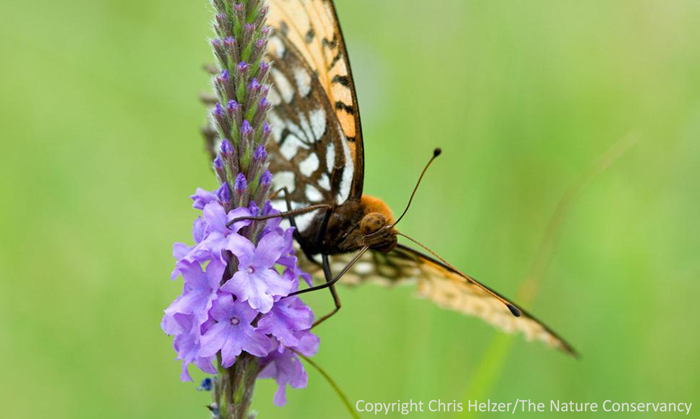
Hoary vervain is a wildflower found mostly in grazed prairies in southeastern Nebraska, and one that is extremely important to pollinators, including regal fritillary butterflies.

Within those same grazed and hayed prairies, we also did some sweep netting of insects.  We targeted our sweeping so that we collected insects off of the same plant species across all of the sites (using a couple different plant species).  We wanted to see whether the insect communities using a particular plant species were essentially the same at all of the prairies.  They’re not.  What we found was that the insect data were even more chaotic looking than the plant data.  Very few insect species were found at all, or even the majority of sites.  That’s likely due to the relatively small amount of sampling we did.  But even with our small samples, it was clear that a large number of species were abundant at one site but absent from many others.  The other strong pattern was that the total abundance of insects was often quite a bit higher – among many species – at the sites we’d considered to be “lower quality” based on our plant data.

There are a number of reasonable – even obvious – explanations for these variations among prairies, including soil type, topography, past management, random chance, etc.  But more important are the lessons that come from recognizing those differences.  First, I think the differences demonstrate the importance of management.  Surely some of the differences between the vegetation composition in those 24 hayed prairies stem from variations between sites relative to the timing and frequency of annual haying, the consistency of timing and frequency over many years, and whether or not the prairies are fertilized.  Later season haying, for example, allows more (and different) plant species to complete their life cycle prior to cutting than early season haying (or twice-annual haying).  Completing their life cycle now and then is critical for the long-term survival of plants because it allows them to reproduce and store energy for the coming winter.

The existence of a combination of hayed and grazed prairies within the landscape is also important.  Because there are plant species (and likely insect species) that do better under grazing management than haying management, and vice versa, having both types of management within a neighborhood can maintain more biological diversity than either of the management types alone.  Of course, managing each of those prairies with a combination of fire, grazing, and perhaps haying, might allow even more plant and insect species to persist on each prairie – although the local abundances of some species might go down because they would lose the consistent management that had allowed them to become dominant.

From a conservation standpoint, one big lesson is that it’s not sufficient to simply rank prairies by floristic quality, size, or other measurements, and act to “protect” the best of those.  In order to conserve the complete diversity of life in the southeastern Nebraska prairies, we need to keep as many of the remaining prairies as we possibly can.  While the grazed sites might look less attractive to a botanist driving by compared to hayed prairies full of compass plant and blazing star flowers, the aesthetic preferences of botanists don’t necessarily reflect the biological needs of ecosystems.  While there was surprising variation between the hayed prairies we looked at, a very significant degree of biological diversity would be lost if the grazed prairies were plowed up.

Even if it were the desired strategy, there’s no way conservation organizations would or could buy up a significant number of the grasslands in southeastern Nebraska, so working collaboratively with the landowners of those prairies is of the utmost importance.  Relying on private landowners to conserve prairies has been a tough pill for many conservation organizations to swallow – including the one that employs me – but during the last several decades most have recognized that need.    The next trick is to refine our skill at working with those landowners without coming across as know-it-all biologists.  The most successful private lands liaisons from the conservation community have been those who listen well, recognize the importance and value of individual landowners’ priorities (remembering that it is THEIR land), and build relationships on mutual trust.  Through those relationships, we can alert landowners to aspects of their prairies and management options they might not be aware of, but the decisions about how to manage their sites still have to be left to the landowner.  Clearly, that will result in some prairies being managed in ways that make some of us uncomfortable, but we don’t want all the prairies to look the same anyway, right?