From the Ashes

Last Friday, I wandered through the small prairie we burned back on March 10.  Even though it is still very early spring, there were already a number of prairie plants popping out of the ground.  I posted photos of this site right after the fire was completed.  Today, I’m posting some photos taken 10 days later at the same site, along with some discussion of the impacts and effectiveness of prescribed prairie fires.

Purple poppy mallow (Calliroe involucrata)

Purple poppy mallow (Callirhoe involucrata) begins its new year of growth.

Most prairie plants grow from belowground buds, making them much less vulnerable to fire than trees and shrubs, which start their new growth above ground – from buds at the tips of branches.  When fire burns woody plants, those aerial buds and living tissue are destroyed, stressing the plants and forcing them to start over from ground level.  However, fire (at least during the dormant season) simply burns up the old stems and leaves of non-woody prairie plants, causing no injury.  Instead removing those dead stems helps stimulate growth in the coming season, especially via increased sunlight, which warms the ground and is available to new shoots as they first emerge.

Scribner's panicum (Panicum oligosanthes), a native cool-season grass.

Scribner’s panicum (Panicum oligosanthes), a native cool-season grass.  In this photo, you can see that the tips of the grass leaves had just started to grow when the fire came through ten days earlier.  Since the leaves grow from the base, those burned tips don’t impede plant growth.

Increased sunlight hitting the ground has helped the small area we burned on March 10 green up much faster than unburned prairie nearby.  Our main objective for the fire was to remove thatch in order to improve the effectiveness of planned herbicide treatment/re-seeding of some smooth brome patches within the small prairie.  The brome is responding very strongly to the fire, and its rapid growth (and the absence of thatch to intercept spray droplets) will make the grass more susceptible to our herbicide treatment.  However, since many other plants are also popping up, we’ll carefully spray only the thickest patches of brome where no other species are growing.

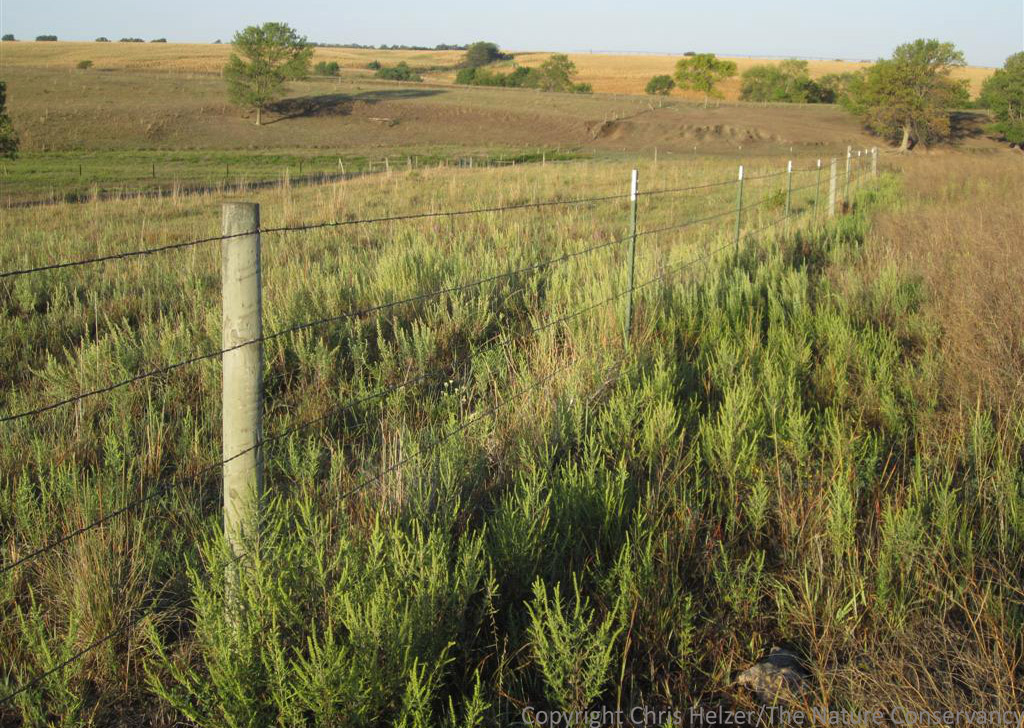
Green sage (Artemisia campestre)

Green sage (Artemisia campestre) growing next to its old stem from last year.

Prescribed fire can be a useful tool when trying to temporarily flip the balance of power from cool-season invasive grasses (smooth brome, Kentucky bluegrass, etc.) to native warm-season grasses (big bluestem, indiangrass, etc.).  However, timing is critically important.  A dormant season or early spring fire is actually counterproductive unless it is followed by herbicide treatment, mowing or grazing.  Those early fires stimulate the growth of cool-season plants – including smooth brome and Kentucky bluegrass – giving them a big advantage over later-season plants which won’t start growth until late April or early May.  By the time those warm-season plants start growing, the early plants will have had a month or more to extract soil moisture and nutrients, and will be big enough to dominate competition for light and root space.

If we’d wanted to suppress smooth brome solely with fire (and not follow up with herbicide), we would have waited until late April or early May to burn.  That late season burn would have stressed the actively-growing brome and bluegrass and provided direct sunlight to freshly emerging shoots of big bluestem and other warm-season grasses.  More often, we combine periodic fire and grazing to suppress brome and bluegrass and facilitate greater plant diversity.

Here's one of the grasses we would like not to see coming back after a fire - Kentucky bluegrass (Poa pratensis).

Along with smooth brome (Bromus inermis), Kentucky bluegrass (Poa pratensis) also responded well to the fire.  This particular plant will likely have a very good year, but the brome and bluegrass in the thicker patches of this prairie will be sprayed with glyphosate herbicide and re-seeded.

The regrowth of prairie plants after fire can seem almost magical.  Fire is absolutely an important natural process and a very useful tool for prairie managers.  However, prescribed fire is not magic, and doesn’t automatically lead to better prairies.  As with any tool, fire has to be applied thoughtfully (and carefully!) in order to meet objectives.

The timing of fire dramatically impacts the way prairie plant communities respond.  Early spring, late spring, summer, and fall fires each have different effects on plants, and those effects are also influenced by soil moisture, the presence/absence of grazers, and many other factors.  Prescribed fire can also have serious impacts on some animals, even during the dormant season.  Many invertebrates, for example, overwinter in the aboveground plant stems or thatch, making them very vulnerable to fire. It’s important not to burn an entire prairie at once – especially if that prairie is isolated from other grasslands.
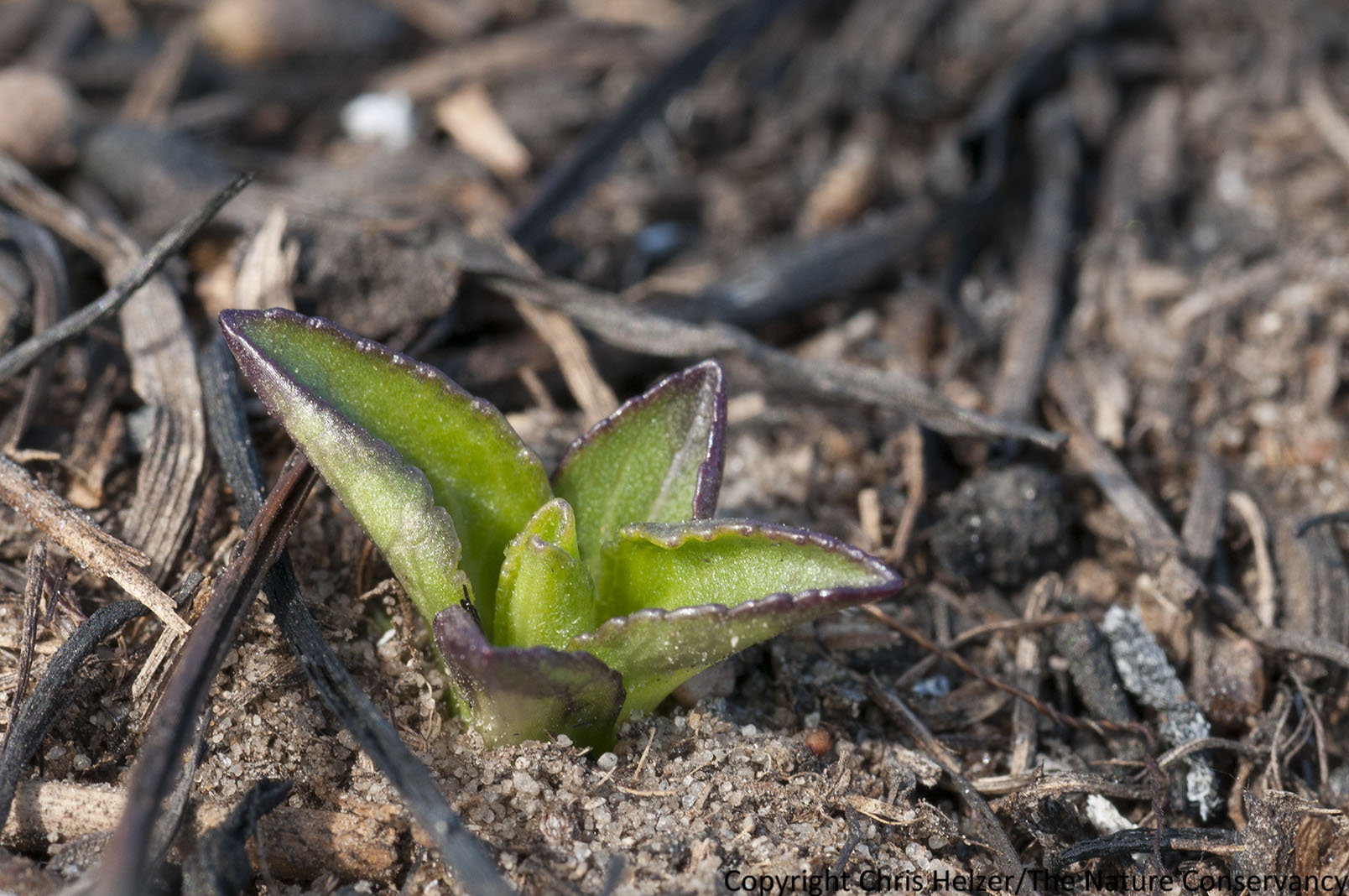
I'm not sure what species of wildflower this is.

I’m not sure what species of wildflower this is but I’m looking forward to finding out as it gets bigger!

Fire plays many critical roles in prairie ecology – suppressing woody plants, removing thatch, stimulating microbial activity, aiding in nutrient cycling, and more.  However, while fire is important and its effects are both useful and aesthetically pleasing, it is not automatically positive.  Safe use of prescribed fire requires training, experience, and caution.  The effective use of fire requires clear objectives and careful planning that ensures those objectives will be met.

As I’ve discussed before, the actual process of conducting a fire can be very stressful.  However, once the smoke clears and I can relax, its easy to appreciate both the beauty and ecological benefits of prairie fires.  The emergence of bright green prairie plants through black ash is one of my favorite sights, and I love watching plant and animal communities respond and adapt to changing habitat conditions.

In prairies, rising from the ashes is more than a metaphor – it’s a way of life.
 

Hubbard Fellowship Blog – The Trouble With Fences

This post is written by Dillon Blankenship, one of our two Hubbard Fellows.  

Back in December we kept pretty busy with fence work. The barbed wire fences at a few sites needed to be repaired, and some had to be taken down and rebuilt from the beginning. Single wire electric fences were taken out altogether and will be replaced this spring to accommodate new grazing configurations.

The barbed wire fences we removed were old and in bad shape. Their wire was loose and rusty; t-posts were bent over or leaning.

When we acquire properties, fences are often in bad shape.  This one has multiple layers and ages of barbed wire and needs to be removed and replaced.

When we acquire properties, fences are often in bad shape. This one has multiple layers and ages of barbed wire, has shrubs and trees grown into it, and needs to be removed and replaced.

I am struck by how dramatically the landscape is changed by the mere removal of a fence. Despite the remaining row of interspersing trees or scraggly smooth brome, fencelessness returns a semblance of the infinite horizon. Of course, I want to see the trees and brome erased too, but these things take time and getting the old fence out of the way begins the process.

Even when the next piece of land is a dusty field of corn stalks – much less imposing post-harvest- the lack of fence is liberating. I am free to view the landscape as it once was and I imagine that wildlife can more freely roam about the planet.

Though it is easy to romanticize the open range, fences obviously have some utility.

Barbed wire fencing is a relatively inexpensive way of delineating property boundaries. It confines one’s own livestock and/or protects crops and pasture from being damaged (by stray vehicles, your neighbor’s cattle, etc.). In our restoration work on the Platte we use fences not just to keep cattle in, but also (using single strand electric) to manipulate where and when they graze to suit our particular management objectives – such as controlling certain plant species or promoting others while maintaining a diversity of habitat types.

m

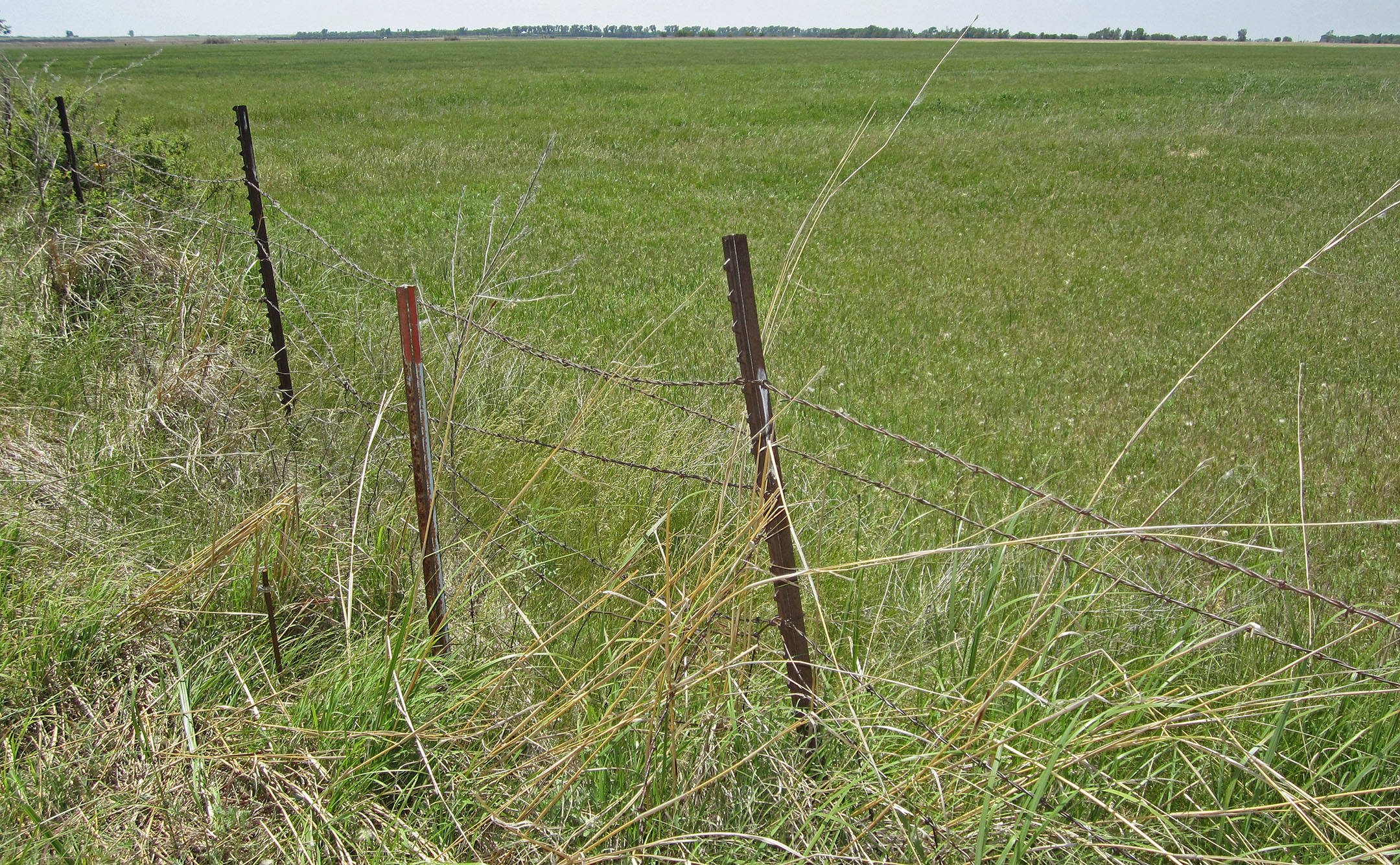
Barbed wire fence is the most common type of fence used in most pastures.  It is strong and effective.  It is also visually prominent, and whether or not it is attractive depends upon your point of view.

Though these are compelling reasons to keep fences around, I remain frustrated by the inconveniences they create. I have already mentioned the aesthetic inconvenience. To my eye – even with agriculture playing a prominent role in the landscape mosaic – the Plains look more expansive and beautiful without fence lines. The image of an unfenced pasture is striking for its rarity.

Fences can also be problematic for certain wildlife. While deer are pretty good at jumping over most fences, animals further west like bighorn sheep and pronghorn need special accommodations for safe passage. Free-roaming bison, of course, have little hope in our highly fenced world – we must confine them to their own big area saying “this is yours, but go no further.” Even birds are affected, sometimes colliding with and becoming entangled in barbed wire. Field fences, though not insurmountable, present their own challenges for ground dwelling creatures.

This duck got hung up and died on a fence along the edge of a wetland.

This duck got hung up and died on a fence along the edge of a wetland.

My biggest complaint is that fence lines are often poorly managed. They can be difficult to work around when treating invasive species, which makes them prime habitat for encroaching trees and exotic plants. Substantial tree lines are common along fences in central Nebraska. In many cases, I suspect the fence came first. While a fence itself is usually not too problematic from a grassland habitat perspective, fences that grow up with trees begin to act as fragmenting agents – deterring grassland bird nesting and generally diminishing the openness favored by grassland species.

So where does that leave us?

There are already a lot of good ways to mitigate fence impacts for wildlife – increasing visibility for birds and using smooth wire with particular spacing for large mammals. Sometimes wooden fences are better alternatives, though more resource intensive (got any spare cedars?). While these address the wildlife objection, they don’t do much for the aesthetic or management elements.

Single-strand, smooth wire, electric fences are simple and temporary, offering reprieve from the oppressive four-strand barriers and better accessibility for management – you can drop the wire and drive right across. Moreover, when you move these fences every year like we do, fence-line management is less of a problem because the following year any given line-site will be back in the management regime of fire, grazing, and manual treatment. This system suits my preferences well, but its greatest assets are also its ultimate downfall.

Even when electrified, single wire fences are often not enough to keep cows in – and, I imagine, never keep in sheep or goats. Also, deer are pretty good at going right through, knocking the wire off the insulators – which is hard to monitor when you have a lot of wire out there. I was going to say that their temporary-ness was another drawback – a guarantee that you have to work fence every year. However, tree and exotic species management need to happen every year anyway, so maybe it wouldn’t be that much work and I feel like removing 20 years of trees from an unmaintained fence probably takes much more time than monitoring and moving temporary fences.

Bison fence at The Nature Conservancy's Broken Kettle Grasslands in Iowa.

Bison fence at The Nature Conservancy’s Broken Kettle Grasslands in Iowa.

My dream of fencelessness is really thwarted at scale. At places like TNC’s Niobrara Valley Preserve with over 50,000 acres to manage, you really just need a sturdy fence that doesn’t have to be constantly checked… or so I thought. I recently learned about innovations in fencing that have been experimented with over the last decade. I had been thinking that something like the invisible fences people use for pets might be an interesting option to scale up, but there are better systems already in play.

Instead of building (or burying) an actual fence, there are folks putting GPS collars on cows and then using digital mapping software to “draw” fences on the landscape which deliver a slight shock (like an electrified fence) when cows cross the satellite-imposed boundary. These digital fences can be placed at property boundaries, around sensitive vegetation or aquatic features, and across a pasture to suit a particular grazing regime – all with the swipe of a computer cursor. It could be modified on the fly, which is even easier now that so many people are carrying smartphones (this technology is already being utilized for things like increasing center pivot irrigation efficiency via monitoring and adaptive management). Doesn’t that sound incredible? No fences breaking up the landscape (which is aesthetic, but also means less work for ranchers), safer corridors for wildlife, less potential for tree encroachment, and better accessibility for managing invasive weeds. Cool.

The system is bound to have its own problems – technical glitches will happen on occasion (with the software or and the collars), there will be new opportunities for trouble-makers to tamper with private property (“digital cattle rustlers”), star-up costs, you name it – but I really like the potential something like this has for prairies and the ranching community.

Nonetheless, most of us aren’t quite there yet, which brings me back to the old-fashioned fence. For now I guess I’ll have to get over it and get on to other things; just manage my own fence better and become hardened to the unavoidable taunting of unnatural tree lines and fence rows on the landscape.

It feels good to vent a little bit here. As it warms up I cease writing and return to work on the post and wire repairs. I return to the prairie and reflect on these musing, “Alas, this is a necessary, if unfortunate evil” and the new fence goes up. I find solace that its days could be numbered.

ENPO130523_D002