
Photo of the Week – August 13, 2015

Nebraska has 108 species of grasshoppers.  They come in a wide variety of sizes, shapes, and colors, and generally speaking, the further west you go in the state, the more species you can find.  While on a short trip to the Nebraska Sandhills last week, I was fortunate to see two of the most beautiful of Nebraska’s grasshopper species.

Lubber grasshopper. Valentine National Wildlife Refuge, Nebraska.

Plains lubber grasshopper (Brachystola magna). Valentine National Wildlife Refuge, Nebraska.

I saw several plains lubber grasshoppers (aka homesteaders) in the prairie.  These huge flightless grasshoppers are about the size of mice (more than two inches long, and very thick).  They feed primarily on wildflowers, including sunflowers and hoary vervain (Verbena stricta).  According to Grasshoppers of Nebraska, they are not crop pests but in years when their population soars, they can present a hazard to drivers because their bodies can make roads slick.  Think of that!
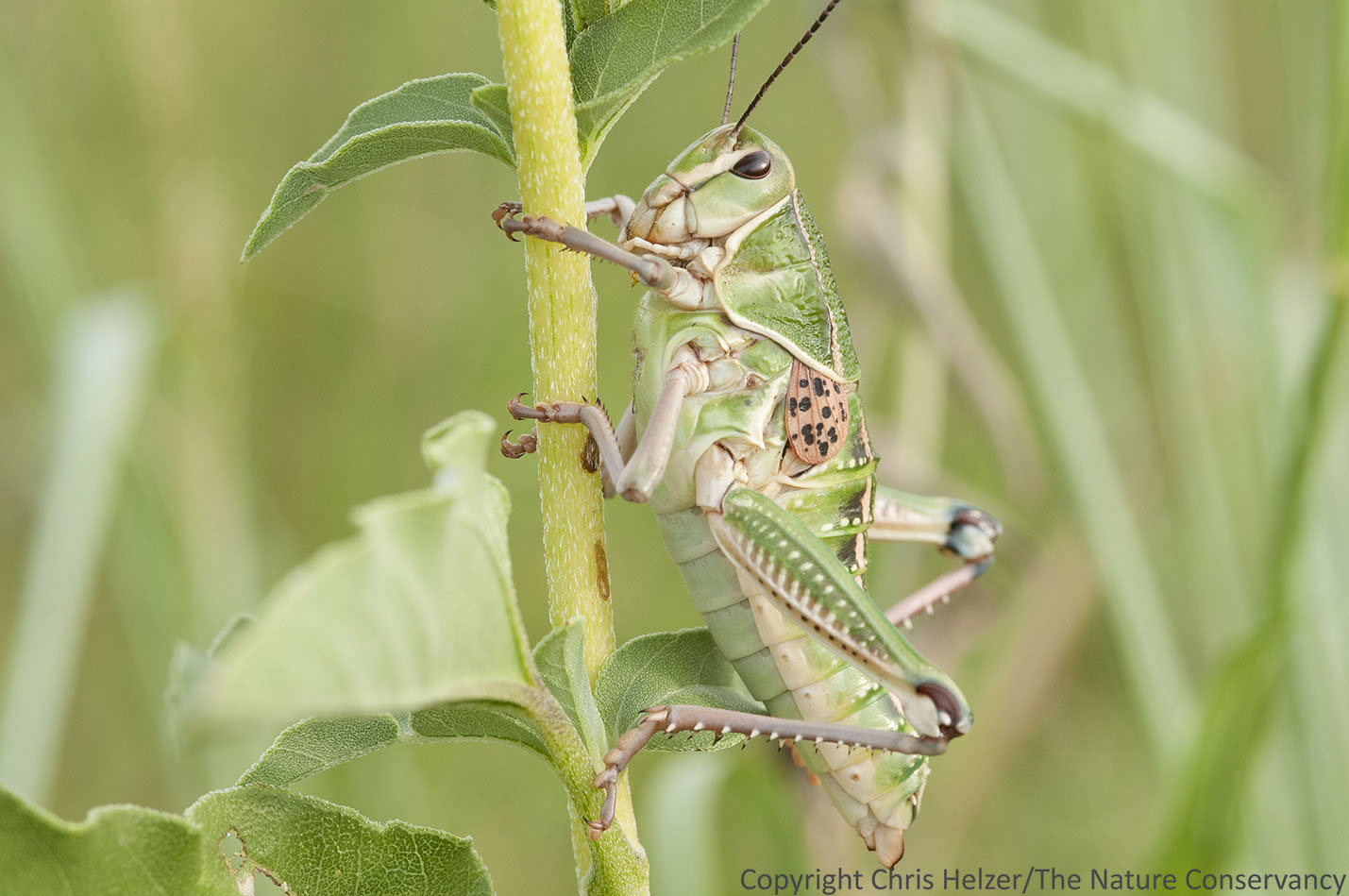
Lubber grasshopper. Cherry county ranch of Jim VanWinkle, Nebraska.

Here is a plains lubber on its favorite (according to some sources) food – an annual sunflower (Helianthus petiolaris).  Cherry County, Nebraska.

I also enjoyed the chance to see a painted grasshopper (Dactylotum bicolor), a species I first noticed last year on a trip to western Kansas.  This gorgeous creature might be the easiest grasshopper in Nebraska to identify – as far as I know, there isn’t anything else in the state that looks remotely like it.  Like the lubber, the painted grasshopper eats primarily wildflowers, particularly false boneset (Brickellia eupatorioides).  It likes habitat with lots of exposed soil, which is convenient for those of us trying to find and photograph them.

Painted grasshopper at the Valentine National Wildlife Refuge. Nebraska.

A painted grasshopper at the Valentine National Wildlife Refuge. Nebraska.  The colors and patterns on this species make it impossible to confuse with others.

Grasshoppers, and katydids, which look like grasshoppers but have much longer antennae, are a fascinating group of insects.  They have interesting and complex communication strategies and each species has its own set of dietary preferences – some are specialists on just a few plant species and others are generalists.  Only a very few are considered to be pest species, and most of those are simply native species that have adapted well to the abundant food humans provide in the form of monoculture row crops.

Perhaps most of all, the sheer abundance and biomass of grasshoppers make them ecologically important in grasslands.  If you collected all the grasshoppers from a prairie, their biomass would equal that of the bison or cattle in the same prairie.  As such, they are a major food source for many other species, including many birds, and major herbivores that influence plant communities in complex ways.

Grasshoppers are also very visually appealing if you take the time to look closely at them.  The plains lubber and painted grasshopper are particularly pretty, but every grasshopper species has its own beautiful combination of colors and patterns.  Go out and find your favorite today!

Double flowered sunflowers

When you look at a sunflower, you’re really looking at a composite of tiny flowers, or florets.  The same is true for asters, daisies, and other members of the composite family of plants.  The colorful “petals” of a sunflower are actually a series of tiny florets, called ray flowers, and the seed-producing dark center is made up of lots of disk flowers.  Together, they join together and function as one large flower that attracts pollinators and produces seed.

Stiff sunflower.  The Nature Conservancy's Platte River Prairies, Nebraska.

This sunflower has two kinds of flowers – ray flowers that look like yellow petals, and small disk flowers in the center.

This is how sunflowers are “supposed” to look.  However, you will occasionally find a sunflower that looks more like a chysanthemum, with yellow ray flowers across most or all of the face of the flower head.  Botanically speaking, this is called “double flowering”.  Horticulturists find and breed double flowering varieties of sunflowers and other composites, and you can find them at many nurseries and other plant stores.

Maximilian sunflower.  TNC Bluestem Prairie, Minnesota.

A double flowered Maximilian sunflower (Helianthus maximiliani) at The Nature Conservancy’s Bluestem Prairie in Minnesota.  Most of the disk flowers have been replaced by ray flowers.

When we were in Minnesota a few weeks ago, we saw a fair number of double flowered Maximilian sunflowers at The Nature Conservancy’s Bluestem Prairie.  I don’t remember seeing so many examples in one prairie before, but maybe I just haven’t paid close attention.  The abundance of them made me curious to learn more, so I did a quick internet search when we got back to Nebraska, and emailed a few botanist friends for more information.  The best information I found was related to a 2012 PLos Genetics journal article in which scientists described their discovery of the particular mutation that causes double flowering to occur.  You can read descriptions of the research here and here.

Maximilian sunflower.  TNC Bluestem Prairie, Minnesota.

Extra “petals” can be awfully pretty.

You might think of genetic mutation as something bad, but mutations are actually very common and mostly benign (and don’t affect form or function).  Now and then, a mutation can cause serious problems for an organism, but other times it can generate variations in a DNA sequence that turn out to be advantageous.  Double flowering seems to be somewhere in the middle.  On one hand, producing fewer disk flowers means the plant has fewer opportunities for pollination and seed production.  On the other hand, extra ray flowers could make a plant more attractive to insect pollinators and increase visitation.  In the case of the Maximilian sunflowers at Bluestem Prairie, the mutation doesn’t seem too disastrous, at least based on the number of plants we saw that have the trait.

I’m glad – it sure is pretty.