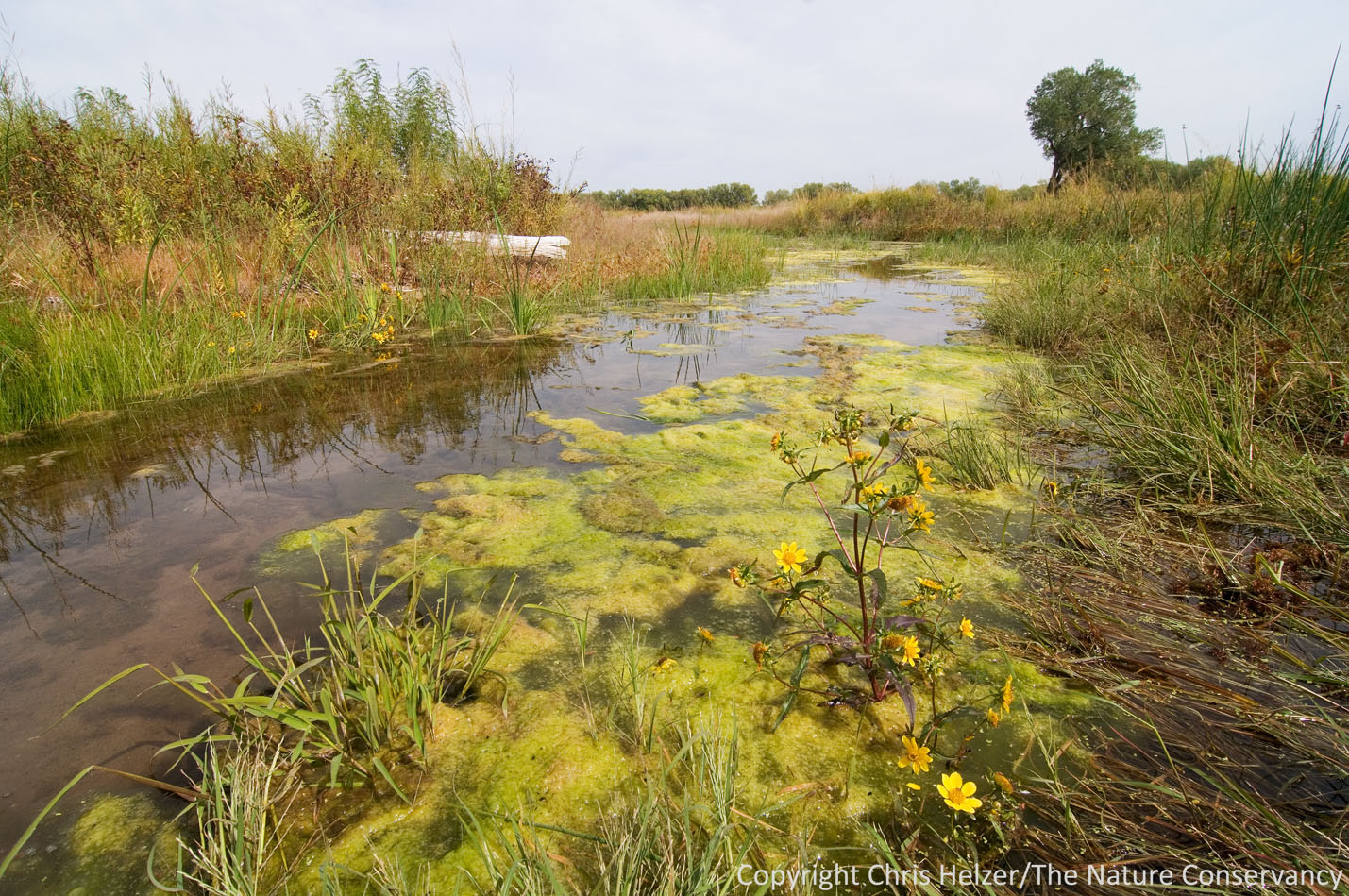
This week, one of our prairies gets a new name, thanks to some generous donors, including the J.A. Woollam Foundation, the Claire Hubbard Foundation, the Howard and Rhonda Hawks Foundation, and many others. The new name, more descriptive than celebratory, is simply this: The Platte River Sandhill Prairie.
The site is actually the combination of a 60 remnant (unplowed) prairie and 110 acres of adjacent cropfield that we seeded with 162 species of prairie plants in 2002. The Platte River Sandhill Prairie sits on a range of sandy hills along the south edge of the Platte River Valley. Most of the historic prairie in those hills has been converted into center pivot-irrigated cropland now, so our 170 acres of floristically-diverse grassland is especially valuable.
Because of this year’s drought, the prairie is not wearing its most showy colors right now. Most of the grasses have been dormant since July, and very few fall wildflowers are blooming. However, as with all prairies, what you see today is not what you’ll see tomorrow, nor what was there yesterday or last year. As a celebration of the Platte River Sandhill Prairie, its beauty and diversity, and the generous donors who continue to support our conservation work, I’ve put together a series of photographs that show this prairie in all its glory. Long-time readers of this blog will recognize most, if not all, of these photos from previous posts, but might not have realized that they were all from the same prairie.
Click on any of the below photos to see it larger, and then use the arrows to scroll through the rest of the photos. I apologize for the quality of a few of them – some are poor quality scans of slides, but were useful for showing different stages of growth in the prairie.

A landscape view of the sandhills in December

A young mouse coming out of its nest.

Sun sedge (Carex heliophilus) is one of the first flowers of the spring.

Showy evening primroses in the restored sandhill prairie.

Parasitic dodder on Canada goldenrod.

A prescribed burn in 2011.

A pocket gopher trail through burned prairie.

Wind flower (Anemone carolinense) in the spring after a summer fire.

Showy evening primrose the year after summer fire and grazing.

The restored prairie in its fifth growing season.

Prickly pear after a fire.

Jumping spider on shell leaf penstemon.

A class trip from Creighton University in Omaha.

Gerry Steinauer teaching plant identification to a Master Naturalist class.

Pussy toes blooming in the early spring.

Rose hips in winter prairie.

Frost and snow on prairie and fence.

Hairy puccoon in the remnant portion of the sandhill prairie.

Bilobed looper moth in the spring of 2012.

Annual sunflowers are one of the few flowers blooming during the drought of 2012.
Thank you to everyone who supports the work of The Nature Conservancy along the Central Platte River in Nebraska. Please don’t be strangers – we’d love to have you come hike our trails and see the results of your support firsthand.
.