Last week, I had an experience that doesn’t come often to a prairie ecologist. I participated in a tree planting project. Well ok, we weren’t exactly planting trees, but we were laying the groundwork.

Collecting cuttings from cottonwood trees for a Missouri River restoration project. This is a panoramic made from two photos stitched together. Click on the photo to see a larger version.
It’s kind of a long story.
Over the last few years, The Nature Conservancy has been working with the Natural Resources Conservation Service (NRCS) on wetland restoration projects along the Missouri River in eastern Nebraska. Tyler Janke, a Conservancy employee, has – among other things – helped design, implement, and evaluate restoration projects implemented through the Wetland Restoration Program (WRP). One of Tyler’s major contributions has been to facilitate the use of high-diversity seed mixes at a number of sites. I’ll write more about that effort another time.
As the number of WRP projects has grown along the Missouri river, one important lesson has been learned by the Conservancy, the NRCS, and other partners. Although the traditional model of wetland restoration in Nebraska has been to convert wet crop fields to wetlands dominated by grasses, sedges, and other herbaceous plants, that model has turned out to be inappropriate in many places. Why? Because most herbaceous plants can not survive the kind of frequent and severe flooding that occurs in some portions of the Missouri River floodplain.
So what to do? Trees. Tyler and others have modeled the floodplain and identified areas where frequent flooding and sediment deposition are likely, and those areas are being proposed as places where cottonwood woodlands should be. Cottonwood woodland has disappeared from much of its historic range along the Missouri River, and what remains is largely stands of old trees. Over time, the lack of young and middle-aged stands of cottonwoods will lead to a drastic change in habitat for many species in the Missouri River valley.
No problem, then. We need more cottonwood woodlands, we can’t get grass to survive in many places anyway – let’s just plant those areas to cottonwoods, which are better at surviving flooding and sediment deposition. Well, as it turns out, there are quite a few questions about how best to do that, and what the cost effectiveness of various methods are. That’s where Tyler comes in again. Through a partnership between the Nebraska Forest Service, the Arbor Day Foundation, and The Nature Conservancy, Tyler is leading an effort to create experiment and demonstration sites for Missouri River cottonwood restoration. Funding for the project comes from the U.S. Forest Service, the Arbor Day Foundation, and State Wildlife Grant funding through Nebraska’s Natural Legacy Project.
I’ll summarize the entire project design in a future post, but suffice it to say that over the next three years, we plan to establish 300 acres of new cottonwood woodlands on WRP lands. We’ll experiment with a variety of methods, including the planting of cottonwood cuttings and seedlings. And that – finally – brings us back to what I was doing last week.
For the first year of the project, Tyler needs to come up with 30,000 cottonwood cuttings. This spring, those cuttings will be put in the ground, and hopefully most will grow into new cottonwood trees. Should be great. First, however, we need to find 30,000 cottonwood cuttings!
It turns out it’s not difficult to get cuttings that can grow into trees. You just need to cut 8-12″ sections from stems that grew during the previous growing season. When those stems are put in the ground, the buds on the stems will facilitate the process of transforming them into new trees. In order to get 30,000 cuttings, Tyler (with the help of others) has organized several volunteer workdays this month. Last week, I joined other staff from The Nature Conservancy and the Arbor Day Foundation in a joint effort to collect as many cuttings as we could on a wet foggy winter morning. The following photos are from that day.

It was a muddy ride out to collect cottonwood cuttings.
.

Tyler found a site where a large number of young cottonwoods had grown where they weren't wanted. Tyler cut those trees down so our crews could come along and easily harvest the active growing tips of their branches.
.
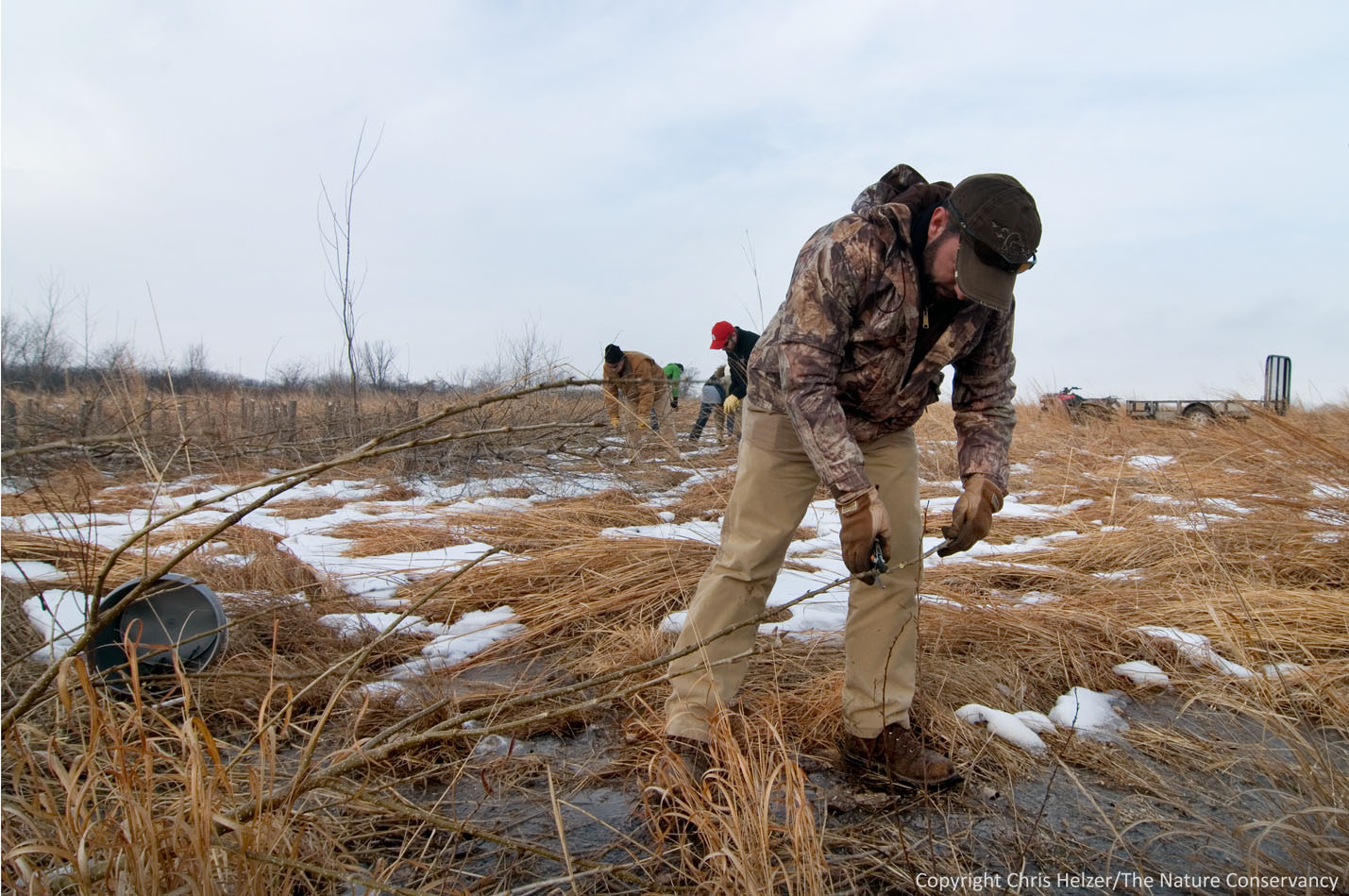
Matt Harris of the Arbor Day Foundation harvesting cottonwood cuttings.
.

Cuttings were collected in buckets and hauled to a central collection point.
.

A batch of cottonwood cuttings, counted, banded, and ready to store until they are planted in April. This tub contains several thousand potential new trees. The total count for the day's harvest was 12,500 cuttings.
The cuttings we harvested will be planted later this spring, and their success will be compared to the other methods of cottonwood establishment Tyler is testing. The experience of others, and some pilot work we’ve done, shows that cuttings are a pretty dependable way to establish trees – so hopefully the majority of those 30,000 cuttings will turn into new trees.
Since much of my career has been spent removing trees (including a lot of cottonwoods) from prairies, this is a new experience for me. I completely understand and agree with the logic and strategy of the project. It’s just a little bit difficult to adjust my mindset. So far, I’m doing fine. We’ll see how I feel when we actually put the trees in the ground…
.