
Photo of the Week November 5, 2010

Stiff goldenrod (Solidago rigida) seeds in the fall.

Autumn prairies are characterized by golden colors and abundant fluffy seeds.  Goldenrods, asters, gayfeathers and many other species become especially conspicous this time of year because their light-colored seed heads stand out strongly against the rusty browns and yellows of the rest of the prairie.

We finished our annual seed harvesting last week and mixed seeds this week.  Most of our seed harvest now goes toward overseeding of degraded remnant prairies because we’ve already converted almost all of the crop land we own.  The focus on remnant prairie restoration significantly changes the way we harvest seeds.  Rather than trying to harvest from 200-230 species to capture the entire range of plant diversity possible, we can focus on getting larger amounts from fewer species.  It also eliminates the need to harvest from some of the more difficult to obtain species like violets, pale poppy mallow, and many sedges.  Those species tend to persist in degraded prairies in the face of chronic overgrazing and broadcast herbicide application that takes out many larger and more show (and easier to harvest) species.
Fall Harvest

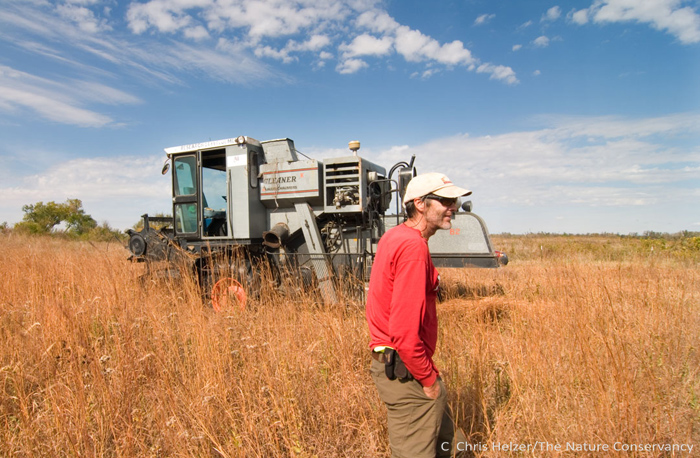
It’s harvest time!  When our neighbors start filling their combines with corn and soybeans, we know it’s time to harvest grass seed from our prairies too.  This year we don’t have a need for large amounts of seed from tall grasses,  so we’re not  combining our own seed.  Instead, we’ve been able to provide harvest sites to Prairie Plains Resource Institute.   They’re harvesting big bluestem, indiangrass, switchgrass, prairie cordgrass, and other prairie species from our sites to use in restoration work around eastern Nebraska.  In return, they’re giving us a share of the seed – in particular, a big load of  mixed seed from one of our more diverse restored prairies.  We’ll be using that seed to overseed some degraded remnants this winter.


Bill Whitney, of Prairie Plains Resource Institute, harvesting grass from a restored prairie at The Nature Conservancy's Derr Tract. Central Platte River, Nebraska.


While we’re getting our fair share of seed in return for letting Prairie Plains harvest from our prairies, I feel really good about being able to give something back to them for other reasons.  Bill Whitney has been a huge influence on my career (and that of many other ecologists).  He pioneered prairie restoration in Nebraska and I feel honored to have been able to learn his methods directly from him.

In addition, Bill was instrumental in getting The Nature Conservancy started on high-diversity prairie restoration back in the early 1990’s, and our earliest restoration sites were planted by Prairie Plains.  Much of the seed Bill’s been harvesting this week is coming from sites that he initially harvested seed for and planted 12-15 years ago.  So, really, we’re just letting him reap what he sowed.

If you’re interested in prairie restoration, you too can learn directly from Bill.  Gerry Steinauer, with the Nebraska Game and Parks Commission, took the initiative to capture Bill’s methods, along with input from me and others, and put it all into complete and readable guide.  You can download the guide here:  http://prairienebraska.org/Restoration%20Manual.pdf