I’ve had too many hours in front of the computer this week and my eyes were complaining this morning. I looked outside and saw that some high clouds were nicely-diffusing the sun and decided that was enough of an incentive to take a prairie break.
I scooted over to Lincoln Creek Prairie and spent about a half hour looking for milkweed seeds, milkweed bugs, and other treasures before heading back to the computer. It was just what I needed. Here are some of the things I found.
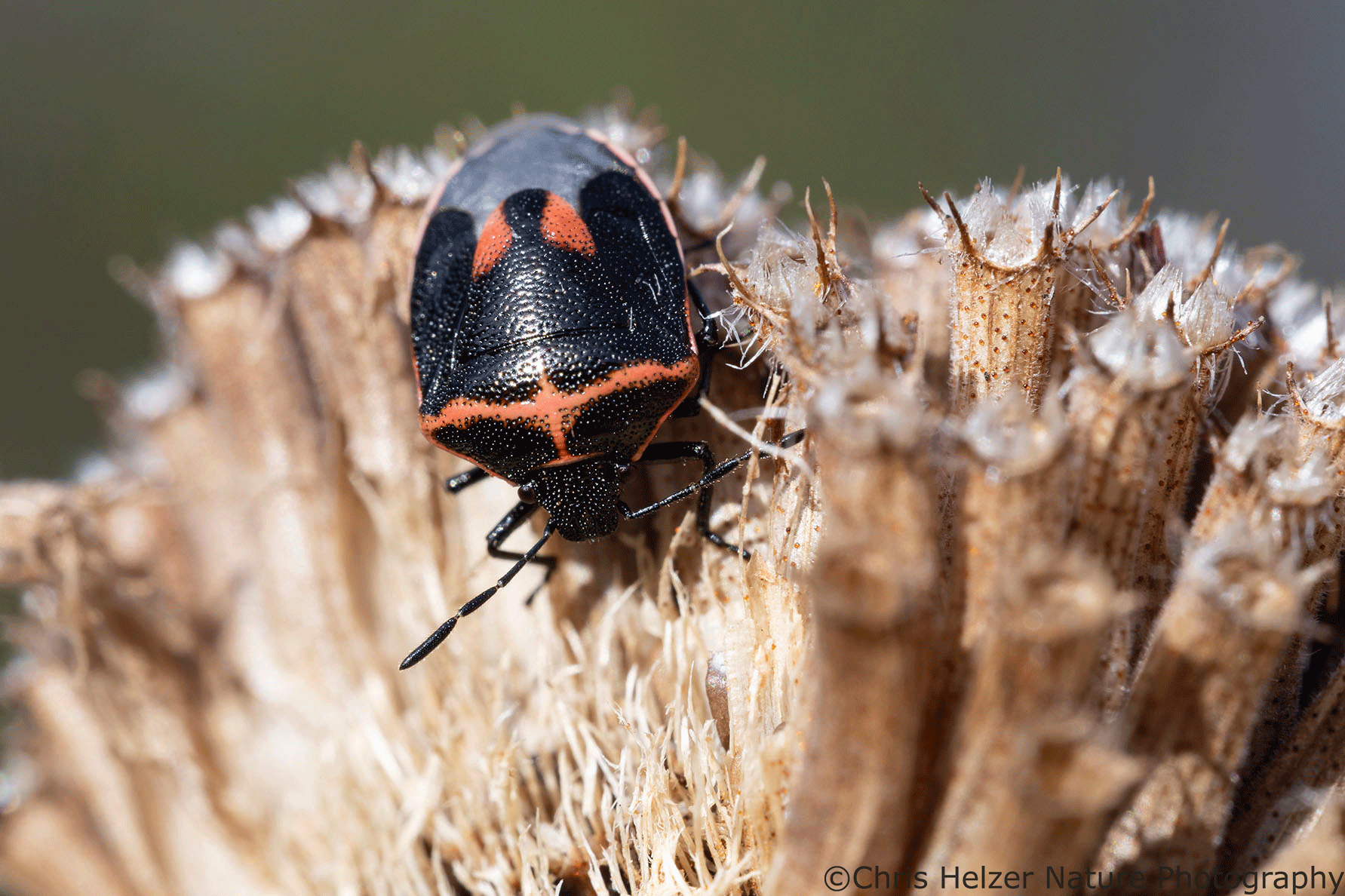
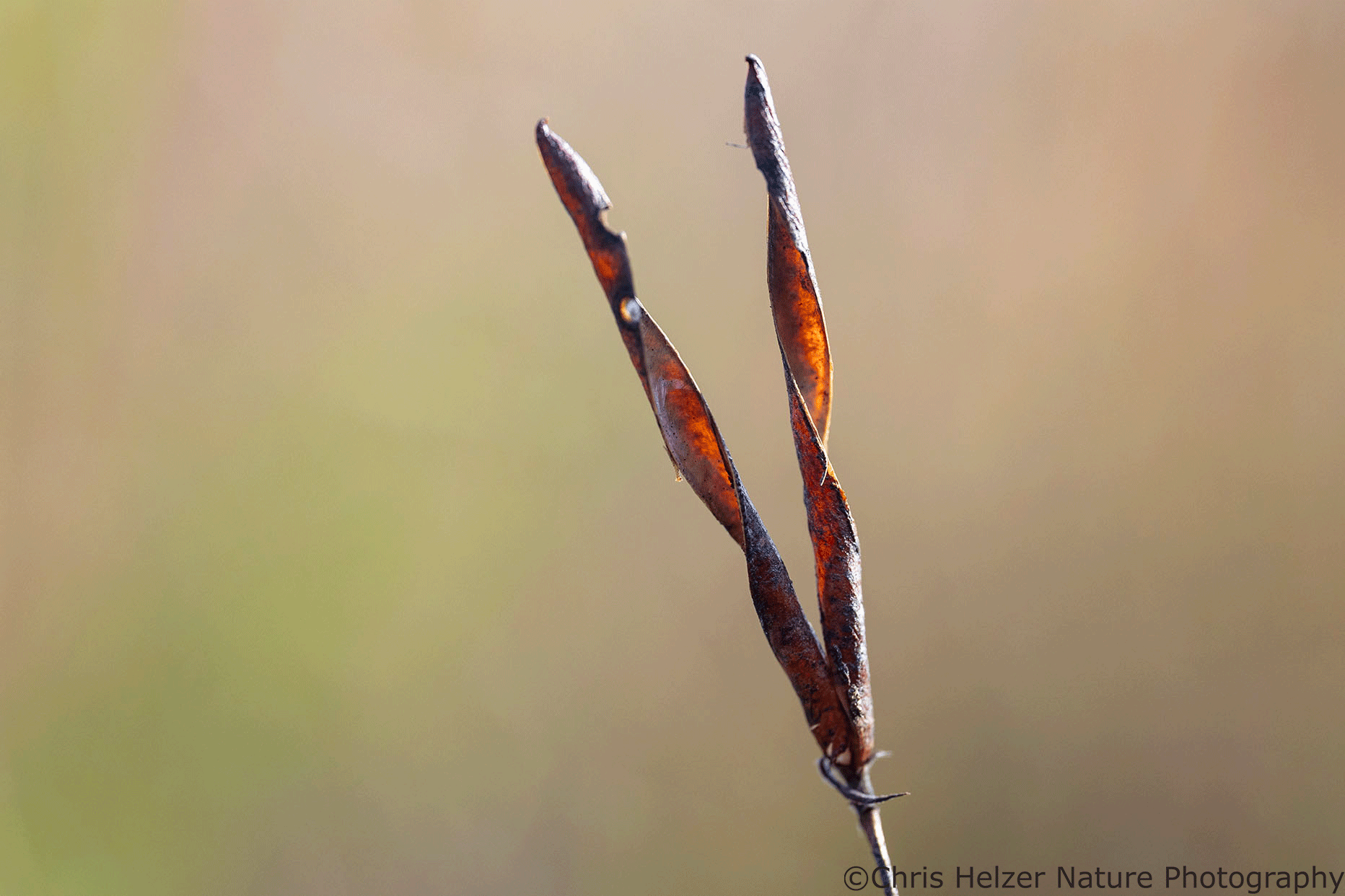
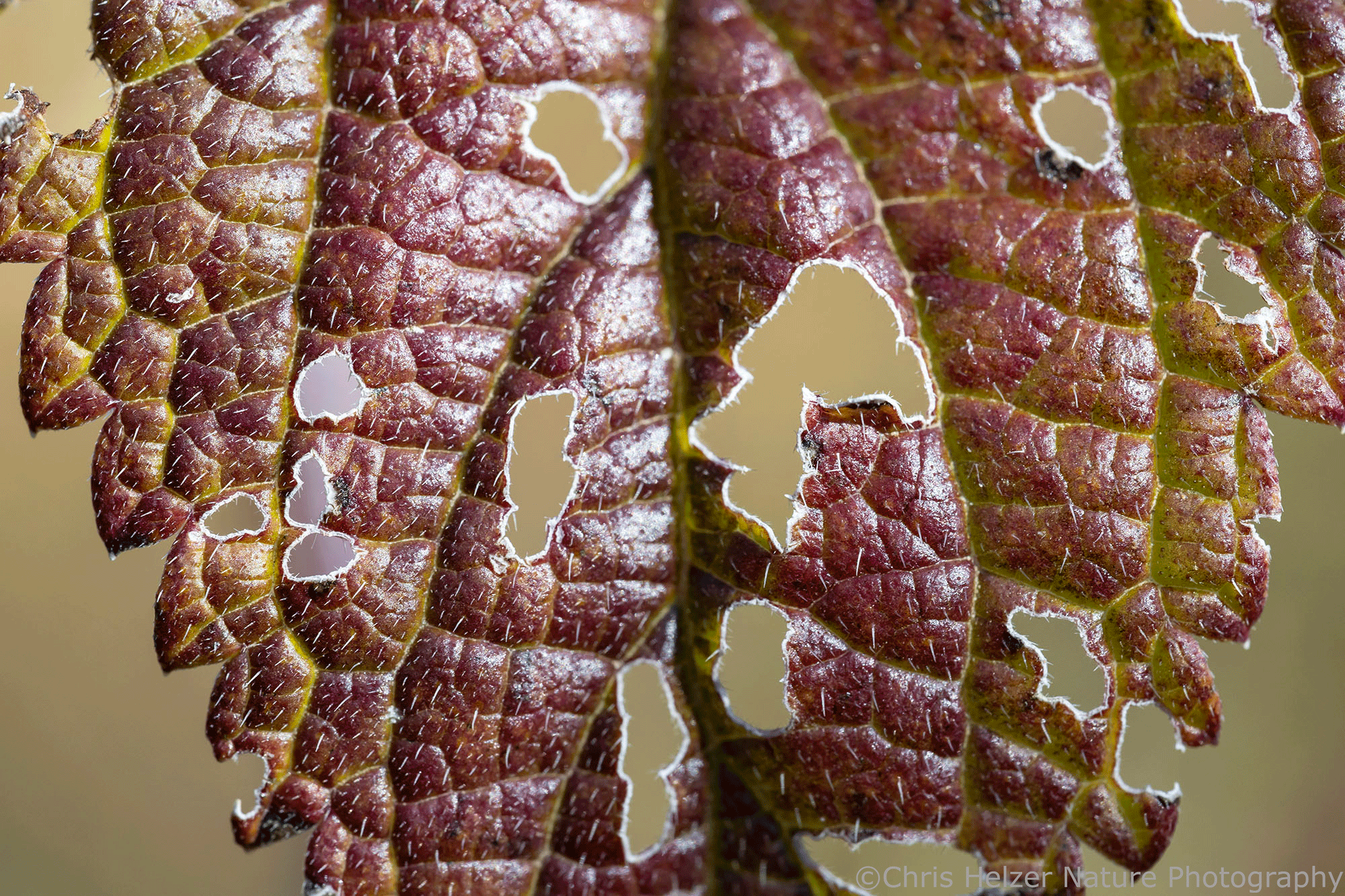
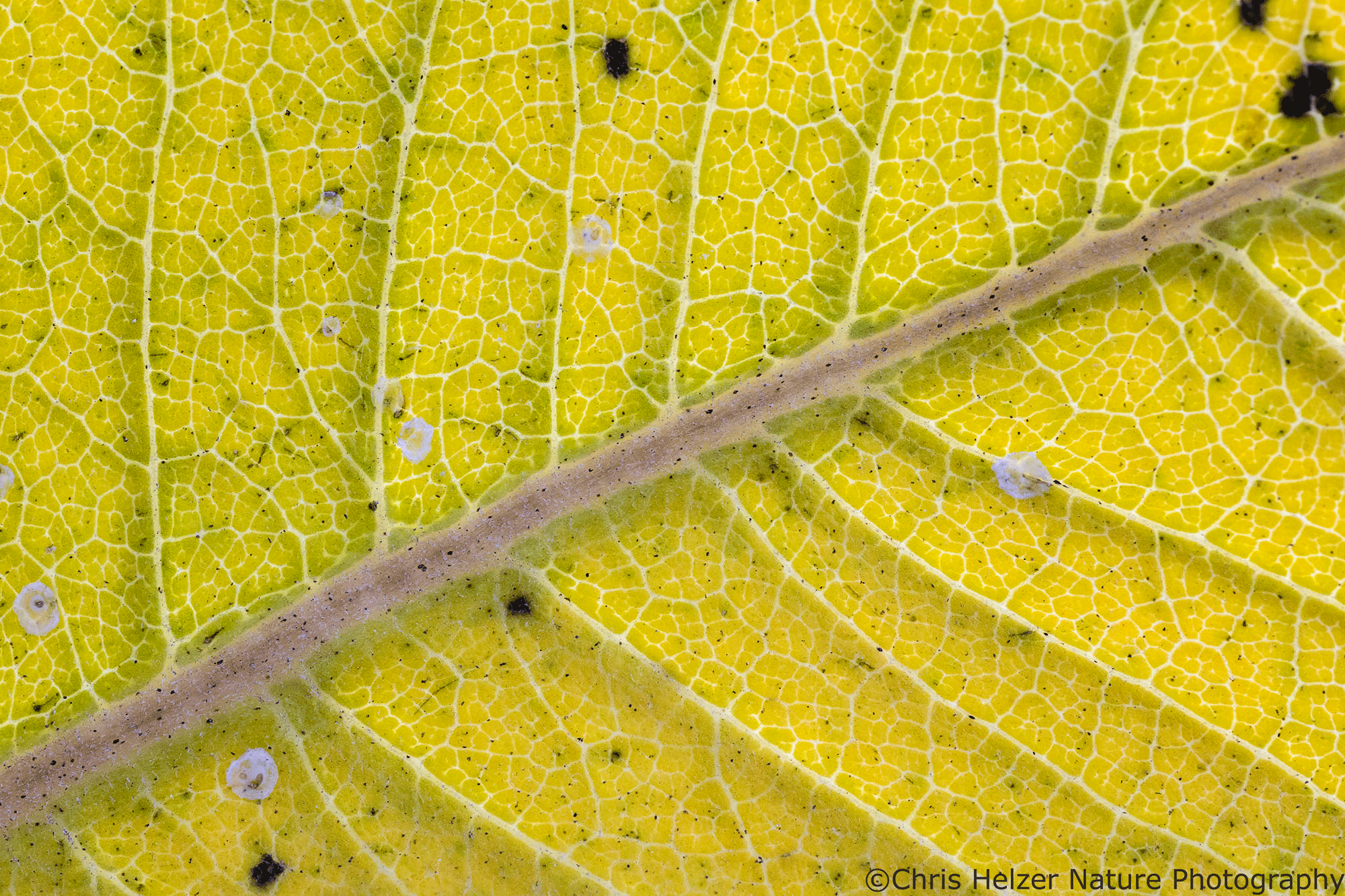
Lead plant (Amorpha canescens) leaves in fall color.Twice-stabbed stink bug (Cosmopepla lintneriana) on wild bergamot (Monarda fistulosa).Deer vetch pods (Lotus unifoliolatus) that have already twisted their seeds free.White vervain leaf (Verbena urticifolia).Common milkweed (Asclepias syriaca) leaf.
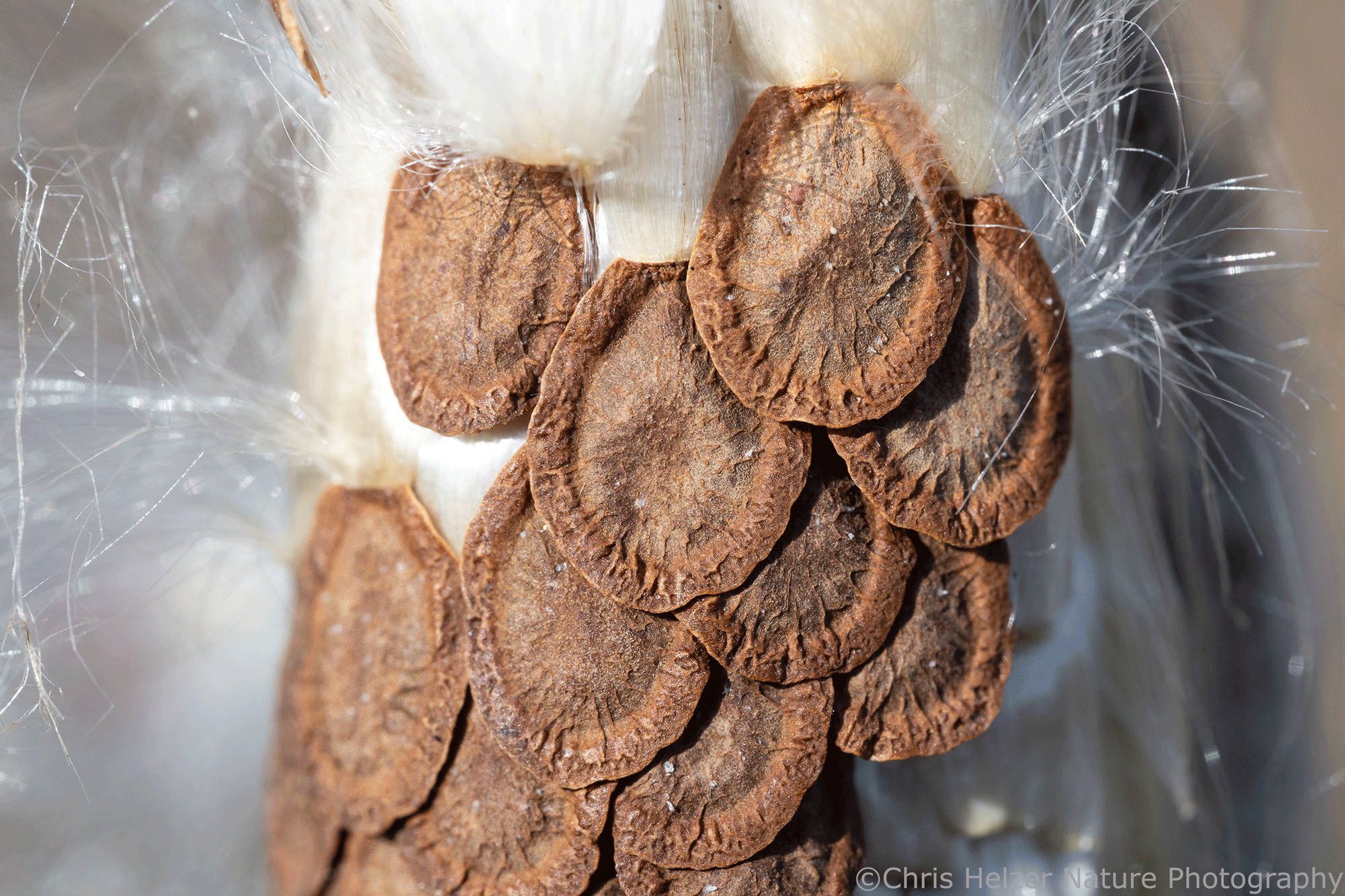
For some reason, I haven’t gotten very many milkweed seed photos yet this fall. It’s always a favorite autumn photo subject, but so far, most of the plants I’ve come across have either lost their seeds or haven’t yet released them. This morning, it was nice to find a few that were poised for photography.
Common milkweed seeds and sky.Common milkweed seeds.Large milkweed bug (Oncopeltus fasciatus) foraging for seeds.
One of my favorite insect trivia tidbits is that large milkweed bugs are migratory. Populations here in Nebraska (at least a big portion of them) apparently migrate south in the winter. I don’t know if they migrate in big “flocks” or not, but that’s how I like to imagine it happening.
“Hey honey, look at the big flock of milkeed bugs passing overhead!”
Can you imagine them in a starling or blackbird-like murmuration?
Large milkweed bug nymph with adult behind it.Large milkweed bug on a common milkweed pod.
Hi everyone. The following blog post is written by 2024 Hubbard Fellow Claire Morrical. Claire put together a fantastic series of interviews with people working in conservation here in Nebraska and we thought you’d enjoy reading and listening to their stories.
This post also contains audio clips. You can find the text from this blog post with audio transcripts HERE. If you’re reading this post in your email and the audio clips don’t work, click on the title of the post to open it online.
Every year, Hubbard Fellows are tasked with completing a project to advance TNC’s mission and conservation in Nebraska. That’s it. That’s the rubric. This is a rare opportunity to explore whatever method, medium, or idea you want. Past projects included research projects, plans for a trail kiosk, and even a comic book about the Platte River.
My project originated with a lifelong friend, an oral historian who interviews people to preserve their experiences and perspectives of the histories they’ve lived through. Hearing how valuable those stories were to understanding the past made me want to create my own collection of interviews. I originally planned to follow more traditional oral history practices, creating an archive of two-hour unedited interviews intended to capture 30 years of experience of people I’d never met. When I presented this approach to Chris, he asked me, “Who’s your audience?” Which was a very kind way of saying, “Who the heck is going to listen to that?” – I had some refining to do.
The great thing about working on one project for a full year is that it gets to develop organically. As I molded the project to fit a public audience, I eventually created “Perspectives of the Prairie” – interviews with people of different ages and experiences, enriched with photos and maps to ground the stories in place.
Spending the year with this project was such a joy. I enjoyed experimenting with ways to deliver context and information. Most of all, I loved talking to people, getting to know them better, and trying to see the landscape through their eyes. The more people I met, the more I thought, “Man! I really want to interview them!” It was so fun to chat with so many people, and I hope you’ll enjoy chatting with them too!
You can explore the full Story Map through this LINK.
On top of that, each interview will be published on The Prairie Ecologist as its own blog post (Psst, the first one is just below)!
Neil Dankert has been surveying butterflies since 1984, just 4 years after TNC bought Niobrara Valley Preserve. Neil and I spoke during the 2024 butterfly survey about how much can be missed by timing and chance, Neil’s reflections on the 2012 wildfire at the preserve, and the importance of sharing knowledge to Neil’s journey.
Interview: July 2nd, 2024
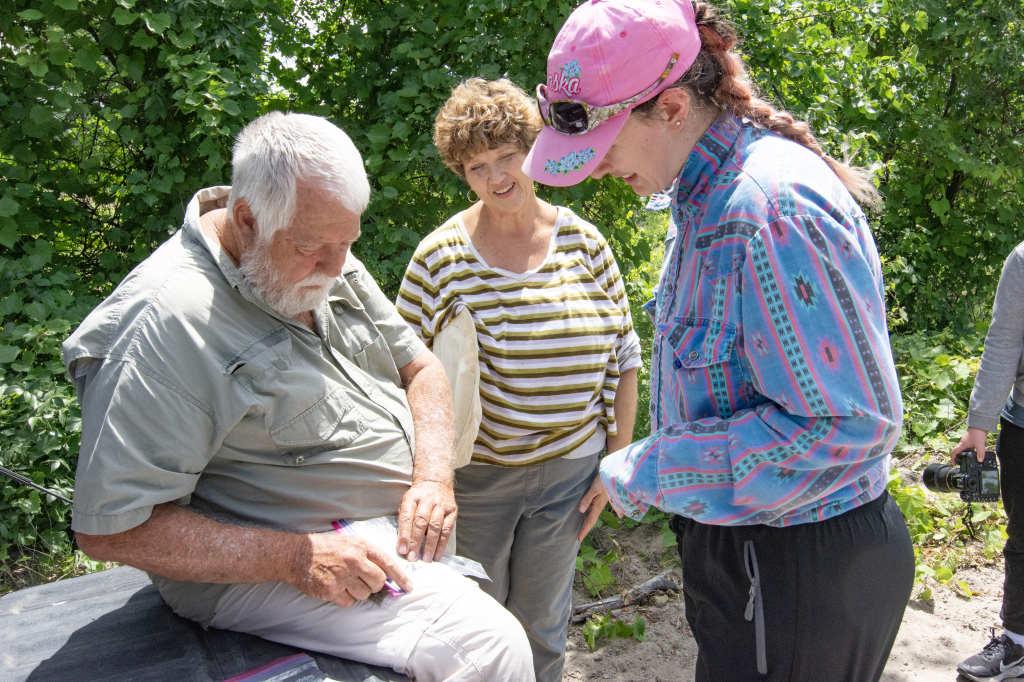
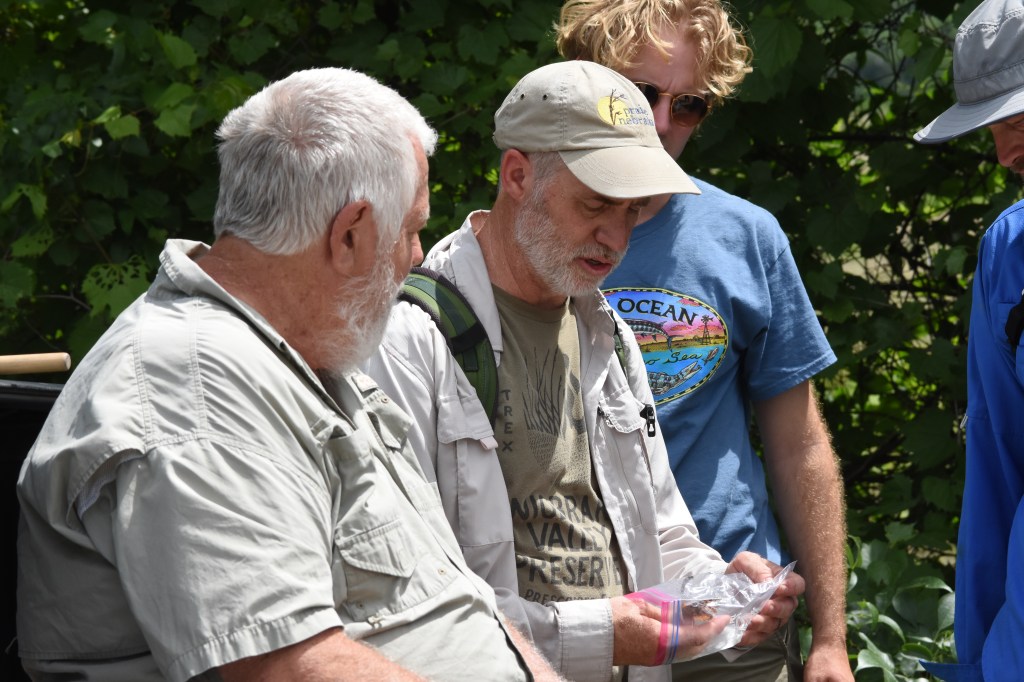
Neil Dankert (left) identifies a butterfly in a plastic bag.
Part 1: Meet Neil
Location: Middle Creek at Niobrara Valley Preserve
These are soundbites from the annual butterfly surveys at Niobrara Valley Preserve. Every year, Lepidopterist Neil Dankert is joined by his partner, Jen, and assisted by Johnathon Nikkila and his son in his search for butterflies and moths that fill the records of the Lepidopterists Society and Niobrara Valley Preserve.
Lepidoptera: a group of insects that includes butterflies and moths
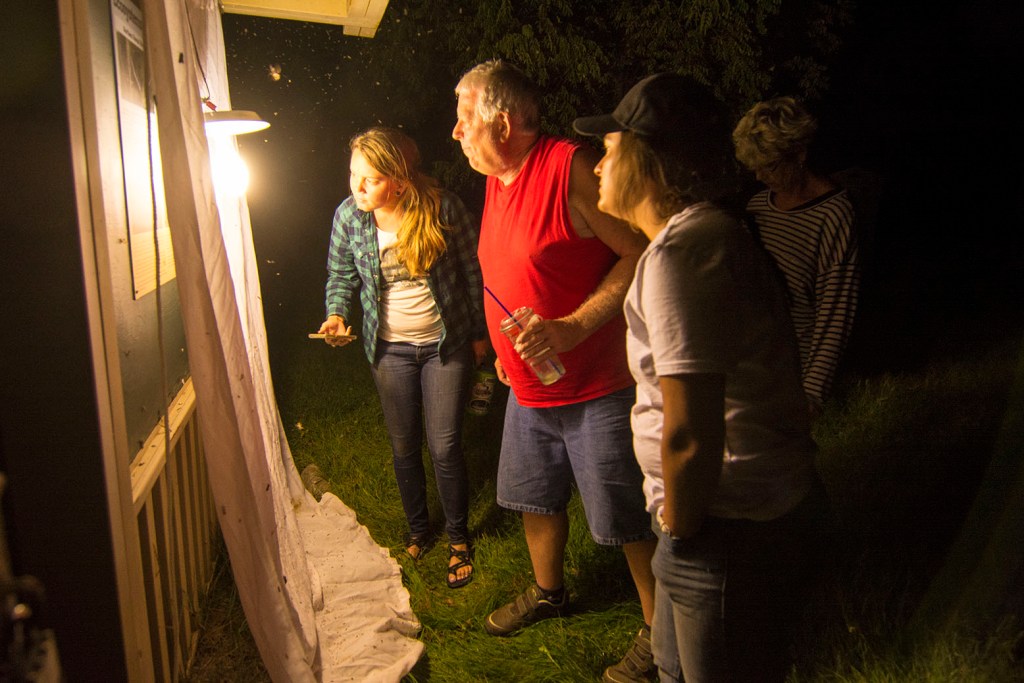
Those of us who hadn’t participated in surveys in the past first met Neil the night before. It was an informal gathering around a mercury vapor light, set up against a sheet to attract moths. We were pointing out moths and insects as they swarmed the sheet (and our faces) when Neil joined us, answering questions and identifying moths. The target of the night was the abbreviated underwing (Catocala abbreviatella), a species identifiable by the showy orange on its bottom two wings. It was a sight to behold; hundreds of moths and flies and insects that flit through the night.
Hubbard Fellows, and Neil Dankert (red shirt) looking at insects at a bug light (photo: Chris Helzer)
The next morning, we passed around some of Neil’s finds, temporarily housed in orange pill jars, until Neil interjected to set the day’s course, leading with the announcement that this would be his 40 th year of surveying butterflies at Niobrara Valley Preserve.
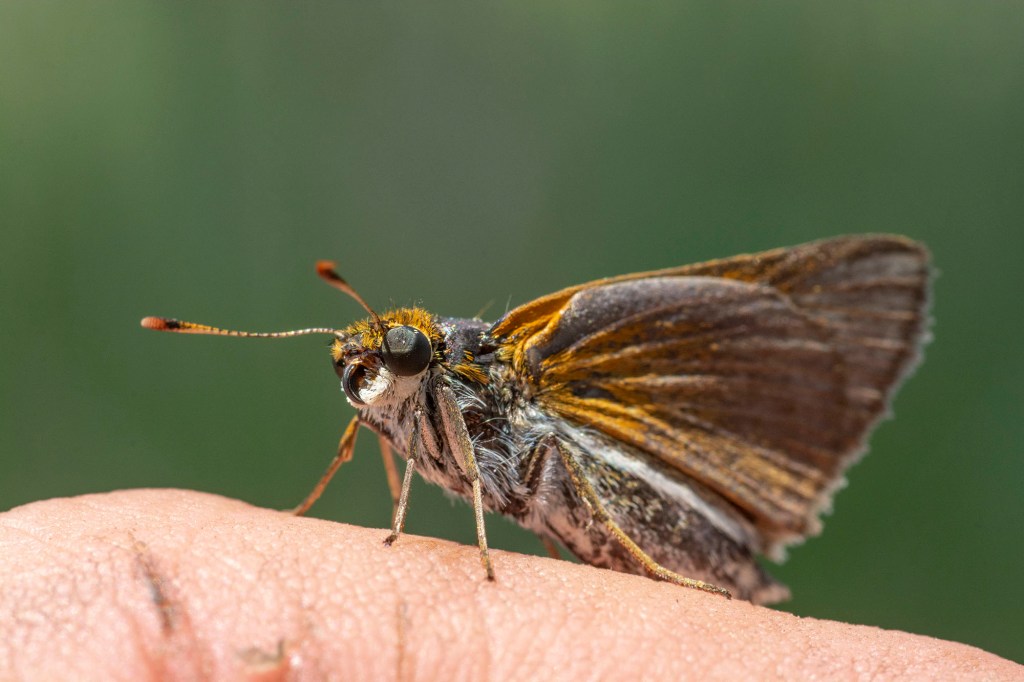
We first hiked through woodlands swatting at more mosquitos than butterflies. But we caught sight of the occasional Wood Satyr (Megisto cymela) and Wood Nymph (Cercyonis pegala). Our second site was at a prairie on rolling hills where we chased our main targets for the day: skippers. Skippers are small brown butterflies that Neil’s partner, Jen, describes as looking like paper airplanes. To an untrained eye, skippers often look nondescript and indistinguishable from each other. So, we brought them to Neil, like offerings in Ziploc bags, and waited patiently for him to confirm or deny our guesses and acknowledge that this was an exciting find, or just another name and tally for the list.
Two-spotted Skipper (Euphyes bimacula) (photo: Chris Helzer)
Our third site was Middle Creek, which runs to the Niobrara River from the north. Here, Neil and I let the others do the hard work of chasing butterflies, while Neil invited me to “pull up a tailgate” as we discussed his 40 years surveying butterflies and moths at Niobrara Valley Preserve. Neil needed no prompting to launch into his story while I scurried to record –
Notes For Context:
Dr. Hal Nagel: A biologist at University of Nebraska Kearney
Dr. Paul Opler: studied Lepidoptera for over 50 years. He wrote a number of field guides including the Peterson Field Guides to Butterflies of Eastern and Western North America
The Lepidoptera Society: A collective of Lepidoptera lovers, scientist and non-scientist, dedicated to the study, recordkeeping, and preservation of butterflies and moths
County Record: the first time a species is recorded in a particular county
You can find a link to the 1988 butterfly survey HERE. The survey covered seven sites across Niobrara Valley Preserve. It recorded 24 Brown County records and 42 Keya Paha County records, as well as 16 species at the edge of their geographic range.
Part 2: What Neil Doesn’t See
Location: One of the sites where Weidermeyer butterflies were recorded at Niobrara Valley Preserve
Neil’s interview was peppered with visits by surveyors, consulting Neil and sharing what they’d found with others
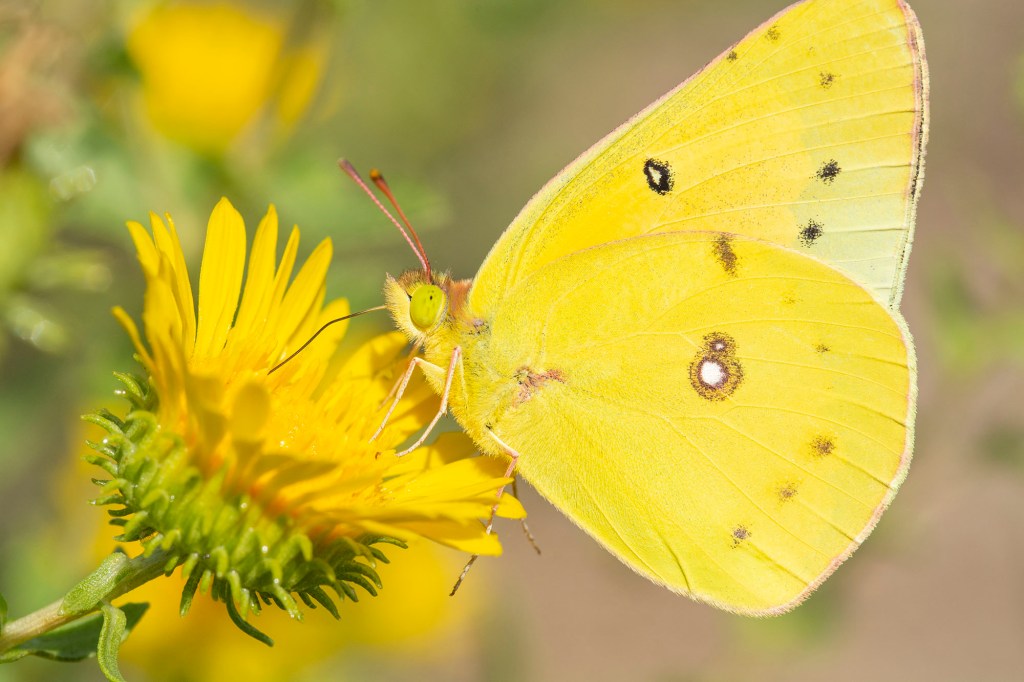
Sulphur butterfly on curly cup gumweed (Grindelia squarrosa) (photo: Chris Helzer)
Back on topic now.
Neil’s career began with Niobrara Valley. And with guidance from other scientists and lepidopterists that shepherded Neil into the field, Neil holds a special perspective of the Niobrara Valley that spans decades. He’s watched species come and go. Some he relies on seeing every visit, others surprise him with their presence or their absence. He’s wondered at what he’s missed in the decades before his arrival that make his 40 years seem like a blink of an eye.
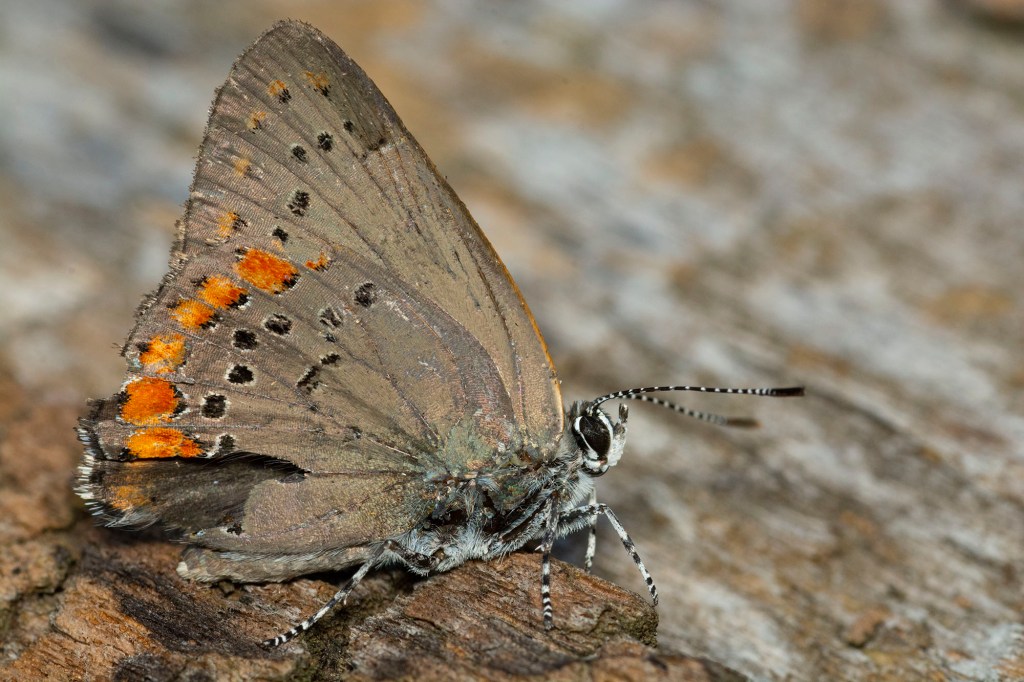
Coral hairstreak (Satyrium titus) (photo: Chris Helzer)
Neil’s comment raises a question. What species do we miss when we choose only one day out of the year to survey and how do we account for them?
Maybe this presents an opportunity for deeper research. But in the meantime, the data that we do collect is no less meaningful.
Neil reflects on how his experience and the preserve has changed in the years since he began.
40 years of data can tell a long story. Neil watches changes on the landscape and how it impacts his butterflies. He mentions seeing the habitat change as the number of shrubs on prairies increases, an issue that concerns many grassland conservationists. Annual surveys can help us to understand how this impacts butterflies, by impacting things like access to host plants. But NVP is 56,000 acres with butterflies active for a third of the year. And speaking with Neil makes me so curious to know how much information exists beyond our 1-day survey. Who was flying in the far west corner of the preserve 2 weeks before we arrived?
Part 3: Fire on the Ridgetop
Location: The northern ridgetop, where ponderosa pines and eastern redcedars burned in the 2012 wildfire
Our closing ceremony of the survey is a count of all of the species we’ve seen, listed off in pieces scattered between surveyors and sites, and dutifully recorded by Neil. We’ve made our contribution to the list of 2000+ individual lepidopterans recorded in Nebraska.
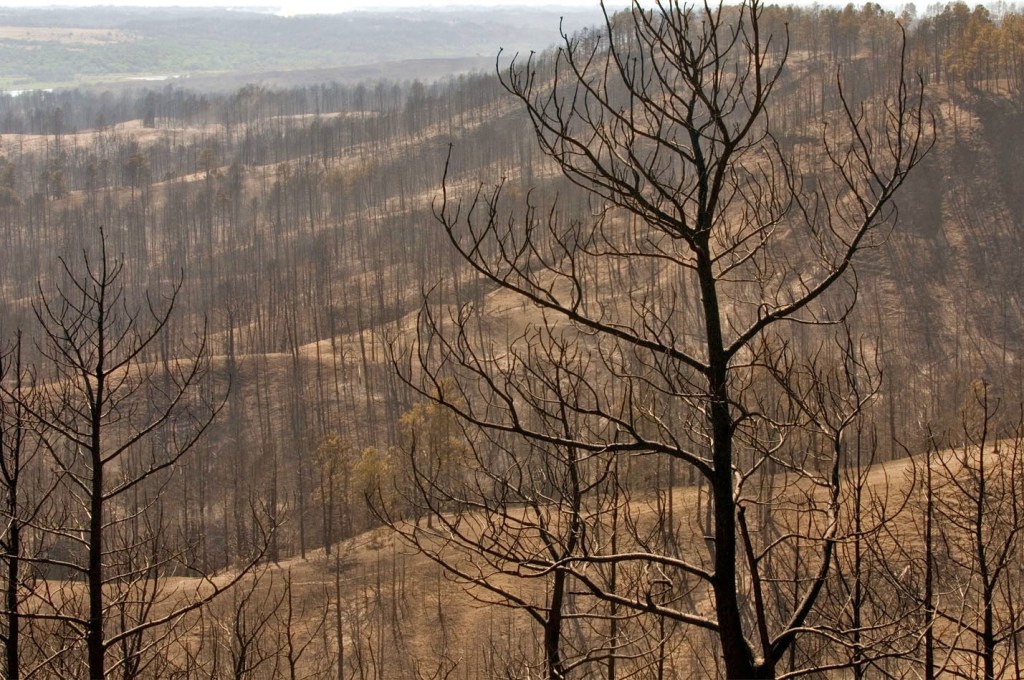
The Nature Conservancy’s Niobrara Valley Preserve after the July 2012 wildfire (photo: Chris Helzer)
2012 was a drought year in Nebraska, resulting in several significant wildfires across the state. In July 2012, a lightning storm set off one such wildfire in Niobrara Valley Preserve. The fire burned 74,000 acres, including 30,000 acres of the Preserve. There were painful losses in the way of homes and facilities, but there’s an argument to be made for positive ecological impacts that the fire had on the preserve. For example, the fire burned through many eastern red cedars crowding out grasses and wildflowers on the northern ridge-side. That doesn’t mean there weren’t worries after the fire.
Location: Another site from the original survey at Niobrara Valley Preserve
Neil highlights it here, but throughout our discussion, his mention of names, advisors, and mentors shines a light on something I have loved experiencing in conservation: the interconnectivity of conservation and the importance of shared knowledge. It’s not so important to remember the names here as it is to understand how many people relied on and learned from to be where he is today.





 The Prairie Ecologist