Photos of the Week – May 8, 2025

This week, I’ve found two different brief opportunities to poke around some local prairies with my camera. Both prairies were nice remnant (unplowed) grasslands with a good diversity of early season wildflowers, native sedges, and other little treasures.

My first stop was at Gjerloff Prairie, a terrific loess hills prairie owned and managed by Prairie Plains Resource Institute. It’s only about 20 minutes north of my house here in Aurora, so it’s a site I know pretty well. I usually try to visit at least once or twice each spring because it has some wildflower species I don’t see often in other prairies near home.

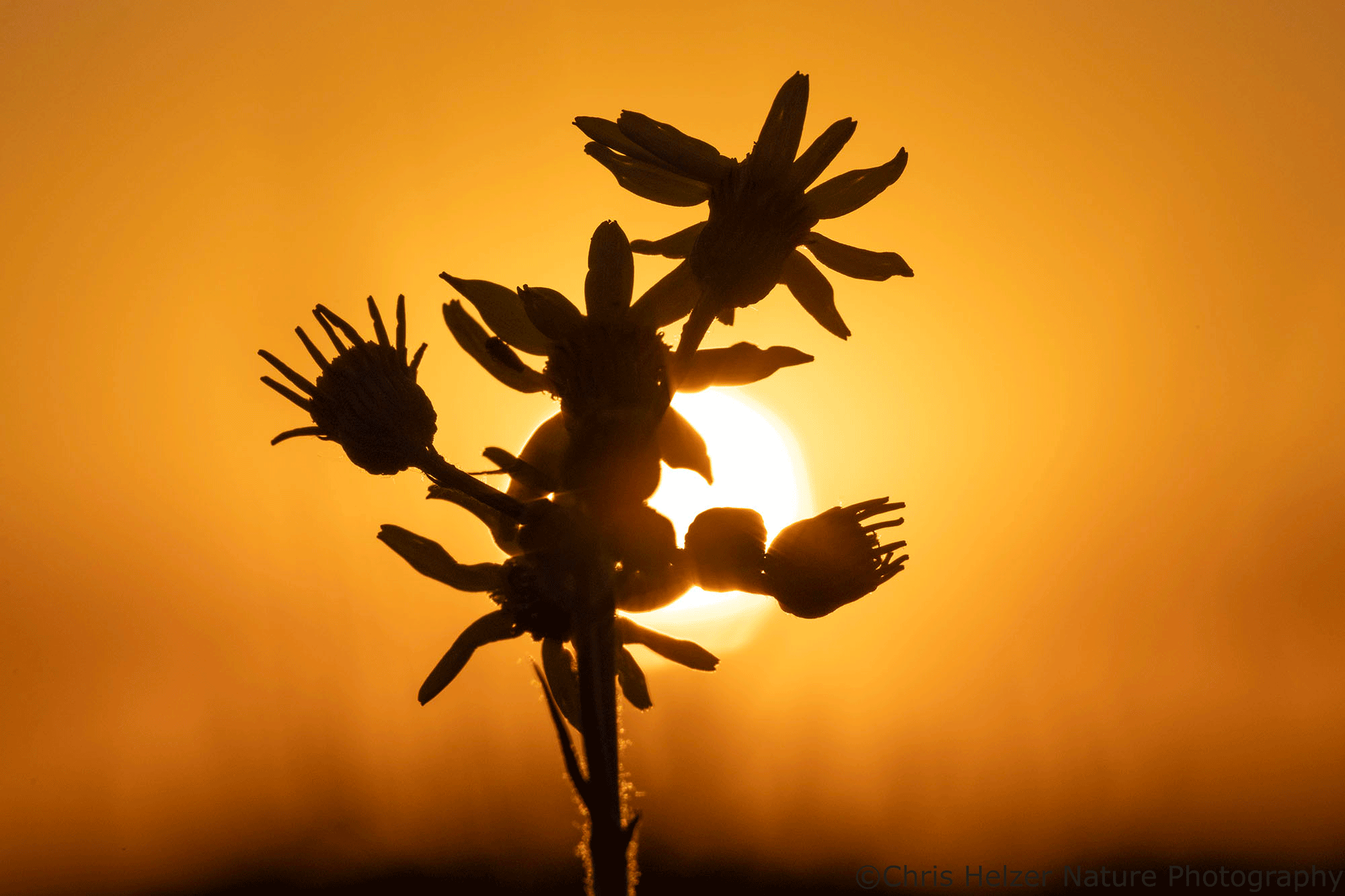
Showy vetchling (Lathyrus polymorphus) at sunrise.
The same plant, photographed at a slightly different angle to get the sun behind it.
Big portions of Gjerloff Prairie were burned this spring, and recently enough that there weren’t yet any flowers blooming in those burned areas. That meant I had to walk further than usual to get to some unburned areas and open flowers.
Prairie ragwort (Packera plattensis) is a terrific little biennial.
I have a hard time not photographing showy vetchling when it’s blooming.
More from the same patch of showy vetchling.
False Solomon’s seal (Maianthemum stellatum) is a confusing plant to me (I still love it) because I first learned it as a woodland plant but it does well in the middle of some open prairies as well.

Later in the week, I took a break from other projects and wandered around one of our sedge meadow/prairie sites (Caveny Tract) at The Nature Conservancy’s Platte River Prairies. It’s a site with sandy alluvial (river deposited) soils, but still has a fair amount of overlap with Gjerloff Prairie in terms of plant species blooming right now. Prairie ragwort, pussytoes, and fringed puccoon are just a few examples. (For some reason a lot of the current wildflowers are yellow.) However, there are lots of different plants as well.

Prairie ragwort with a tiny moth at the Platte River Prairies.
Fringed puccoon (Lithospermum incisum)
Yellow stargrass (Hypoxis hirsuta) is a “locally common” wildflower along the Platte River. It’s not in all sites, but can be very abundant in some.

The Caveny Tract includes more than 350 acres of prairie that is adjacent to hundreds of acres more. There are lots of little sedge meadow habitats embedded in the prairie, mostly in old swales formed by the meandering Platte River hundreds or thousands of years ago. Those swales are now close enough to groundwater to host a mixture of wetland and mesic prairie plants. Those sedge meadows, not surprisingly, contain both an abundance and diversity of sedges. In many places, you can stand still and see half a dozen sedge species within a few yards of your feet.

That’s assuming you’ve spent enough time with a dichotomous plant key to learn to identify some of the different sedge species. If you’ve never used a dichotomous key to identify plants, you’re missing a terrific opportunity to be overwhelmed by botanical terminology. I know enough to recognize differences between most sedge species and can identify the more common ones on sight. Every once in a while, I’ll grab a sample of one and run it through the key to stay in practice (and try to confirm my identification guess). It can take a while, mostly because I have to keep referring to the glossary to remember what a lot of the words mean.

If I did it more often, of course, I’d be better at keying plants. On the other hand, there are other things I’d rather be good at, so it’s all a matter of perspective and prioritization. I’m an ecologist, not a botanist, entomologist, or ornithologist. I don’t have to know all the species within any particular taxonomic group. I just need to know enough of them that I can recognize interactions between them. Or, at least, this is what I tell myself when I don’t feel like keying out plants.

I’m pretty sure this is Carex tetanica, one of many sedge species in the wet meadows of the Caveny tract and surrounding areas.

Here’s an example of what I mean about the terminology needed to quickly run through a plant key. The sedge pictured above is probably Carex tetanica. I think that because its lower pistillate spikelets appear to be loosely flowered, as compared to those on Carex meadii. Both species have perigynia with 2 strong marginal ribs and are glaucous at maturity. Their pistillate scales are also usually purplish brown on each side of the midrib.

If you’re a botanist, all the words in that paragraph probably make perfect sense (though you may also tell me that the pictured plant is Carex meadii rather than C. tetanica and I won’t argue with you). If you’re an ecologist like me, you’re content to live with a little uncertainty and keep some brain space reserved for other words and ideas.

These buttercups were thriving in a particularly low/wet part of a slough where a tree clearing/thinning project recently took place along the south edge of the Caveny tract. What species of buttercups are they? I have no idea. They’re really pretty, though.

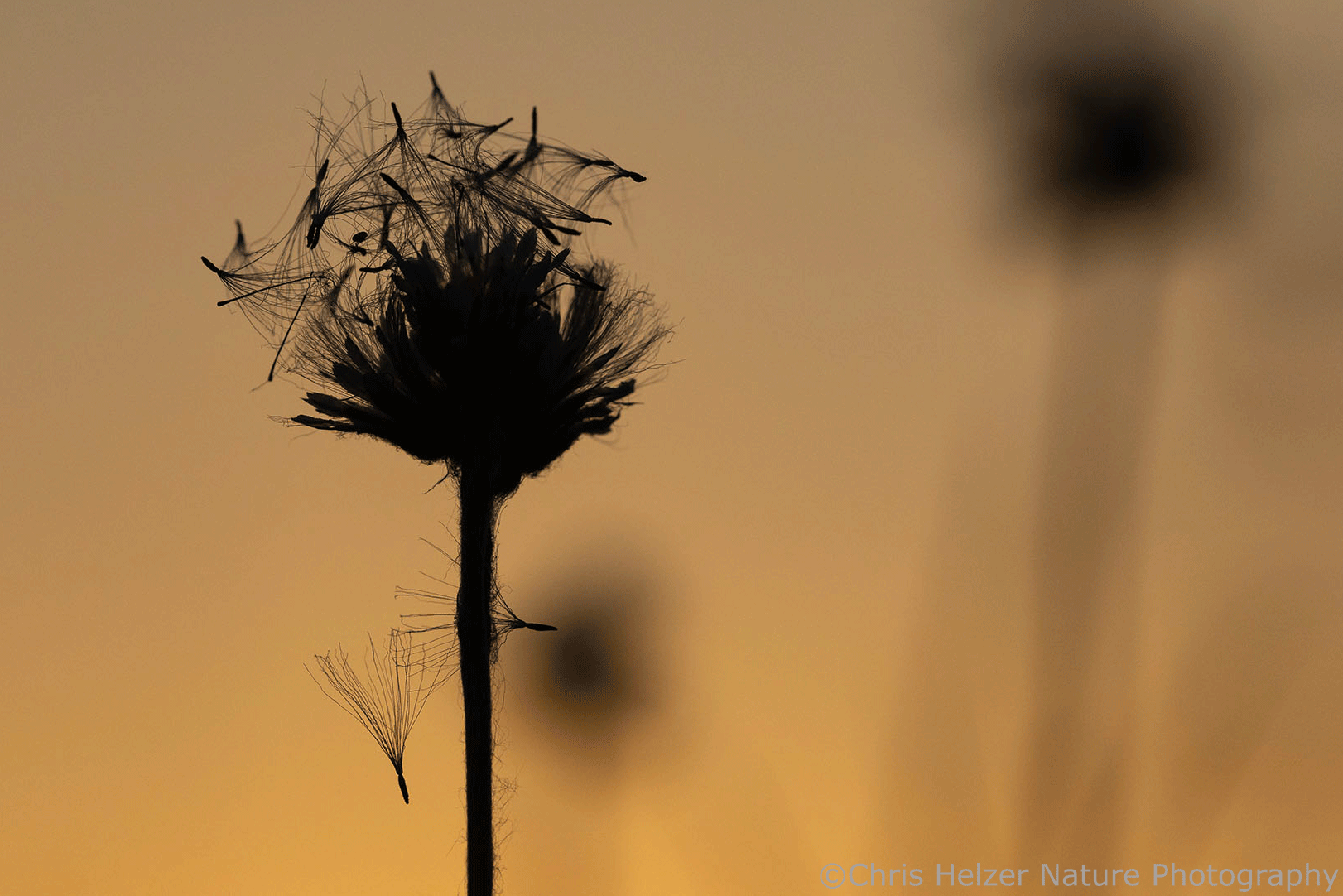
The photographic highlight of my Caveny Tract exploration was a big patch of pussytoes (Antennaria neglecta) going to seed. I spotted the pale patch of fuzzy plants from 50 yards away or so. Growing right in the middle of it was a lone prairie ragwort plant. I found the combination of the two species really attractive and spent a lot of time photographing the ragwort flowers surrounded by the pale fluff.

Prairie ragwort and pussytoes

These are just a few of the many photos I liked from the myriad composition options I played with. I used three different lenses to photograph the flowers, including a wide angle, a macro telephoto (180mm) and a longer telephoto (400mm). After I’d been shooting for a while, a little sweat bee arrived on the scene and kept me captivated for a few more minutes.

Prairie ragwort and pussytoes with a sweat bee for fun

Later in the season, both of these prairies will have much bigger, more abundant, and showier flowers. Right now, the short stature and scattered nature makes most of the blooms are hard to see from the road. From that perspective, it doesn’t look like much is happening in the grasslands. Once you start walking, though, wildflowers are dotted around throughout and each one is a joy to come across. That’s especially true if you’re just appreciating their beauty and not worrying about whether their achenes are tuberculate or not.

The End of the Square Meter Photography Project

Well, it’s all over. Yesterday (May 4, 2025) marked the conclusion of my square meter photography project. I spent an hour or so at Lincoln Creek Prairie last evening trying to capture some final images before the sun literally set on this amazing journey.

Between May 5, 2024 and May 4, 2025, I visited my little plot 131 times. If you do the math, that averages out to a little more often than once every three days across the year. That seems like a lot, doesn’t it? Of course, the average doesn’t tell the whole story. There were 14 days when I was there twice and two days when I visited three times. What can I tell you? There was a lot happening and I didn’t want to miss it.

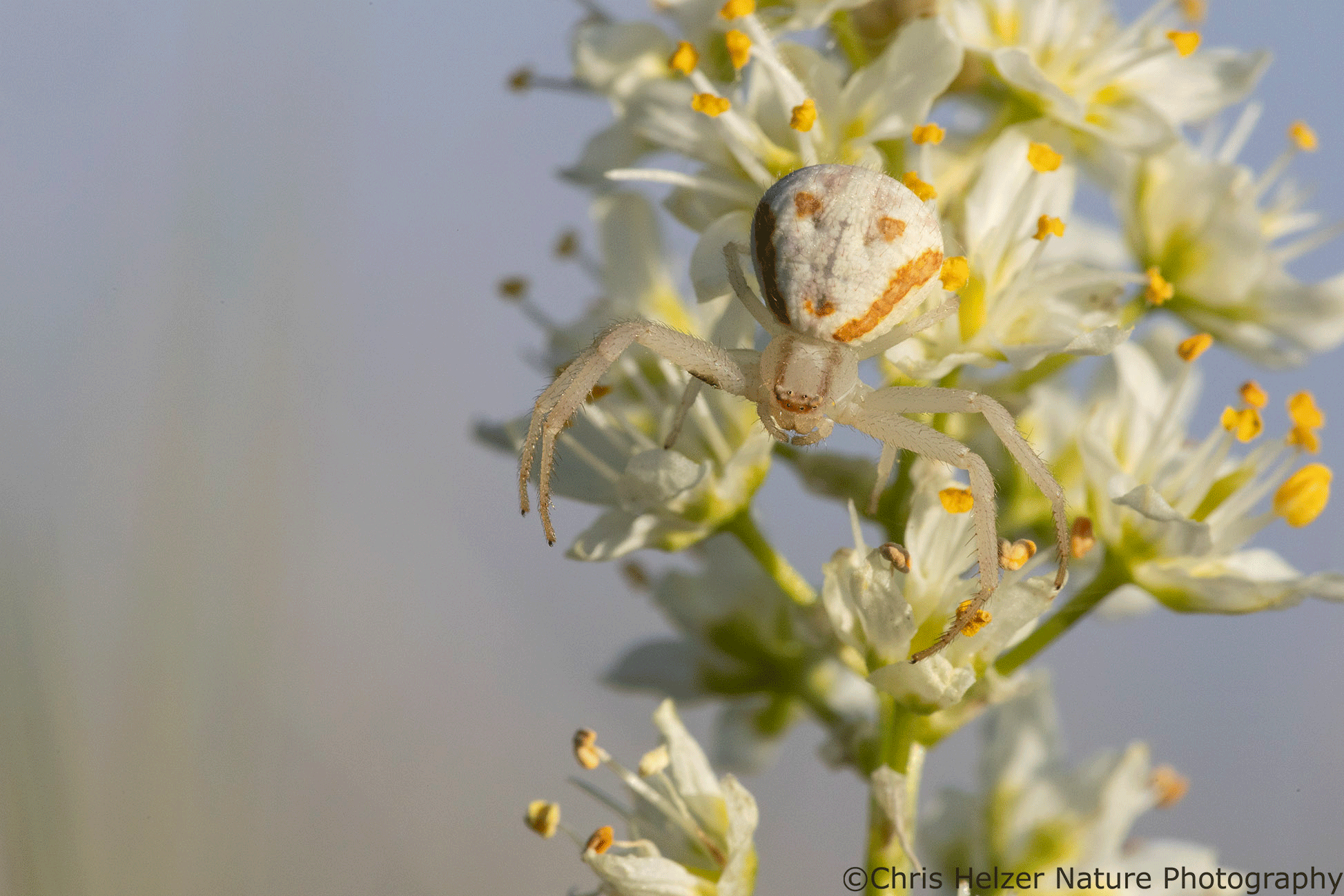
A tiny lynx spider posing for me on my final night of the project.

On my final night, some of my last photos were of a tiny lynx spiderling. That felt very appropriate, since lynx spiders felt like near constant companions through most of this last year. I saw them hunting, guarding eggs, and ballooning through the air. I’d like to think the little spiderling I saw last night was one that hatched out from within my plot, but there’s obviously no way to know for sure.

The same spiderling from a different angle.
Here’s the last photo of the plot itself as the sun was nearing the horizon.

I visited the plot throughout the winter, though not as often as I had during the 2024 growing season. As this spring came on and the prairie started to green up again, I ramped up my visits again. I was anxious to grab everything I could from the final weeks. Here are some of the photos I took during (roughly) the final month of the project.

Maximilian sunflower seed head.
Yellow woodsorrel (Oxalis stricta)
A clover looper moth in late March
Another, smaller moth – a grass miner moth of some kind, according to bugguide.net
Flies were almost always present in the plot. Telling one species from another was (and is) a huge challenge.
These springtails (Collembola) were only a millimeter or two long.
This was one of several itsy bitsy caterpillars I’ve seen this spring.
This is (unfairly) called a false milkweed bug. Naming injustices aside, it was a welcome burst of color this spring!
I photographed these lead plant buds many times as they began opening.
Kentucky bluegrass
Another fly. This one has red eyes. What species is it? I have no idea.
A ground beetle.
A four-spotted sap beetle (Librodor quadrisignatus)
Earthworm
This turkey vulture flew directly overhead. I counted it.
Ah, ticks. A wonderful sign of spring.
As soon as Maximilian sunflower started growing, ants started harvesting extrafloral nectar from it.
This little inchworm (geometer moth larva) was only about 4-5 mm long. I chased it around a long time before I finally got a few decent photos of it.
Short-beaked sedge (Carex brevior) on the final night (May 4, 2025).

Even though I’m now finished with the photography part of the project, I still have a lot of work to do. I’ve been very fortunate that a number of generous experts have helped me with species identification but that process is not yet complete. Currently, I think I photographed about 330 species over the year, which is a staggering number, but that number could still go up or down a fair amount as experts continue to weigh in. Regardless, it’s a lot bigger number than the 113 species I photographed (and felt proud of) when I first tried this project in 2018.

This second edition of the project came about because the managers of Lincoln Creek Prairie (Prairie Plains Resource Institute) burned the prairie last spring. That allowed me to find what was left of my flags from the 2018 project. I decided to re-mark the same plot with fresh flags while I had the chance – just in case I decided to come look at it again sometime. That pretty quickly led to a second full-fledged version of the photography project.

I loved every minute of it.

As I work through images and have time to absorb and synthesize this whole effort a little more, I’ll probably share more images and stories in various forms. I’m working with the amazing folks at Platte Basin Timelapse Project to create some kind of short film, and who knows what else will come out of all this. Stay tuned.

Meanwhile, here are a couple short video clips from my final night at the plot. The first is the tail end of my last hike into the plot. The second is a brief reflection on the whole effort as the sun disappeared behind the trees and marked the final moments of the 12-month period. (If the videos don’t work for you, click on the title of the post to open it online and activate the links.)

Thanks for tagging along with me on this. I hope you felt even a small fraction of the joy and wonder I got out of that tiny plot of grassland. Remember, if you’re impressed by how much beauty and diversity I was able to find in a single square meter of prairie, imagine how much exists at the scale of a whole prairie, including one that may be located close to where you live. For that matter, think about what you might be able to find by just looking more closely at your backyard, a local park, or even the potted plant on your apartment balcony.