This post was written by Ashley Oblander, one of our Hubbard Fellows this year. Ashley came to us with strong experience in land management, including invasive plant control. She and our other current Fellow, Dat Ha, introduced themselves recently in a previous post. I hope you enjoy Ashley’s thoughtful essay about weeds.
Since beginning my career in conservation, I’ve had the opportunity to interact with people from different backgrounds. During those conversations, a topic that has stuck out and interested me is weeds. In my opinion, the definition is quite simple: a plant that is growing in a place where it isn’t wanted. What I find more compelling than a definition is differing opinions of what is truly a weed and how my perspective on that has changed.

Dandelion (Taraxacum officinale)
As a young kid, I remember picking bouquets of dandelions to bring to my mom and urging her to put them in a vase in the windowsill. Since my dad kept a clean, short lawn, these pops of color seemed like a treasure. As I grew, I thought of them more as weeds and would pick them with the sole purpose of wiping the yellow color of its pollen onto my friend’s shirts. But now that I’ve become more educated on the topic, I see dandelions as a possible resource for pollinators.
In an urban setting where there are fewer floral resources, especially early in the growing season, the nectar from dandelions and other lawn weeds can be a crucial food source. A research project done on lawns in Kentucky found 25 species of bees visiting dandelions over two growing seasons. When I become a homeowner, not only will I opt out of spraying species like dandelions, but I plan to plant native species throughout my yard as well. If that is something that would interest you, there are great resources online, including lists of native species based on where you live from the Xerces Society for Invertebrate Conservation. A few of my favorites from the Northern Plains Region handout are eastern pasqueflower, wild bergamot, and stiff goldenrod.

Velvetleaf (Abutilon theophrasti)
When I first saw this plant, I couldn’t believe how soft its leaves were! Walking through nature, I like to feel the textures of different plants, so this got my attention right away. On top of that, the seed capsules of this species are so strange looking (they’re the circular capsule with spines at the top in the image above). I really enjoy seeing plants that are unique. However, I learned recently that the positive view I have of this plant is not shared by everyone, and farmers may consider it a weed. Not having grown up on a farm, I had no idea that it was perceived this way. Farmers see this plant as a weed because it grows in their crop fields competing for light and moisture which can reduce yield. In a pasture it may grow in a space where grass could be instead, but in this case, I’d consider it more of an opportunistic plant. I think Chris covered this concept well in a past blog.

Queen Anne’s Lace (Daucus carota)
Before working the Prairies for Agriculture Project (PFA), you could’ve shown me this plant and I would’ve thought it was beautiful! I’ve seen people stage senior photos by it, and it looks like it belongs on the roadsides. However, after working for the PFA for two years and hand pulling Queen Anne’s lace out of research plots, the sight of it makes me cringe. What’s interesting is that after working on other preserves with areas larger than 9x9m research plots, it doesn’t seem to be as a big of a concern. While it is still considered invasive, a plant with the ability to outcompete other species and diminish biodiversity, it’s not usually on the top of the priority list at most sites I’m aware of.

Crown Vetch (Securigera varia)
A species that is usually toward the top of priority lists is crown vetch. It may seem like any other pretty legume, but don’t let it fool you. Once it establishes, it can cover huge areas where it is the only species you’ll find. Not only does that negatively impact the other species of plants that it outcompeted, it also lessens the value of an area for wildlife. If there is only one species of plant around, animals that rely on a diverse diet or specialize on certain native species can’t thrive. I became very familiar with this plant while working for The Nature Conservancy in Iowa, and now it feels like I see it everywhere. I haven’t worked in a great number of places, but it seems like every preserve I work at has a species that I worked hard to control and that will follow me for the rest of my life. That’s the unfortunate reality of the battles of stewardship.
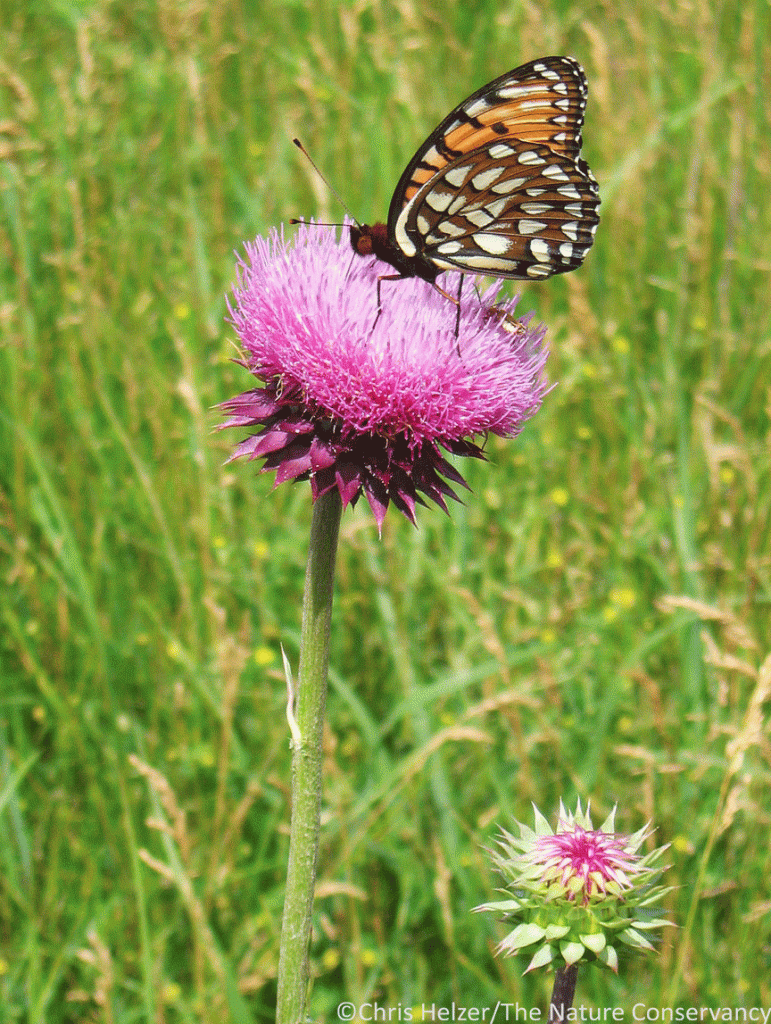
Musk Thistle (Carduus nutans)
I also learned from working in conservation about noxious weeds. A noxious weed is a plant that is particularly troublesome and could directly or indirectly injure or cause damage to crops, livestock, etc. A local example for Nebraska is the musk thistle. If this species is on your property, you are required to remove it. In Nebraska, the removal of this species is monitored by each county’s weed superintendent. So, although pollinators may visit it, the negative effects of this plant outweigh the good, and it has to go.
At the end of the day, the biggest lesson I’ve learned about weedy plants is that they are not all created equal. While they may not be ideal in the eyes of a human, they could be exactly what a pollinator or other critter need. It’s important to assess whether a species is being aggressive to the point of being invasive and pushing other species out, or whether it’s taking advantage of preferable conditions this year and while it may flourish, may be gone or not an issue the next. I think it all comes down to perspective. And perspective comes from what you have experienced previously and how long you’ve been in the weed-killing business. It’s a nice reminder that someone’s opinion may be different than ours, but that doesn’t always mean they’re wrong.
I would love to hear about a weedy species that you have later found value in, one that has frustrated you, or one that you can’t help but love even if it is a “weed”.