Photo of the Week – January 12, 2018

Tomorrow, I’m leading a photography workshop; something I rarely do.  I’m looking forward to the workshop, but always feel a little funny teaching photography for a couple reasons.  First, photography is a very individual activity, by which I mean that every photographer interprets the world in their own way.  Because of that, trying to “teach” someone how to be a photographer seems like kind of a crazy thing.  As a result, I’ll be talking very little about the interpretive part of photography, and concentrating mostly on the mechanics of how cameras work and how to use that knowledge to create art.  Then I’ll try to provide a lot of examples of what’s possible with photography, hoping to inspire people to develop their own vision.
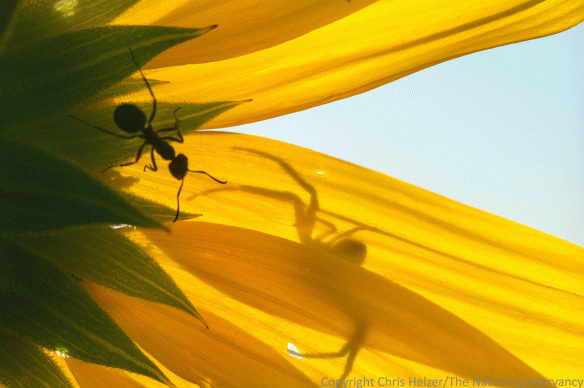
Bugs (in the broad, non-scientific sense) and flowers are subjects I feel comfortable with.  Landscapes, wildlife, and other subjects are much less in my wheelhouse.

The second reason I hesitate to lead workshops in photography is that I feel pretty limited in my own knowledge.  After all, I spend most of my time on my knees, photographing tiny bugs and flowers, and I’ve learned how to do that using the few pieces of equipment I happen to own.  I suppose I know more than the average person, but I don’t feel like I have the kind of broad knowledge of camera equipment or techniques  held by many photographers I admire; people like Michael Forsberg, Clay Bolt, Piotr Naskrecki, and Joel Sartore.  Also, when I stray from my narrow range of expertise, I tend to make a lot of mistakes.  That seems to happen particularly often when I attempt night time photography.

The latest example of my night time photography foibles came during the trip Kim and I made to the Niobrara Valley Preserve over the holiday season.  The weather was very cold while we were there, but I braved the temperatures one night and went out to photograph in the light of a half moon.  I worked along the river, mostly, shooting starry scenes with the river and silhouetted trees in the foreground.  Because of the moonlight, the stars weren’t really popping in the photos, so I decided to switch and shoot the moon instead.  I wandered over to “the chute”‘ a locally famous waterfall on the Niobrara River, right near the Norden Bridge.  Because of the sub-zero temperatures, much of the river was frozen, but the water pouring over the falls was still ice free, and there was fog (is it really called fog in those conditions?) coming off the falls and rising up toward the moon.  It was a magical scene, and I worked for about an hour to capture images of it.
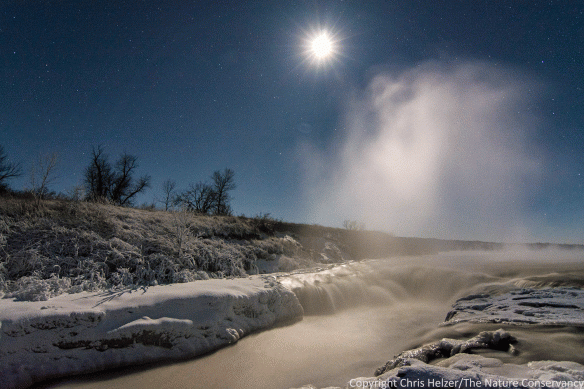
Here is one of the three images I brought back from more than an hour photographing ice and water in the moonlight.  All three photos were taken with a Tokina 12-28mm lens at ISO 800, f/4, and a shutter speed of 6 seconds.
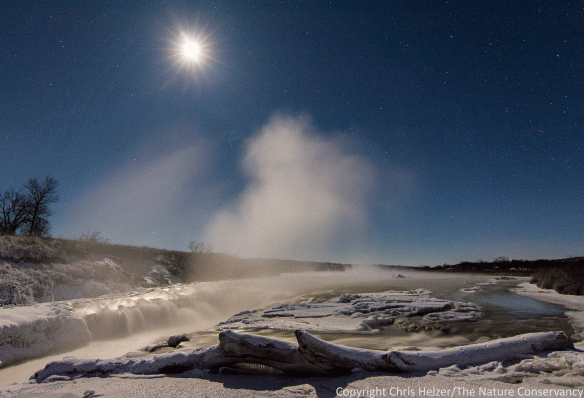
The log in this scene has been stuck on the same ledge for several years now. I keep waiting for a big water event to wash it away…

Unfortunately, my mind must have been as frozen as the the ice I was (carefully!) walking around on.  I completely forgot to change my aperture settings on the camera from the wide open settings I’d been using for star photos to settings that would give me more depth-of-field.  And because it was dark, I had a hard time focusing anyway, and didn’t notice how out of focus many of my foregrounds were.  This led to a lot of almost great photos with blurry images of rocks, ice, and/or water in the foreground.  Out of that entire hour, I ended up with three images that were fairly sharp all the way across – only because I was far enough from the foreground for it to be sharp.  Anything with a nice close waterfall in the foreground and starry sky in the background turned out to be junk.
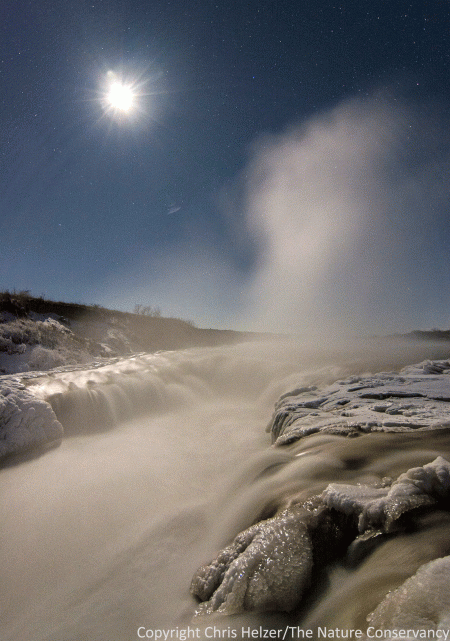
This was my favorite of the three decent shots, mainly because there was something interesting in the foreground (though I had a couple others with that ice formation much closer to the camera that would have been spectacular…)

I sometimes make mistakes photographing bugs and flowers too, but night time photography always seems to give me big problems.  In fact, one of my biggest recurring issues with bug/flower photography is tied to night photography… I very often forget to reset my ISO after shooting star photos the night before and end up taking grainy photos of flowers with an obscene ISO of 2500 or so.  I’m telling you – night time photography is out to get me.  I’d like to think I’ll get better at it if I do more of it, and I’ve been making an effort in that regard, but so far, not much luck.  Fortunately, there are lots of bugs and flowers to photograph during the daylight hours, so my ego hasn’t completely deflated.

Gee, this wasn’t a great advertisement for my photo workshop tomorrow, was it?  If you’ve signed up and are reading this, I promise I’ll do my best to make it worth your time.  The good news is that the workshop happens during the day – not at night!

The Diversity, Beauty, and Secret Lives of Grasshoppers

I know I say this about a lot of different insects, but grasshoppers are truly amazing creatures.  Grasshoppers have a reputation as voracious consumers of crops and forage grasses, and that reputation is well-earned.  However, the pest tag is far too often and broadly applied.  There are something like 400 species of grasshoppers in the western United States, and only about 20 species are categorized pests.  In Nebraska, we have 108 grasshopper species, with only a handful that ever cause economic damage, and that damage occurs sporadically – mainly in years when those species have population booms.

The differential grasshopper is one of only a few grasshopper species that can cause economic damage to farmers, ranchers, and gardeners. It’s a native species that has adapted very well to the way we’ve altered its world.

Unfortunately, the “Grasshoppers Destroy Crops” headline tends to swamp the many and much more interesting grasshoppers stories we should be talking about.  Let’s start with the numbers I’ve already presented.  THERE ARE 400 SPECIES OF GRASSHOPPERS IN THE WESTERN UNITED STATES AND 108 SPECIES IN NEBRASKA ALONE!  That doesn’t include katydids or crickets, by the way, just grasshoppers.  I’m guessing most of you had no idea there were that many kinds of grasshoppers.  Am I right?

I’m including a half dozen grasshopper photos in this post to show off just a taste of the beauty and diversity of grasshoppers in prairies.  If you want to read more about this, you can read an article I wrote for the August/September issue of NEBRASKAland Magazine.  While you could be forgiven for thinking there are two kinds of grasshoppers in the world – green and brown – you would be very wrong.  There are grasshoppers with much more color and pattern variation than many species of birds, but nobody makes movies about people circling the globe to see more grasshopper species than anyone else, do they?  Many band-winged grasshoppers show off gorgeous red or yellow wings as they fly, wings that rival those of butterflies, but you don’t hear about historically-prominent British Prime Ministers collecting grasshoppers, do you?

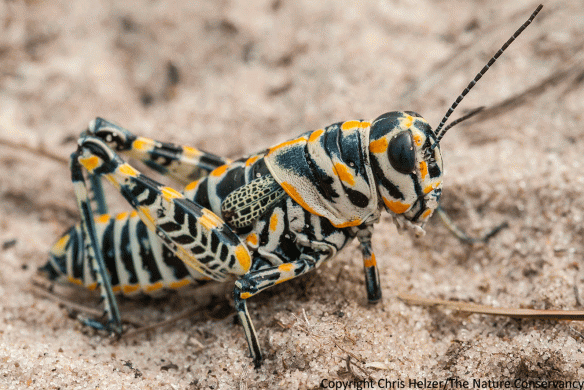
The painted grasshopper (Dactylotum bicolor) rivals any bird for beauty in color and pattern.

Now let’s discuss grasshoppers’ diet, which can include far more than just grasses.  Some grasshopper species feed high up in the canopy of prairie vegetation, while others stay on the ground.  Many have a very wide diet, including both grasses and wildflowers, but others are much more specialized, including grasshoppers that feed almost completely on one or a few wildflower species.  Grasshoppers are often seen feeding on the pollen of flowers, especially sunflowers, providing further evidence that they are much more than just grass eaters.  Most grasshopper species prefer the newest, most tender leaves of plants, but some – especially those that live mostly on the ground – make their living off of older leaves, including some dropped by their brethren living above them.  Regardless of what they like to eat, grasshoppers have very sensitive organs on the tips of their antennae that help them determine the forage quality of a leaf before they eat it.

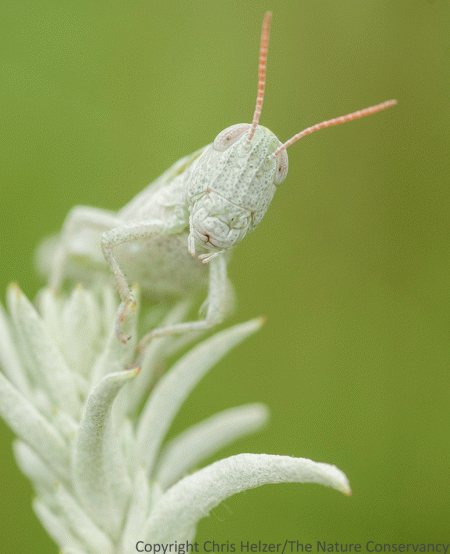
The cudweed grasshopper (Hypochlora alba) is named for its favorite food plant – cudweed sagewort, aka white sage (Ambrosia ludoviciana), on which it is supremely well camouflaged.

When you think about animals that have sophisticated communication systems, you probably think about creatures like apes, whales, and even prairie dogs, right?  You might be surprised to learn that grasshoppers have their own complex methods of communication as well.  Every grasshopper species produces its own unique set of sounds, most of them created by rubbing their hind legs against their abdomen.  In addition, some employ what’s called “crepitation” – a loud clacking sound made by snapping their hind wings while flying.

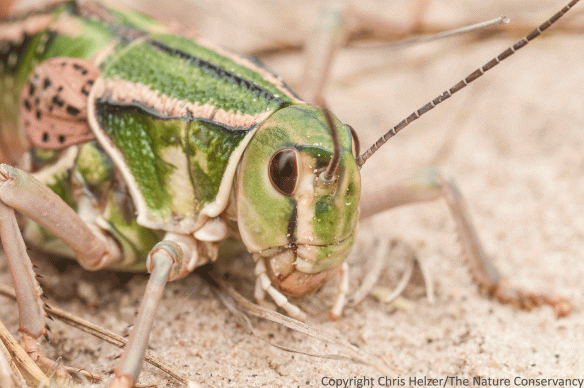
The huge and flightless plains lubber (Brachystola magna) is as gorgeous as it is large.

Grasshoppers can also communicate visually.  They can do this by rubbing their legs against their wings, flashing their wings, and making a variety of motions with their legs.  Those visual signals can help them attract mates, defend breeding territories and feeding areas, and ward off unwanted suitors.  I’m not saying we should make documentaries about people trying to teach grasshoppers how to communicate with American Sign Language, but I’m not NOT saying it either…

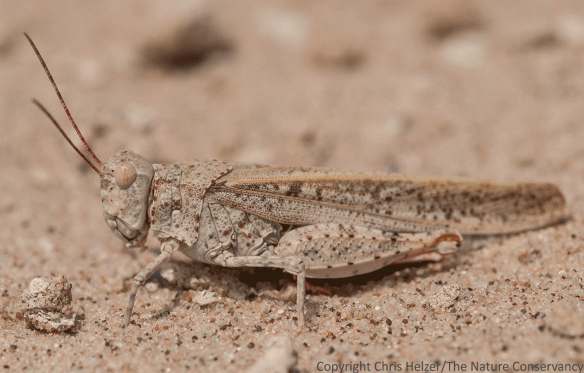
This bandwing grasshopper (Oedepodinae) is about as well camouflaged as you could hope for against its sandy background.  When it flies, though, it displays very colorful wings (color and pattern varies by species).

If you’re someone who doesn’t care about the beauty, diversity, or communication abilities of grasshoppers, maybe their utilitarian value will make an impression.  As a major consumer of vegetation in prairies, grasshoppers play a huge role in nutrient cycling, a role that becomes even more important in prairies without large vertebrate grazers.  Perhaps most importantly, though, grasshoppers are a crucial food source for many other animals, including birds and other wildlife species you (hopefully?) enjoy having around.  They are large and packed with nutrients, as well as abundant and fairly easy to catch.  In addition, while they aren’t a particularly popular food item among people here in North America, grasshoppers are an important source of protein for humans in other parts of the globe.

When grasshoppers start to emerge next spring, please take a little extra time to notice and appreciate them.  See how many different colors and shapes of grasshoppers you can find in your neighborhood prairies (remembering that if their antennae are as long as their body or more, they are katydids, not grasshoppers.)  Look for the grasshoppers with big colorful wings as they clatter noisily away from your feet.  And if you’re a person of financial means, and are interested in making a movie about grasshopper watchers or people trying to teach grasshoppers how to talk to humans, call me.  I know people who know people.

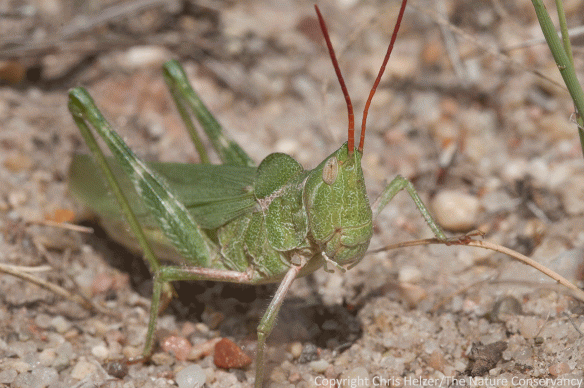
How can you not like and admire the green fool grasshopper (Acrolophitus hertipes), with its raised back ridge, bright red antennae and charming face?