This post was written by Evan Barrientos, one of our Hubbard Fellows. Evan is a talented writer and photographer and I encourage you to check out his personal blog. If you would like to see more of his photographs, you can follow him on Facebook.
When I started my Fellowship I had strong interests in outreach and stewardship. I was hoping the Fellowship would help me choose which to focus on, but instead it’s shown me a way to combine the two: volunteer stewardship programs.
Although I greatly enjoy the physical work of stewardship and recognize that conservation can’t happen without it, I sometimes feel that it’s a losing battle. The fact is, the conservation movement just doesn’t have the resources to rigorously manage entire landscapes. Here on the Platte River Prairies, there are always more invasives than we can spray, more seeds than we can collect, more equipment repairs than we can fix, etc. This is why outreach matters to me. I think that in order for conservation to be successful we need to inspire more people to support it. Over the course of my Fellowship, I’ve come to believe that volunteer stewardship programs can make significant gains on both of these fronts.

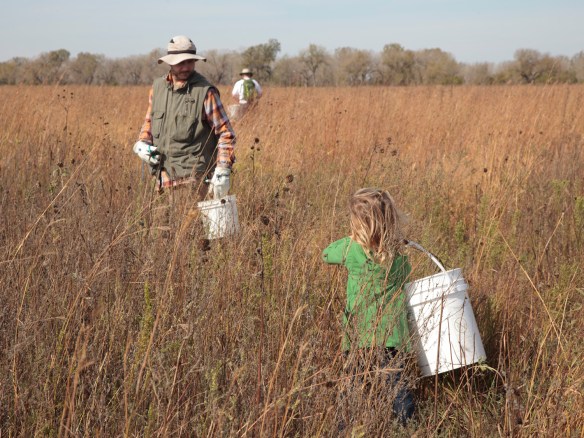
Volunteers help collect seed from one of our larger Platte River Prairies.
Last June at the start of my Fellowship, I heard that there was a volunteer workday coming up. During high school I enjoyed volunteering at my local nature center, so I thought I would check it out. Although only three volunteers attended, at the end of the morning I sensed a hint of accomplishment and camaraderie. I decided I would stay involved with the workdays.
Only three more workdays had been scheduled for the year. Through a mix of chance and initiative, I wound up leading them. This was new territory for me and I would become very nervous for the entire week before each one, but the feeling of accomplishment afterwards was incredible. Not only did we accomplish large tasks in short amounts of time, but I sensed that people were learning a lot and building meaningful connections to our prairies. Little by little, new volunteers started showing up, people consistently drove from 1.5, 2.5, and 3 hours away, and my pre-workday nerves started to lessen.
I decided to extend the workdays into the winter. Although this meant figuring out a new volunteer activity (invasive tree removal), I felt that there was too much good momentum to quit. At this point I had started interviewing other volunteer coordinators for advice, and a repeated recommendation was to build a sense of community through social events. Copying a great tradition from my high school nature center, I started hosting lunches after the workdays. People really seemed to enjoy these and the tree removal, and our average attendance grew to about nine. (In a later post I’ll summarize my findings from nine interviews and 160 responses to a survey I conducted).
With momentum still rising, in February I decided to attempt a larger event. Our ongoing prairie restoration was due to be seeded and I thought it would be a fantastic opportunity for volunteers to create something beautiful, important, and permanent. Some volunteers could even have the gratification of knowing that they had picked the seeds during the previous summer. I sent press releases to four newspapers, announced the event to the Nebraska Master Naturalist program, invited members of a local church, recruited TNC staff to attend, and advertised a large potluck. Despite freezing temperature and 25mph winds, 30 volunteers (probably the largest volunteer event we’ve ever had) came to help! We made tremendous progress very quickly, and then enjoyed a delicious potluck and Q&A with our staff. The event was covered by a local newspaper, picked up by the Omaha World Herald, and even mentioned in USA Today!
New people of all ages continue to attend the workdays, as well as several who have been coming regularly since the summer. Among our most dedicated volunteers are a college student, a father/son team, and a grandfather. Since June, 48 volunteers have contributed 270 hours of stewardship. This time is so valuable because it is spent on essential tasks that wouldn’t receive any attention otherwise. Tree removal is a great example. If we let trees go wild on our prairies, very soon we won’t be able to hay, graze, or burn the prairies the way we need to to meet our management objectives. Yet in my 11 months here I’d estimate that staff have spent less than ten hours treating young trees, simply because we’re busy with more specialized tasks like prescribed fire. Fortunately, volunteers have contributed 105 collective hours to remove trees from 70 acres of heavily-infested prairie since November.
But workdays are even more valuable, in my opinion, because they provide a way for people to make personal connections to our organization, Nebraska’s prairies, and global conservation issues. By attending workdays, volunteers learn about prairie ecology, management, threats, and more. By spending time in our prairies and working towards a goal, they develop a personal attachment to our properties and to prairies in general. And who knows, maybe the workdays will even inspire some to dedicate their careers or savings to conservation. That’s what I love most about leading workdays: you never know when you’ll change someone’s life forever. Sound far-fetched? Well, that’s how I got here.
The last aspect of building a volunteer program is sustaining it. The volunteers have asked me many times, “What will happen to the workdays after you leave?” I think about that a lot. My goal from the start was to foster a group of volunteers with enough dedication and experience to be fairly self-sufficient after my Fellowship ends. So far, I’ve trained two dedicated volunteers to lead workdays. I’m hopeful they’ll continue to engage Nebraskans in the meaningful work going on here after I’m gone. Based on the enthusiasm I’ve seen so far, I’m optimistic that they will.
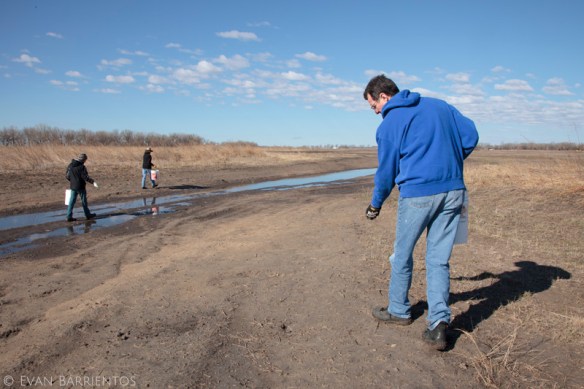
Steve (blue sweatshirt) has attended 7 of the last 11 workdays, and has stepped up to become a Workday Leader! He’ll be leading his first workday this Saturday!
If you’d like to get involved, our next workday is this Saturday, April 23, at 9:00am at the Platte River Prairies. Email evan.barrientos@tnc.org to sign up!






 The Prairie Ecologist