Rising from the ashes. Again and again.

Fire and prairies go together like bologna and ketchup.  (There is no discussion about that, by the way, it’s just a fact.)

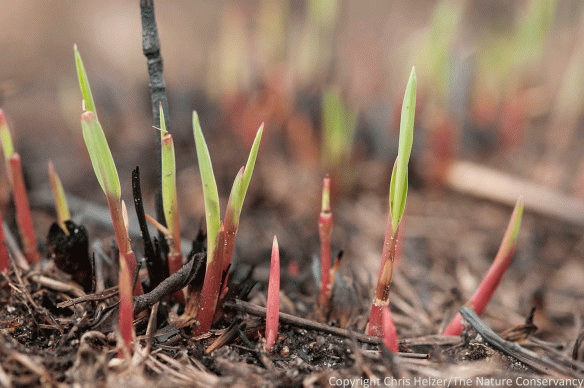
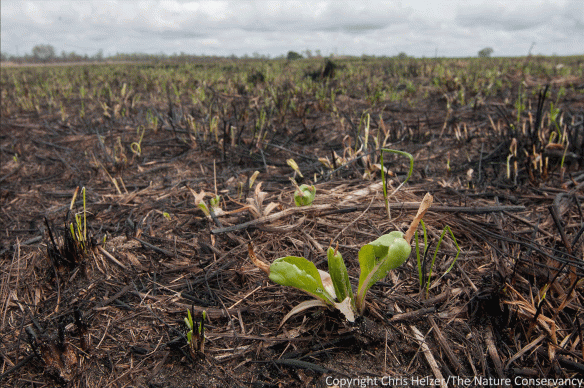
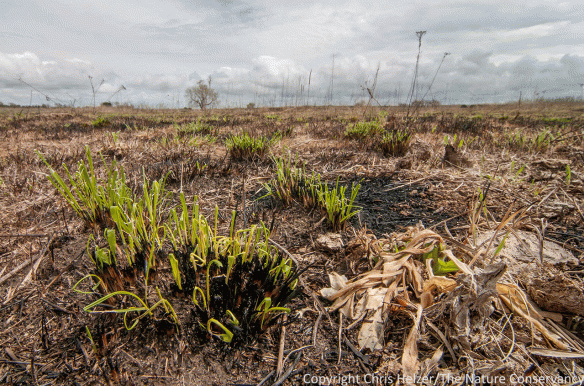
It’s always fun to watch prairies green up following a prescribed fire.  Plant regrowth is rapid and vigorous, especially after a fire that takes place just as the growing season is starting.  In fact, because the soil warms up faster in recently burned areas, we often see plant species emerging weeks earlier where we’ve burned than in unburned prairies.  The photos below were all taken one week after a fire we conducted at The Platte River Prairies this spring.
Rosin

Rosinweed (Silphium integrifolium) and grasses in restored prairie.

A created wetland

Rainwater filled this created wetland after it was burned, creating excellent habitat for migratory shorebirds and many other creatures in what was formerly a corn field.

False gromwell (Onosmodium molle) was one of the fastest to re-emerge from this spring's burn.

False gromwell (Onosmodium molle) was one of the fastest to re-emerge from this spring’s burn.
g

Beautiful two-toned grass shoots were scattered across the entire burned prairie.

Beautiful two-toned grass shoots were scattered across much of the burned prairie.

Photo of the Week – April 15, 2016

Back in July, I got to photograph flowers and insects at The Nature Conservancy’s Bluestem Prairie in Minnesota.  One of the subjects I enjoyed photographing was a little yellow-flowered plant in the genus Lysimachia.  I don’t know the name of the species (I’m sure someone will tell me what it is, which would be fantastic).

I played around with the background in my Lysimachia photos.  I moved the camera slightly up and down, changing what was visible behind the flowers.  The problem with doing that, of course, is that I had to later decide which version of the photo I liked better.  Or, as I sometimes do, I get lazy and just put multiple versions in a blog post to see if you have a preference.

Lysimachia sp. at The Nature Conservancy's Bluestem Prairie. Version one (a little lower perspective to show a little sky in the background).

Version 1. (a little lower perspective to show a little sky in the background).

Version 2.

Version 2.  (the camera was a little higher so the sky is not visible.)

If you have strong feelings, let me know if you like one or the other better, but don’t feel obligated to encourage my laziness.

And, just for fun, here’s a completely different composition of a different plant of the same species (from the same morning).  I actually like this composition less well, partly from an artistic standpoint, and partly because I just think the two earlier images better represent the way the flowers tend to delicately droop on either side of the plant.

Version 3.

Version 3. (Different plant, same morning)

Someone I know, not-to-be-named, likes the last composition much better than the first two.  That person is wrong, but to be fair to them, I’m including the composition in the post.  I’m sure all of you will agree it’s nice, but not as good as the first two…

Right?