Killer Thistles

Two years ago, I posted some photos of ants and other insects that had died on the sticky lower portion of thistle flowers.  At the time, I speculated about whether or not the sticky bracts below the thistle blossoms were an adaptation to prevent ants from reaching the flowers and “stealing” nectar.  Since ants aren’t fuzzy and don’t dependably go from flower to flower like bees do, they probably don’t provide many (any?) benefits to the flower in return for the nectar they take.

Dead ant stuck to bottom of wavy-leaf thistle flower. Helzer family prairie near Stockham, Nebraska.

Dead ant stuck to bottom of wavy-leaf thistle flower. Helzer family prairie near Stockham, Nebraska.

After that post, a friend sent me a journal article detailing a study (see citation below) in the 1980’s that looked at this same phenomenon, trying to figure out what benefit the thistle might get from having sticky bracts.  They used Liquid Paper to coat the bracts and make them non-sticky and then measured seed predation between coated and non-coated plants.  Overall, their results were fairly inconclusive, though they did see higher seed predation by insects on non-coated flowers in one of their sites.  The mystery remains!

One interesting part of the study was that of the 331 insects they found trapped on the bracts of Flodman’s thistle at Frenchman’s Bluff in Minnesota, 96% were ants.  (Given that result, I’m not sure why they focused on seed predation – I don’t think ants feed much on thistle seeds?)  I have been trying to keep track of what insect species I see stuck to thistle bracts during the last few years, and while ants do make up the majority of dead insects found there, a number of other species show up as well.
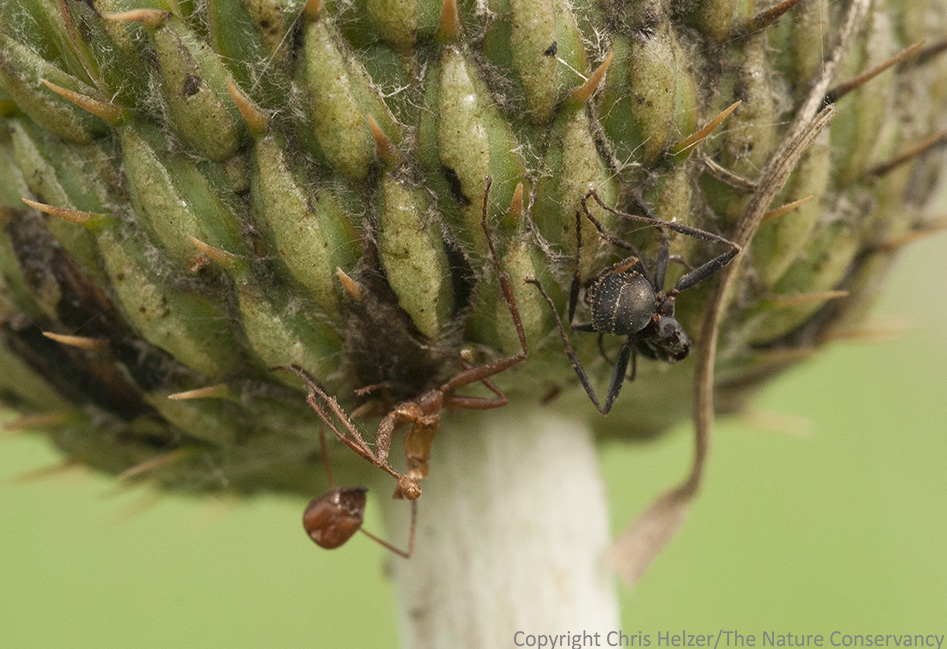
Dead ant stuck to bottom of wavy-leaf thistle flower. Helzer family prairie near Stockham, Nebraska.

The ant on the left appears to have completely lost his head over sticky thistles.

All the photos on this page were taken on the same morning last month.  I was walking around our family prairie and looking at the wavy-leaf and Flodman’s thistles (Cirsium undulatum and C. flodmanii) to see what was feeding on them, as well as what insects had become fatally stuck.  As usual, the majority of dead insects were ants, but there were several bees and even a little cicada as well.  More interesting, I also tried to pay attention to insects that seemed to move across the sticky flower bracts without getting stuck.  Crab spiders and stink bugs were two that seemed to have no trouble.  Spiders, at least some of them, have a special coating on their fuzzy feet that help keep them from sticking to their own webs – does that help them not stick to thistle bracts?  Maybe?  What about stink bugs?

Dead bee on bottom of wavy-leaf thistle flower. Helzer family prairie near Stockham, Nebraska.

This bee probably chose a nice sheltered place to spend the night without knowing it’d be the last choice it ever made.

Dead bee on bottom of wavy-leaf thistle flower. Helzer family prairie near Stockham, Nebraska.

This bee had been stuck for a while.

Dead beetle on wavy-leaf thistle flower. Helzer family prairie near Stockham, Nebraska.

This tiny beetle was another victim of the killer thistles.
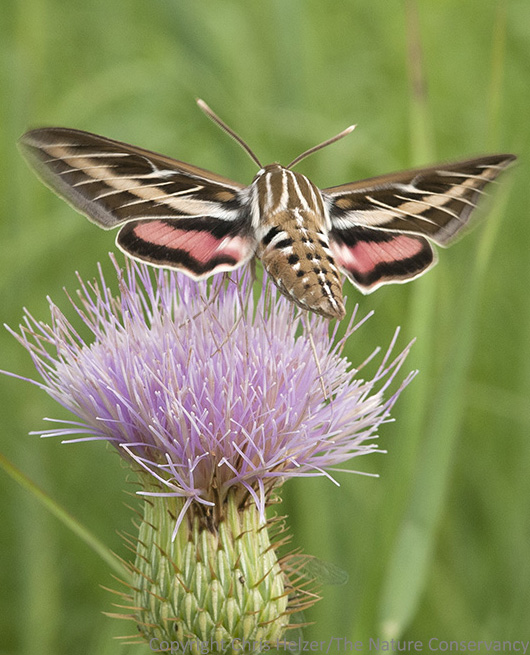
Sphinx moth on wavy-leaf thistle flower. Helzer family prairie near Stockham, Nebraska.

Sphinx moths and many other pollinators feed on the tops of on wavy-leaf thistle flower. It’s the underside that’s dangerous.  If you look closely at the bottom of the thistle flower, you can see a couple wings…
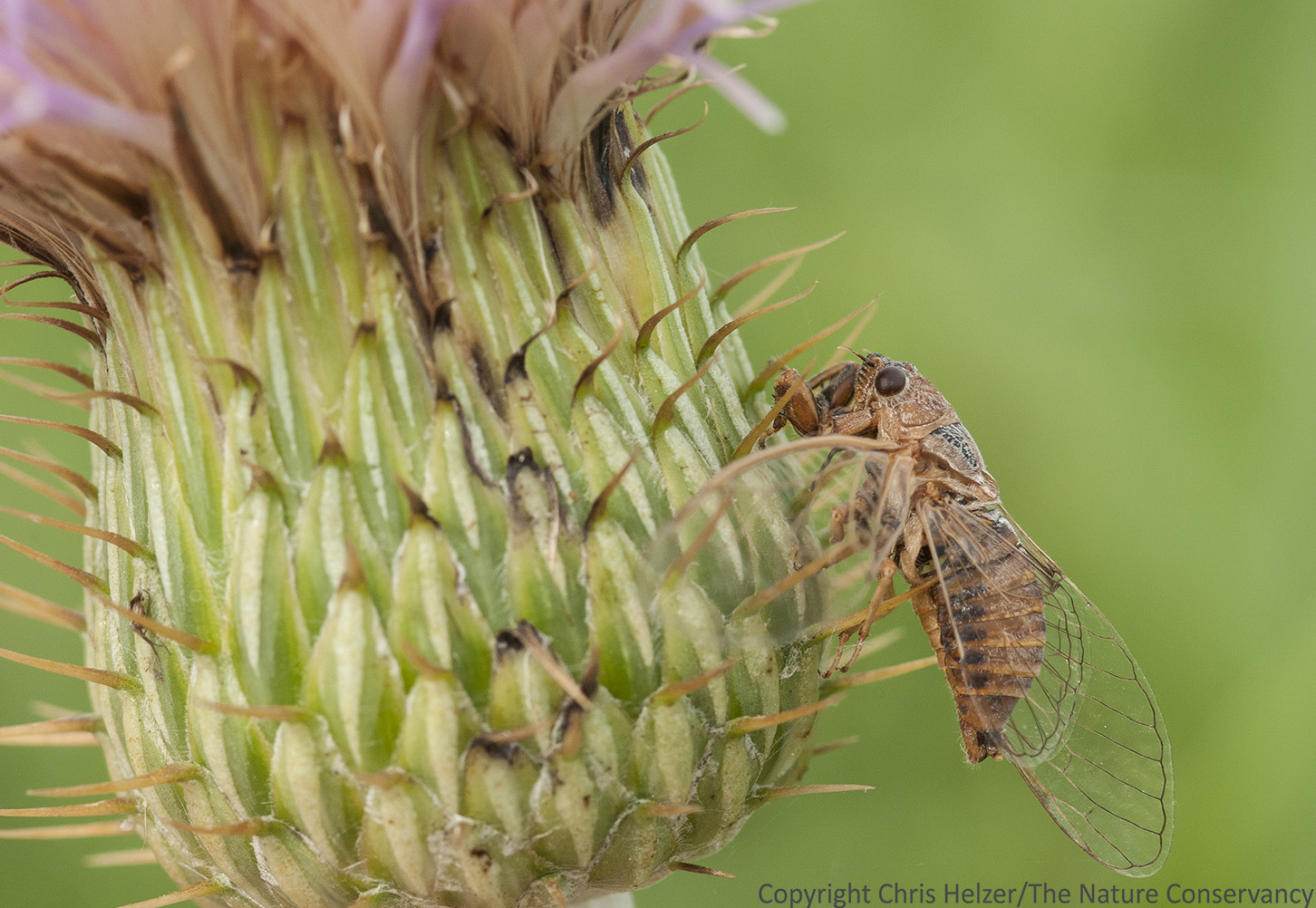
Dead cicada on bottom of wavy-leaf thistle flower. Helzer family prairie near Stockham, Nebraska.

…and those wings belong to this poor dead cicada.
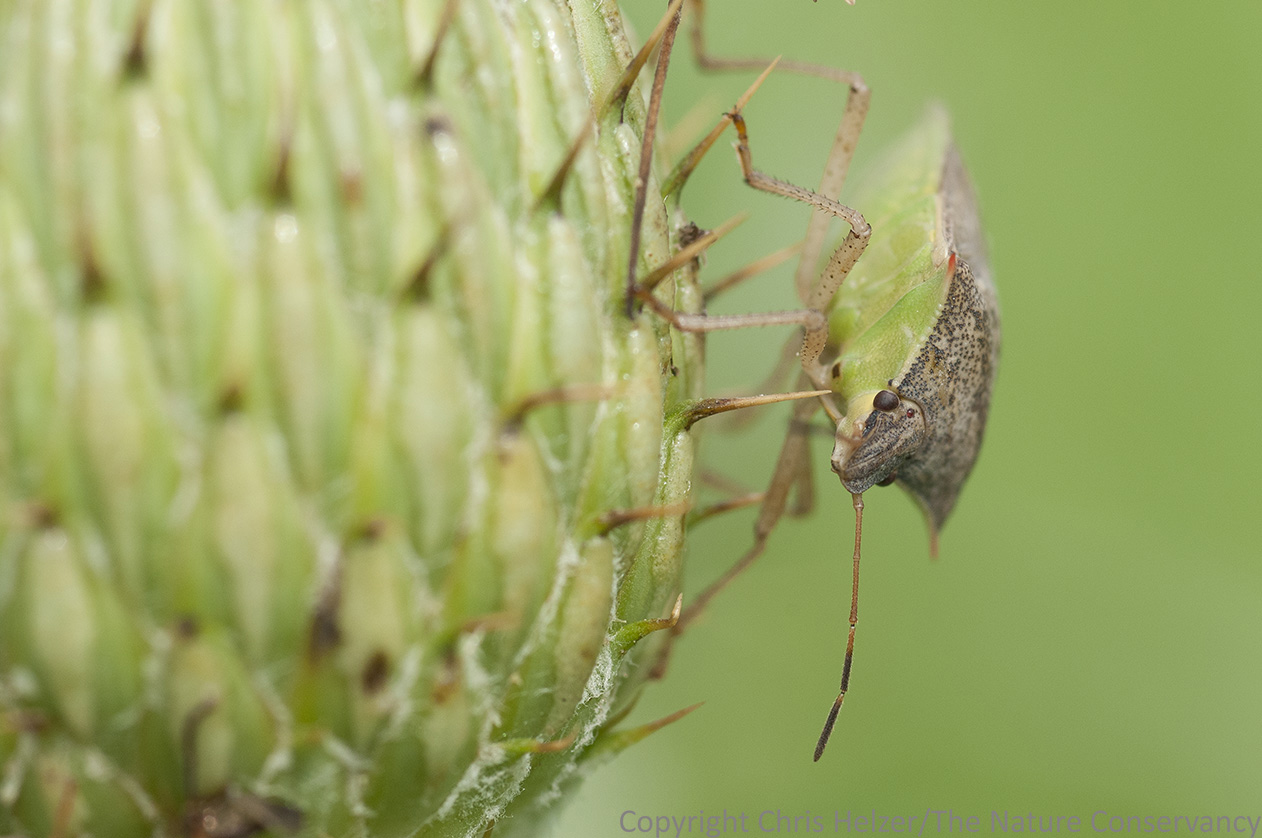
Stink bug on wavy-leaf thistle flower. Helzer family prairie near Stockham, Nebraska.

Stink bugs and crab spiders are among the insects that are apparently unaffected by the sticky thistle bracts.  This stink bug was moving around the flower with no apparent problems.

These are the kinds of mysteries that make walking through prairies fun.  Maybe someday we’ll figure out the secret of thistles’ “bracteal exudate”, but in the meantime, it’s just one of many prairie interactions we can marvel at.

>>>>>>>>>>>>>>>>>>>>>>>>>>>>>>>>>>>>>>>>>>>>>>>>>>>>>>>>>>>>>

Journal Citation:

Bracteal Exudates in Two Cirsium Species as Possible Deterrents to Insect Consumers of SeedsAuthor(s): Mary F. Willson, Pamela K. Anderson and P. A. ThomasSource: American Midland Naturalist, Vol. 110, No. 1 (Jul., 1983), pp. 212-214Published

.

Photo of the Week – August 13, 2015

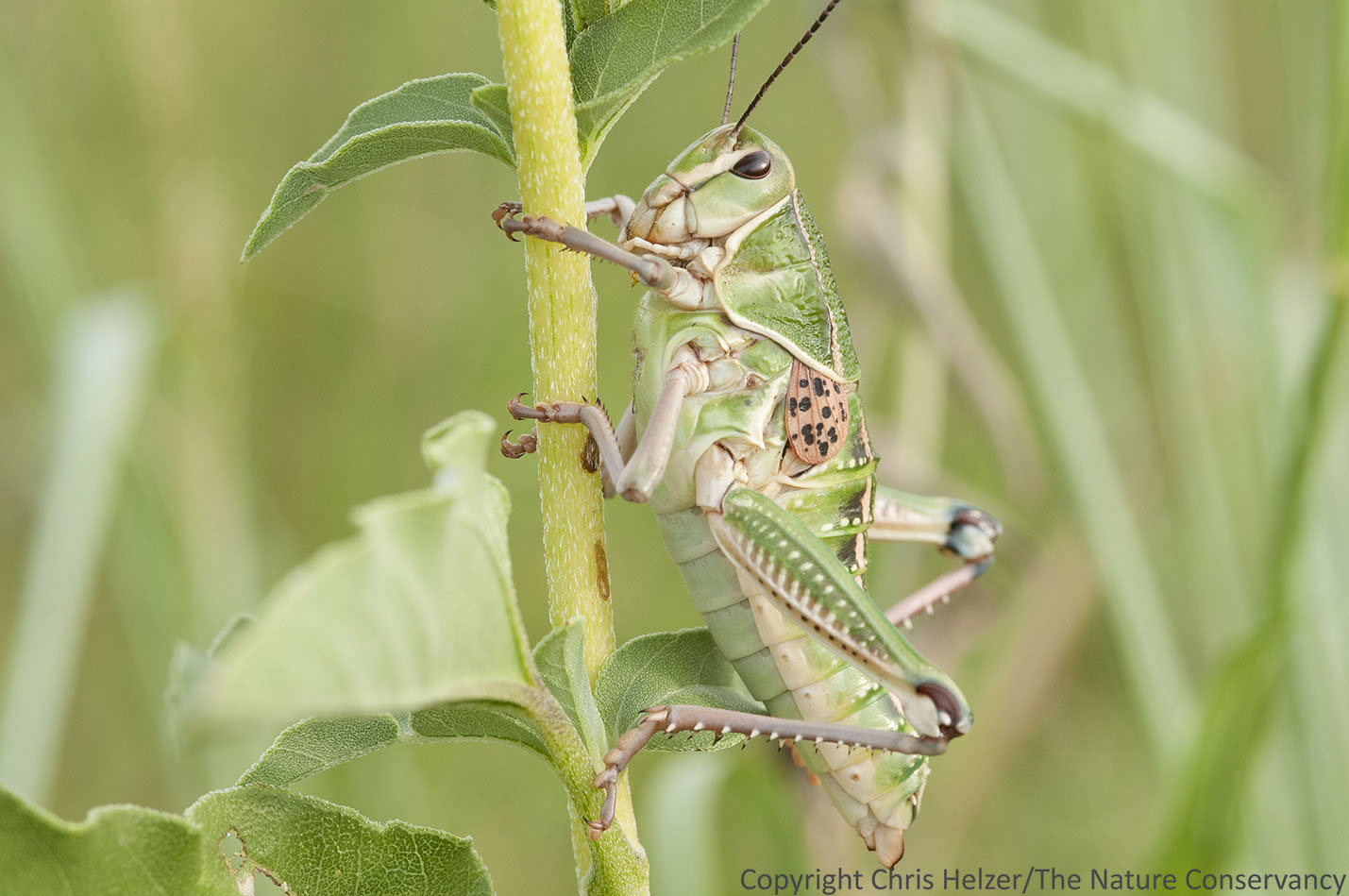
Nebraska has 108 species of grasshoppers.  They come in a wide variety of sizes, shapes, and colors, and generally speaking, the further west you go in the state, the more species you can find.  While on a short trip to the Nebraska Sandhills last week, I was fortunate to see two of the most beautiful of Nebraska’s grasshopper species.

Lubber grasshopper. Valentine National Wildlife Refuge, Nebraska.

Plains lubber grasshopper (Brachystola magna). Valentine National Wildlife Refuge, Nebraska.

I saw several plains lubber grasshoppers (aka homesteaders) in the prairie.  These huge flightless grasshoppers are about the size of mice (more than two inches long, and very thick).  They feed primarily on wildflowers, including sunflowers and hoary vervain (Verbena stricta).  According to Grasshoppers of Nebraska, they are not crop pests but in years when their population soars, they can present a hazard to drivers because their bodies can make roads slick.  Think of that!

Lubber grasshopper. Cherry county ranch of Jim VanWinkle, Nebraska.

Here is a plains lubber on its favorite (according to some sources) food – an annual sunflower (Helianthus petiolaris).  Cherry County, Nebraska.

I also enjoyed the chance to see a painted grasshopper (Dactylotum bicolor), a species I first noticed last year on a trip to western Kansas.  This gorgeous creature might be the easiest grasshopper in Nebraska to identify – as far as I know, there isn’t anything else in the state that looks remotely like it.  Like the lubber, the painted grasshopper eats primarily wildflowers, particularly false boneset (Brickellia eupatorioides).  It likes habitat with lots of exposed soil, which is convenient for those of us trying to find and photograph them.

Painted grasshopper at the Valentine National Wildlife Refuge. Nebraska.

A painted grasshopper at the Valentine National Wildlife Refuge. Nebraska.  The colors and patterns on this species make it impossible to confuse with others.

Grasshoppers, and katydids, which look like grasshoppers but have much longer antennae, are a fascinating group of insects.  They have interesting and complex communication strategies and each species has its own set of dietary preferences – some are specialists on just a few plant species and others are generalists.  Only a very few are considered to be pest species, and most of those are simply native species that have adapted well to the abundant food humans provide in the form of monoculture row crops.

Perhaps most of all, the sheer abundance and biomass of grasshoppers make them ecologically important in grasslands.  If you collected all the grasshoppers from a prairie, their biomass would equal that of the bison or cattle in the same prairie.  As such, they are a major food source for many other species, including many birds, and major herbivores that influence plant communities in complex ways.

Grasshoppers are also very visually appealing if you take the time to look closely at them.  The plains lubber and painted grasshopper are particularly pretty, but every grasshopper species has its own beautiful combination of colors and patterns.  Go out and find your favorite today!