What do you do with a prairie that’s missing most of its plant species? In some cases, good management can allow some plants to seemingly return from the dead. In others, though, the species are gone and – especially if the prairie is isolated from others – they’re not coming back.
When the species are gone, the only remedy is to bring them back. Seedlings are one way to do that, but can be expensive if the area to be restored is very big. Harvesting seeds from nearby prairies and throwing them out is probably the most cost effective strategy.
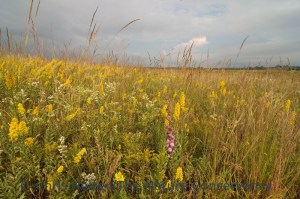
An overseeded prairie north of Lincoln, Nebraska.
However, most people who have done prairie overseeding share a similar tale of the results. It usually goes something like this. “I threw the seeds out and nothing happened. For several years, I looked every year and never saw any new species come up. So I gave up. Then, 5 years later, I happened to go by the site and there were new plants everywhere!”
Exploring why and how overseeding works (or doesn’t) is something I’ve been spending a lot of time on lately. I’ve got several research projects underway that, I hope, will help shed some light on this topic. There are some things I think I’ve learned that I’ll share in a later post. In the meantime, I’ll add my own story to the raft of others.
The above photo was taken this fall at a site we manage north of Lincoln, Nebraska. It was a brome-dominated hill prairie – if prairie is the right word – that had few species other than smooth brome. Some goldenrod, heath aster, yarrow, and a few other scattered plants that are good colonizers and/or resistant to overgrazing and herbicides. We burned the site in about 2001, sprayed it with Glyphosate in April when the brome came up, and then seeded it with a diverse mixture of prairie species. The next year, the brome was back in full force and it looked like nothing had changed. Over the next several years, it looked exactly the same, except that every once in a while I’d stumble onto an isolated plant of prairie cinquefoil or Canada milkvetch that had obviously come from our seed.
In the last couple of years, I started noticing more of those prairie species, and warm-season native grasses started becoming more abundant as well. Then, last season, we brought in a bunch of cows and grazed the site for the entire year – down to the proverbial “golf course” height. And this year, the prairie looks marvelous. It still has some brome, but it’s not dominant. I’d love to see some of the species like compass plant and Canada milkvetch be more abundant, but they’re there. And it looks like a prairie. Was it the grazing that released everything? I’m sure it helped, but the prairie was headed in the right direction already. Why did it take so long? What finally triggered the species to show up?
Stay tuned. I hope to have more ideas on this soon. And please share your own!