
Photo of the Week – January 21, 2010

Bumblebees are fascinating creatures.  Like honey bees, they are social insects that split foraging and brood rearing chores between groups of workers.  However, unlike their non-native cousins, bumblebee colonies die off at the end of the year, leaving only a few fertile females to overwinter.  Those females emerge from hibernation in the spring, find a suitable nesting site, and begin building up a new colony of bumblebees that can reach several hundred individuals in size – all within a single season.
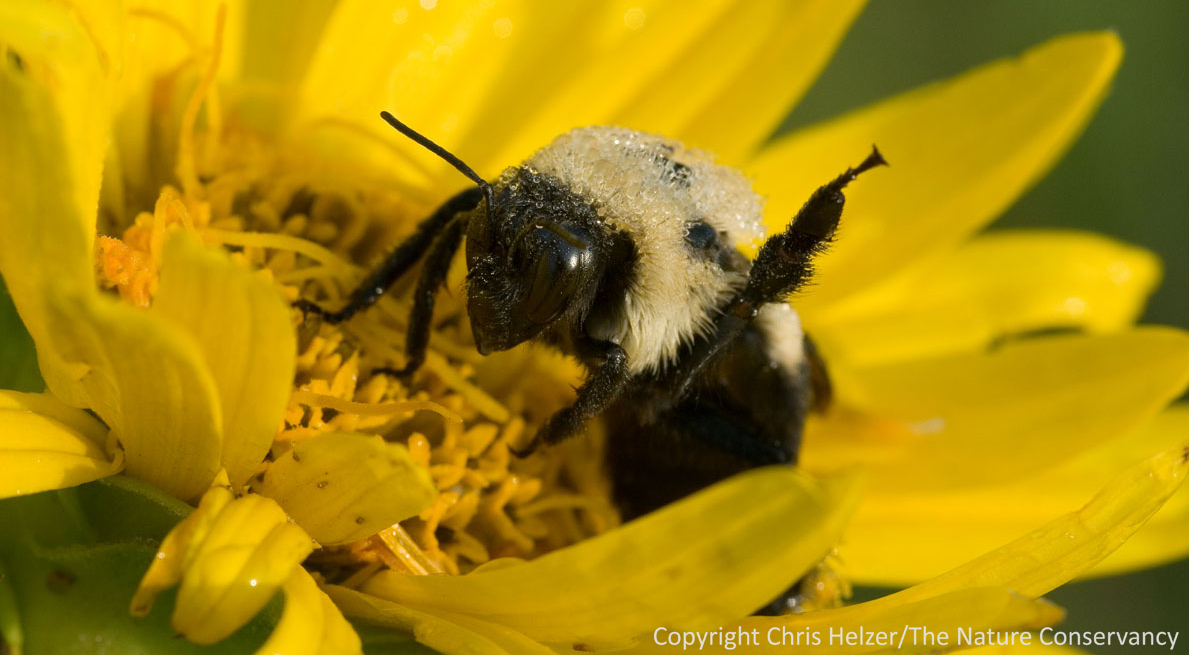
This bumblebee kept lifting and lowering its leg as I photographed it. The Nature Conservancy's Platte River Prairies, Nebraska.

This particular bumblebee was sitting on a rosinweed flower in a dew-covered prairie one morning.  As I began photographing it, it started lifting and lowering one of its legs.  I have no idea why it was doing that.  It could probably be construed as either a greeting (or perhaps the opposite!) but was probably more of a stretching exercise as the bee began warming up in the early sunlight.

To learn more about bumblebees, and to find an easy identification guide (at least for the 17 Nebraska species) go to the University of Nebraska’s bumbleboosters site.

Photo of the Week – December 30, 2010

I photographed this juvenile wolf spider on an 18 degree (Fahrenheit) day in the middle of the winter.  At the time, I was walking along a frozen creek, admiring the hoar frost on the surface and looking for photos of ice formations.  The presence of a spider on a frozen creek was so unexpected, it took me a few moments to register what I was seeing.  Not only was there a spider alive and moving around in temperatures well below freezing, it was walking fast enough that I had a hard time following it with my camera.  I still don’t understand how it’s possible, but I saw it nonetheless (and have photographic evidence to back me up!)

A juvenile wolf spider walking along a frozen creek - Lancaster County, Nebraska.

When I got home, I did some research and found that it’s not unusual for wolf spiders to be active for much of the winter, particularly on days when temperatures are around or above freezing (although 18 degrees F is well below that!)  During the winter, wolf spiders feed on other tiny invertebrates that can handle cold temperatures – primarily snow fleas (aka springtails or Collembola).

This has become one of my favorite photos for a couple of reasons.  First, it’s a nice photographic image.  More importantly, it’s a fantastic reminder of how resilient and surprising nature is.

On that note…

HAPPY NEW YEAR!