
Ants in Restored Prairie – Part 2 of our 2012 Insect Week Results

As promised, here is the second half of the results from our insect week back in July.  Back in September, I reported that it appears bees are using our restored prairies much as they do our remnant prairies.  That’s particularly important because our prairie restoration objective is to functionally enlarge and reconnect our remnant prairies by restoring the cropland around and between them.  That objective can only be reached if insects and other creatures in our remnant prairies are using restored areas as habitat.

Besides bees, the other group we focused on during our insect week was ants.  James Trager (biologist and naturalist at the Shaw Nature Reserve in Missouri) and Laura Winkler (a graduate student at South Dakota State University) were here to help us start an inventory of the ants in our prairies and – more importantly – to begin evaluating our restored prairies as ant habitat.  As with the bees, there’s still much to learn, but the news so far is good.

Mound building ants (Formica montana) tending aphids on bull thistle. Platte River Prairies, Nebraska.
Continue reading

Quantifying the Value of Plant Diversity

Why is plant diversity important? 

I can come up with lots of reasons, including the value to pollinators, correlations between plant and insect diversity, and contributions to ecological resilience – among others.   But it’s much more difficult to quantify the specific functional differences between high-diversity and low-diversity prairie plantings.  Even basic questions are difficult – for example, how many plant species does it take to see benefits?

Most of us who spend time in prairies know intuitively that plant diversity is important, but if we’re going to influence environmental policy, agricultural practices, and other large-scale conservation strategies, we’re going to need stronger and more quantified answers than intuition provides us.

In an attempt to help find some of those more specific answers, we have built some research plots within our Platte River Prairies, in which we’ve established prairie plantings of various plant diversity.  Each treatment plot is 3/4 acre (1/3 ha) in size – big enough that we hope to compare patterns of invertebrate species composition and activity,  soil changes, differences in the resistance to invasive species, and more.  We’ve actually established two sets of plots now; one in 2006 and the second in 2010.  The 2006 set consists of low diversity (15 species) and high diversity (100 species) plots, and the 2010 set consists of three treatments: a monoculture of big bluestem, low diversity (mostly grasses, with a few forbs), and high diversity (100 or more plant species).  Each treatment is replicated at least 4 times.

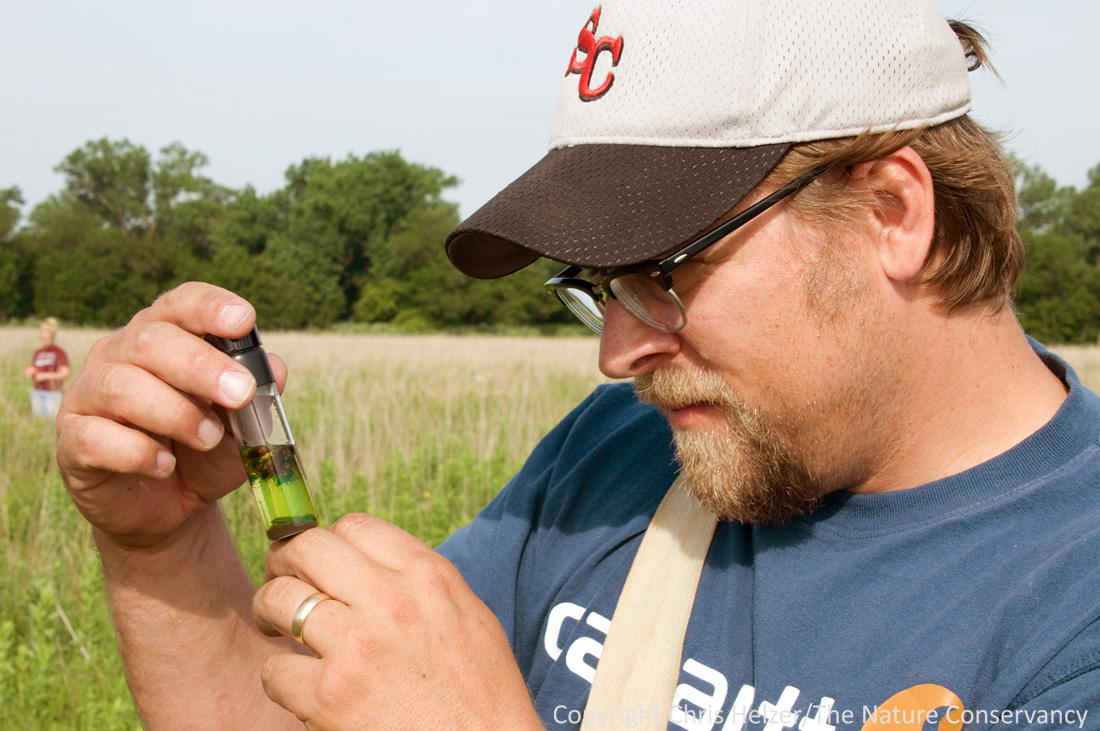
Clint Meyer, of Simpson College (Iowa), was out last week doing some sampling of ground-dwelling invertebrates.  Here he examines insects caught in a pitfall trap within our 2010 diversity research plots.

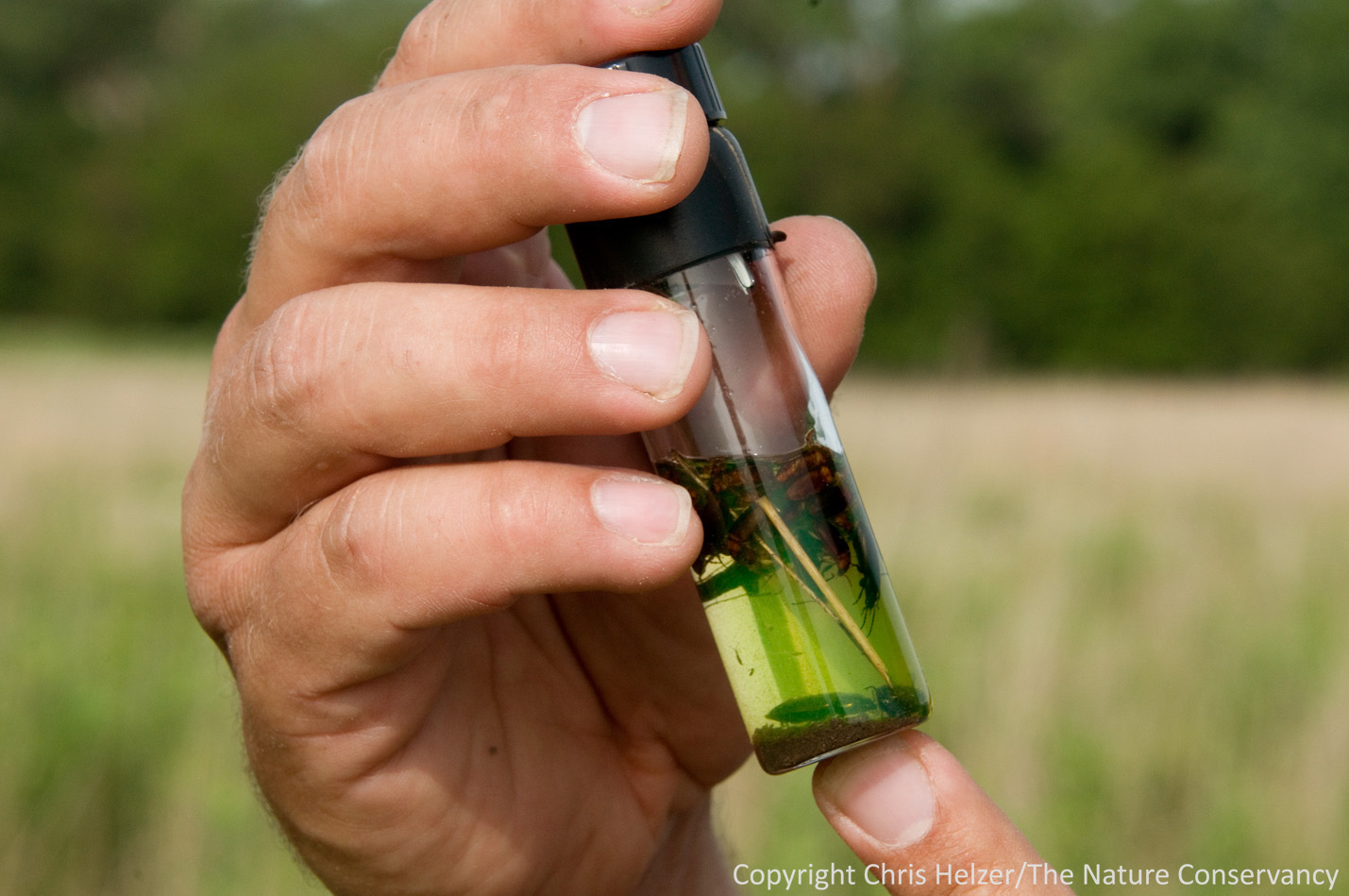
A close-up view of a vial of insects caught in a pitfall trap. There are least two species of ground beetles in the vial (floaters and sinkers!) as well as springtails (the little specks floating in the lower left hand portion of the vial).

Continue reading