
Guest Post by Anne Stine, one of our 2013-14 Hubbard Fellows:
When one considers that the weed-whacker is the modern incarnation of the scythe, Konstantin Levin’s ecstatic enlightenment while cutting wheat with his peasant tenants in Anna Karenina comes across as a little ridiculous. It is easy to imagine him, a ruddy-faced and awkward aristocrat, smiling beatifically in the center of a line of serious men going about the business of mowing.

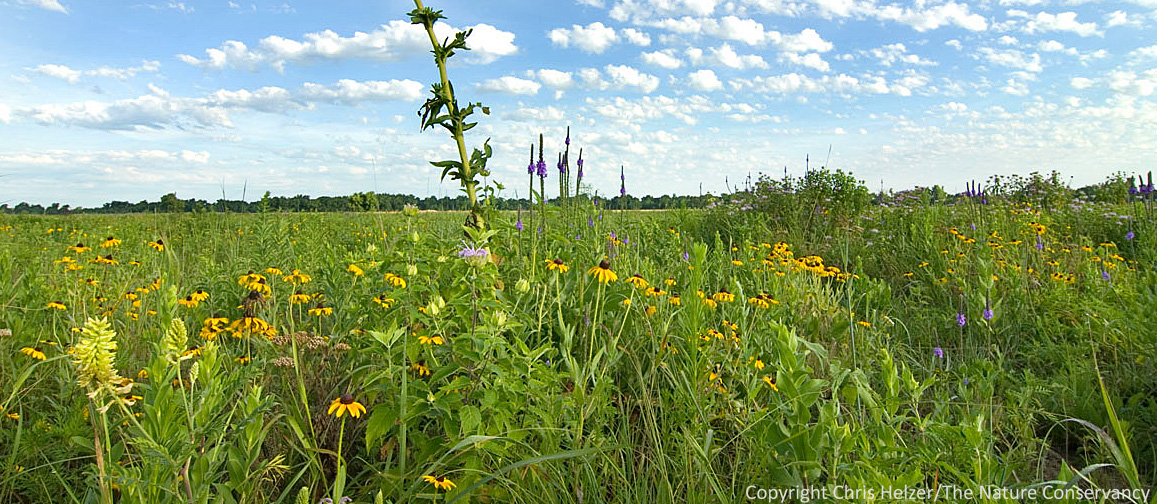
Instead of a wheat field in Russia, this is my work site. The Nature Conservancy’s Platte River Prairies, Nebraska.
Scythes and weed-whackers use the same efficient, swaying pivot through the body. Back and forth, back and forth, the returning stroke hitting the grass missed in the initial swing. Such work does provide the opportunity for quiet thoughts. Unlike Levin, however, I did not achieve enlightenment while weed whacking the grass beneath the 14-gauge wire of an electric fence. Drifting into the repeating beat of the movement, my mind rippled towards the remarkably competent field technicians I have known.
I have been continuously impressed by the manual aptitude of the technicians I have worked with in my academic career. If something broke, rather than sitting completely stumped, they had the know-how to wire it together and make it work. I hope to gain a measure of this generalized comfort with mechanical workings during my tenure as a Hubbard Fellow. I’ve already learned to drive an ATV, a tractor, and a riding mower; and to operate weed-wackers and backpack sprayers. I’ve set electric fence and helped cut free a calf tangled in wire. I want to write all of my physically competent colleagues and say “See! I’m learning.”
Similar to on a farm, the summer season in our pastures is the busiest time of year. We’ve spent most of our hours so far as plant executioners- mowing, spraying, and spading invasives, aggressive natives, and other plants growing where we don’t want them to. The major difference is that our primary product is a restored and healthy prairie rather than cattle or corn.
Thistle chasing has been our primary objective. The musk thistle is classified as a noxious weed—this means that we are legally obliged to assist in its eradication. The musk thistle can grow to be well over a meter high, with multiple fuchsia flower heads. Their leaves are edged in sharp thorns but no hair, and the undersides of their leaves are green rather than white like the native thistles. Originating in Europe, it gets its name from the supposedly odiferous roots and vegetation. We attack them with herbicides and spades. They are prolific seeders. Sometimes killing musk thistles can feel like a Quixotic quest, like we are fighting the tide with a bucket.
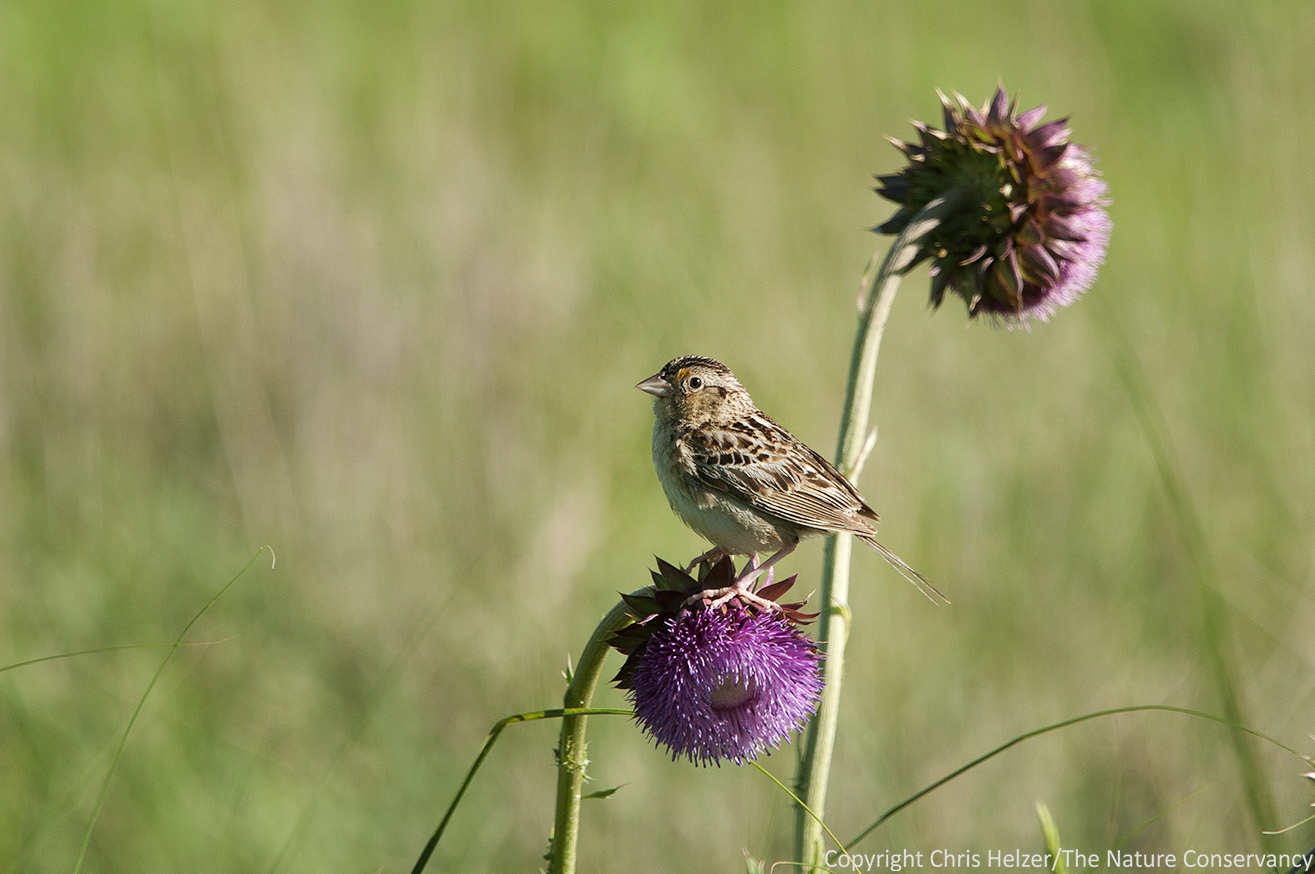
The enemy (with a grasshopper sparrow sitting on it).
.

My weapon of choice.
Killing plants and fixing fences is a full time job in the summer growing season. I have already gained an appreciation for the broad-based knowledge necessary to maintain a working pasture. I hope to continue to develop my applied skill-set, and I will keep saying to the world: “See! I’m learning.”
 The Prairie Ecologist