
One of the biggest challenges of prairie management today is the suppression of woody invaders. Both native and non-native woody species can spread rapidly in prairie, making it difficult to maintain the open grassy habitat that most prairie species depend upon.
There has been extensive speculation about why shrubs and trees appear to be more aggressive and successful now than in the past. Fire suppression has been a factor identified by many as a likely cause, but it’s clearly not the only factor because there are examples such as Konza Prairie in Kansas where shrubs have spread strongly under more than 20 years of regular fire application.
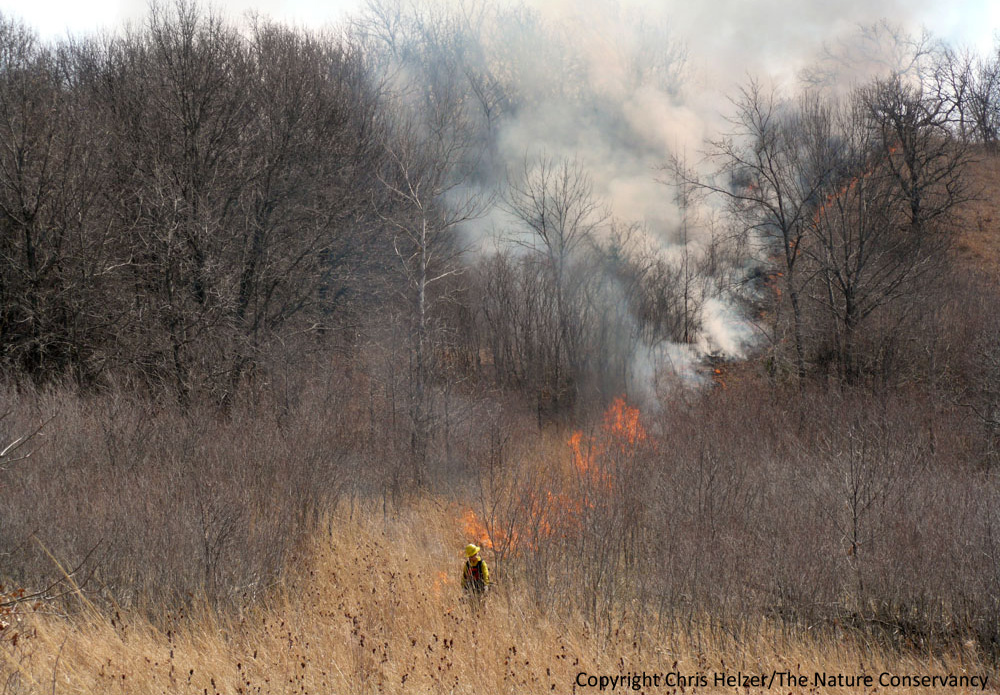
Fire can help suppress shrubs, but there are plenty of examples where frequent fire is not sufficient to stop their expansion.
Now, a new study from Konza Prairie may shed some light on at least some of the reasons behind the agressive expansion of shrubs in the Kansas Flint Hills and other mesic tallgrass prairies. The research paper, written by Zak Ratajczak, Jesse Nippert and others, addresses both the initial survival of new woody plants and the subsequent spread by clonal species (such as dogwood and sumac, which spread by underground rhizomes). It’s worth reading, and you can find a PDF here.
The question of why woody plants are able to establish more successfully in prairies now than they could several decades or more ago is still largely speculative. Jesse Nippert explains his reasoning in an interview here. Changing atmospheric conditions – especially higher nitrogen and carbon levels – are altering the competitive balance in grasslands to favor C3 plants over C4 plants. Because shrubs like dogwoods (Cornus sp.) are C3 plants, higher levels of nitrogen and carbon in the atmosphere are likely giving them an advantage over C4 plants such as big bluestem and other warm-season native grasses that have historically had a competitive edge in tallgrass prairie. This could explain why woody plants are surviving their seedling stage more now than they did in the past – but the idea still needs to be tested further.
However, while initial survival of shrub and tree seedlings is one important component of the issue, the research paper by Ratajczak et al. also addresses the subsequent spread of those shrubs – and they do so through field data collection. They focused their work on the primary shrub species spreading at Konza Prairie – rough-leaved dogwood (Cornus drummundii). What they found was that while most prairie plant species get the vast majority of their resources from the top foot or so of the soil profile, dogwood plants get almost half of their resources from below that level. In other words, dogwoods are using resources – especially moisture – that most prairie plants aren’t taking advantage of. (Yes, most prairie plants do have deep roots, but they typically reserve the use of those deeper roots for periods of drought and rely on their much more abundant shallow roots most of the time.) Importantly, not only do “parent” stems of dogwood use deep soil water, new stems that are initiated by rhizomes (below-ground stems) do too – probably because they can pull water from their parents until they get their own deep roots established.
Taken together, the two ideas proposed by Ratzjcak, Nippert, and others provide an interesting hypothesis about how today’s shrub invasion may be taking place. Higher levels of carbon and nitrogen in the atmosphere and/or soil provide a new competitive edge to colonizing woody plants. That “fertilized” environment overrides the traditional advantage that warm-season grasses have over shrubs, which is that grasses are very good at monopolizing soil resources within the top foot or so of the soil profile. Today, young woody plants are surviving long enough in that dry upper soil layer to extend their roots into deep moist soil – below where most other prairie plants mine resources. Once those woody plants tap into that deep soil moisture, their survival is much more assured. Woody plants that are clonal – such as rough-leaved dogwood and smooth sumac (Rhus glabra) – can then spread by rhizomes, continuing to take advantage of their ability to utilize the deep soil moisture their neighbors aren’t using.
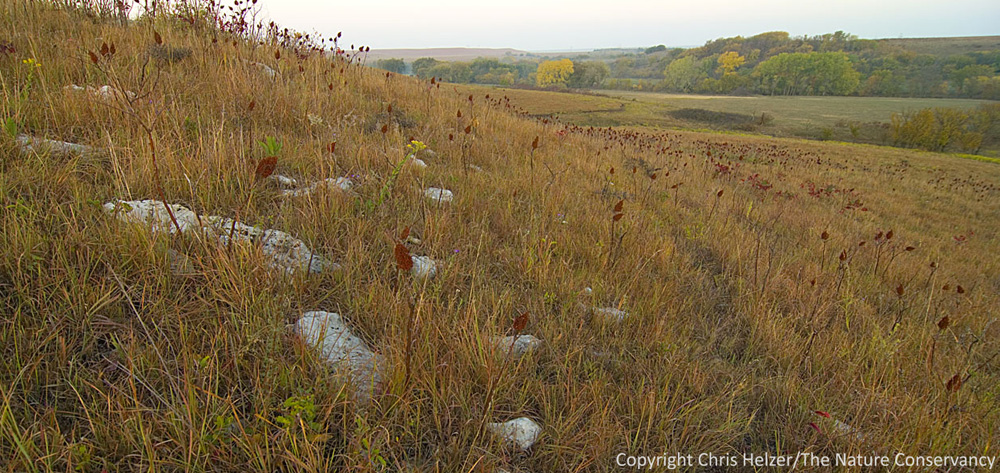
Smooth sumac and flint hills prairie - Kansas. Konza prairie researchers have found that shrub invasion in upland prairies has much less aggressive than in lowlands. Is this because deep soil moisture is less abundant in uplands, reducing the competitive edge to those shrubs?
In addition to the carbon/nitrogen levels and deep soil moisture that both favor shrubs, anyone who has conducted prescribed fires in prairies containing large clones of dogwood or sumac knows that those shrub patches can inhibit the growth of grasses around their edges, reducing the amount of fuel for fires. In other words, shrub patches can reduce nearby fire intensity – thus greatly reducing the effectiveness of one of the most important threats to their survival. You really do have to admire their strategies, don’t you?
I think the hypotheses proposed by Ratajczak, Nippert, and their colleagues could explain a good portion of the puzzle. Atmospheric conditions have certainly changed over recent decades, and that could explain why trees and shrubs have an easier time getting started in grasslands now. However, the competition for deep soil moisture shouldn’t be much different now than it was historically. We know there were at least some shrubs in historic prairies – why didn’t they grow into gigantic unstoppable clones? What controlled their spread that isn’t doing so now? Was the historic abundance of browsing animals high enough to control those clones? Are the fewer browsers today simply overwhelmed by the increased number of new clones that are successfully establishing? Are there other factors we’re not even considering yet?
There are plenty of questions left to answer, but it’s great that we’re moving in the right direction. Besides the work of Ratazcjak, Nippert, and their colleagues, there are several other projects I’m aware of that are working to investigate the issue of woody invasion of prairies. There are certainly plenty of us interested in their results!

 The Prairie Ecologist