Last week, Eliza wrote a nice post about the value of professional conferences, and how much she’s learned by attending several of them during her time as a Hubbard Fellow. It’s great to know that she’s getting a lot out of the meetings she’s attended this year. Coincidentally, at the time Eliza’s post came out, I was attending the 5th World Conference of the Society for Ecological Restoration (SER) in Madison, Wisconsin – along with about 1,200 other people from around the world. The conference was big enough that there were thirteen (!) concurrent sessions going on at any one time. Topics ranged from peat moss restoration in Alberta to tiger habitat restoration in Sumatra.
The SER conference was well organized and interesting, but very different from most of the conferences I attend – including those that Eliza referenced in her post. I think the SER conference was probably really good for scientists who wanted to get a pulse on the research going on around the world and pick up ideas for future research of their own. However, as someone who actually restored and manages land, my main objective was to find ideas I could bring home and apply to our sites. Because of the size and breadth of the conference, I found it difficult to figure out which presentations to attend; most of the talks were from habitat types other than mine and it was hard to decipher which might have themes that would fit with our work. I ended up spending quite a bit of time in the hallways, talking with other attendees with interests similar to mine – and learning a great deal from them.
Wandering around the huge conference center last week made me consider what I really appreciate about the smaller applied conferences and workshops I attend – and often help organize. Here is a list of attributes that I find valuable at those kinds of events. Some of these attributes are probably good for any conference, butI think they are particularly important for those of us directly involved in land management and restoration.
1. Comfortable group size. I like meetings at which I have a decent chance of meeting a majority of participants, or at least knowing something about who they are and what they do. That helps me find people I might want to talk to and learn from, and also makes group discussions possible and effective. I think meetings of 80 people or less are ideal.
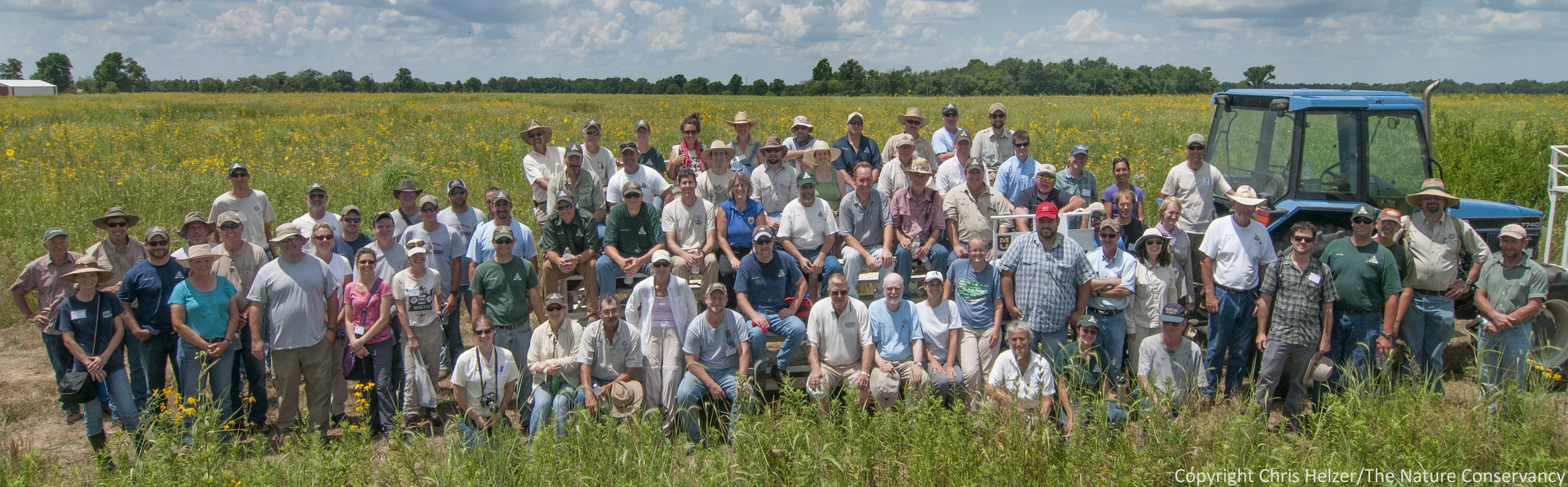
This year’s Grassland Restoration Network workshop was hosted by the Missouri Department of Conservation. The attendance was strong, but the group small enough that it was possible to meet and talk with a majority of them during the workshop.
2. Narrow Focus. It’s nice to know that a high percentage of presentations I listen to are going to be relevant to my work. Two of my favorite gatherings each year are those of the Grassland Restoration Network and the Patch-Burn Grazing Working Group because both are focused on activities I’m very involved in. While their ranges of subject matter are relatively narrow, both of those meetings include participants from across a large geographic area, with a wide variety of perspectives and experiences I can learn from.
3. Lots of discussion time. At many conferences, presentations are typically limited to 15-20 minute time slots and although presenters are encouraged to leave time for questions at the end, they rarely do. Even when there is time, it’s not discussion time, but rather a couple of quick clarification questions. I like sessions in which there is a short presentation (or two) of thought-provoking ideas or examples, followed by a well-facilitated group discussion that brings out innovative thoughts and questions from audience and presenters alike. Many times, those kinds of discussions generate ideas far different – and more interesting – than what the presenters started talking about.
4. Effective field trips. I learn best when I can see what someone’s site really looks like, and evaluate the impacts of their work firsthand. The best field trips are those during which the trip host takes us not just to places where their work has been very successful, but also where things have not turned out at as they’d hoped. Seeing both the good and the bad, and having honest thoughtful discussions (in the field) about those is incredibly useful, and generates ideas I can bring back home and use. I also appreciate field trips that allow participants to wander away from the vehicles a little and explore, instead of just loading us into vehicles as soon as the host is done talking.
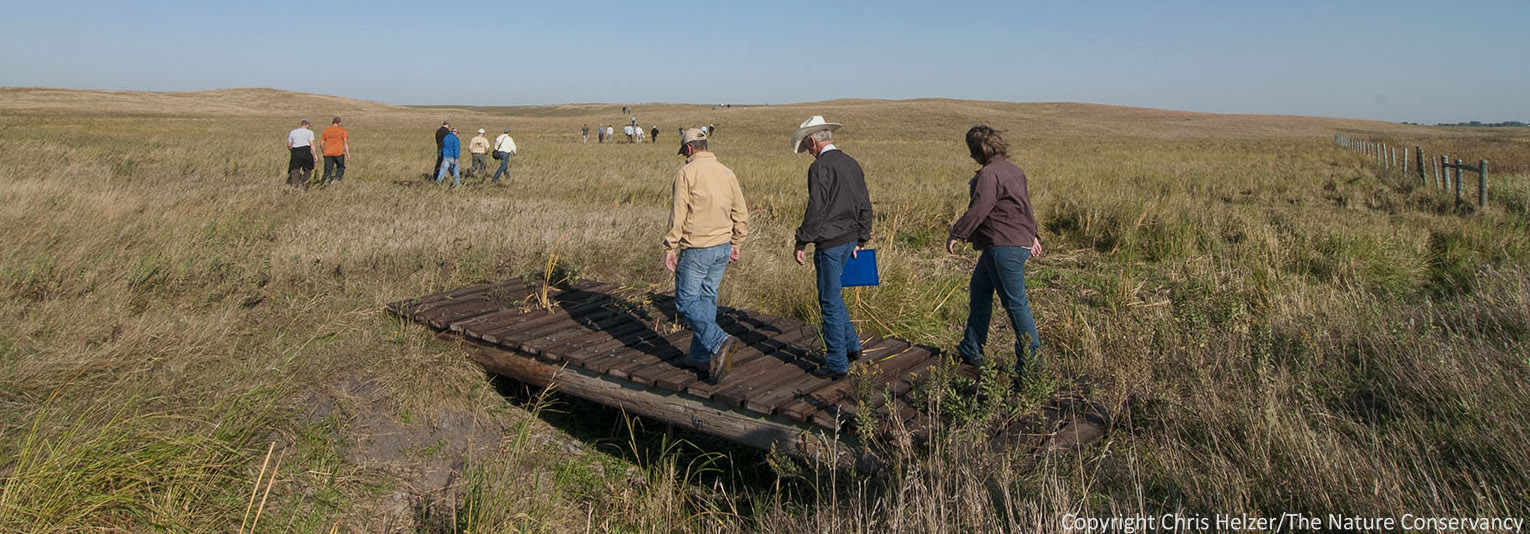
Participants of this year’s Patch-Burn Grazing Working Group meeting walk across The Nature Conservancy’s 7-mile Fen in western South Dakota. This was one of two half-day field trips we went on during the conference, and the hosts did a great job of showing us results of their efforts, but also giving us time to explore and evaluate the site ourselves.
5. Plenty of time and space for informal networking. Conferences and workshops I help organize typically schedule plenty of time to just sit around and talk informally. It’s really frustrating to go to a conference that is scheduled from dawn to dusk with events and presentations, leaving no time for getting to know other participants. Much of what I learn from group meetings comes from side discussions during which I can really get to know someone and learn about their experiences. The benefits of that informal time extend beyond the conference as well because I come home with a list of people I can call in the future when I have a question or idea on a particular topic.
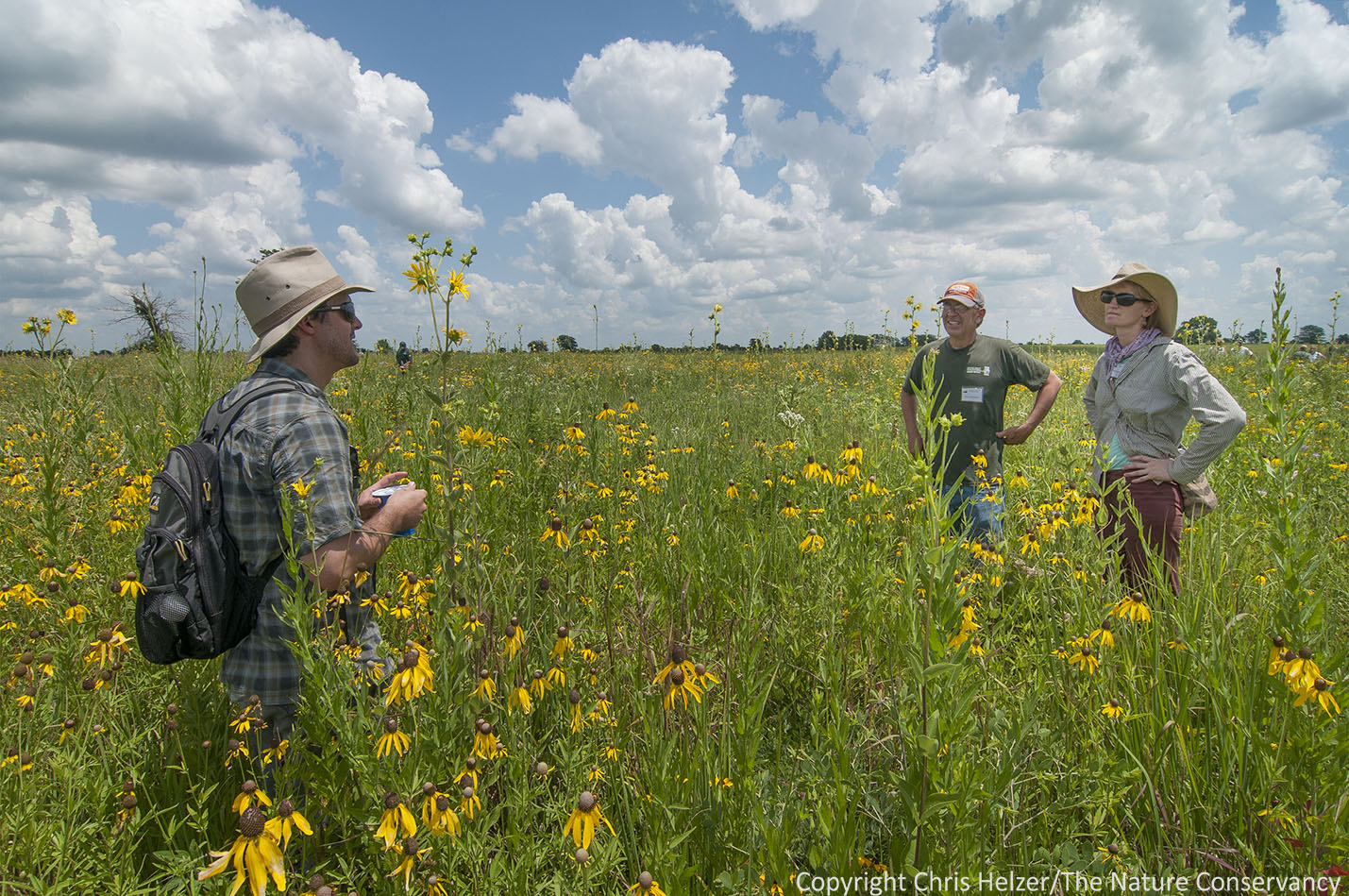
Informal discussion time, whether in the field or indoors, is often the most valuable part of any conference. This conversation – during the 2013 Grassland Restoration Network – occurred during some free time on a field trip.
6. Presentations that focus on a lesson or message rather than statistical methods. In graduate school, students are usually taught to give presentations that follow the format of a scientific journal article: introduction, methods, results, discussion. When giving a thesis defense presentation to get your degree, that’s probably appropriate. However, at a conference with others who want to learn about your project, spending most of your allotted time talking about how you set up your project and analyzed your data is worse than useless. The most useful presentations focus on the results and how they fit into the larger context of a topic. If I want to know what statistics you used to analyze your data, I’ll ask you at another time or read the publication you’ll eventually write. Tell me what you learned and why it’s interesting and important.
7. An accessible price. When I help organize workshops and conferences, keeping the cost of attendance down is a top priority. Most of the attendees at our meetings are land managers or scientists that work for state agencies or non-profit conservation organizations, and both money and time are tight. It’s hard enough to convince people to leave their sites and task lists for a couple days. Making them pay high registration fees in addition to hotel and travel costs is an unnecessary barrier to their attendance. We can’t do anything about travel costs to get to the meeting, but we work hard to find conference centers and lodging options that are low cost. Often, those lower cost meeting locations tend to facilitate better informal interactions anyway.

This is the kind of conference venue I like best…
I was grateful for the opportunity to attend the SER conference in Madison last week, and I got the chance to meet some new friends and catch up with some old ones. However, the conference also gave me a chance to compare and contrast meeting styles and think about what attributes are important to me. I’m curious to hear what you think on this topic.
….
P.S. I have one request to anyone who talks about ecological restoration. Can we please agree to stop using the phrase “If you build it, they will come”?
Seriously. Thank you.