
When is a Prairie Restoration (Reconstruction) Project Successful?

This is a follow-up to last week’s post on using prairie restoration to enlarge and reconnect remnant prairies.  In this week’s post, I present a case study of a remnant sand prairie and an adjacent prairie restoration, and give thoughts about how to measure the effectiveness of that restoration project.  We’re (all of us) just getting started figuring out how to measure this kind of thing, so I’m hoping my thoughts will stimulate others to come up with their own ideas to improve upon – or contradict – mine.

Last week, I wrote about how we can improve our chances of conservation success in small isolated prairies by using prairie restoration (reconstruction) to enlarge and reconnect prairie fragments.  I even made a goofy analogy about catching falling popcorn.  At the end, I mentioned that when measuring the success of a prairie restoration – as a tool for enlarging or reconnecting remnants – we need to take a different approach than simply comparing the remnant and restored prairies to see how similar they are.  If the point of the restored prairie is to reduce the level of threat to species and natural communities inside the remnant prairie, that’s what we need to measure.

To explain what I mean, let me use a restored/remnant prairie complex along Nebraska’s Platte River as an example.  In 2000, The Nature Conservancy added several hundred acres to our Platte River Prairies through a land acquisition.  Most of the new land was cropland, but it also included 60 acres of remnant mixed-grass sand prairie with good plant diversity.  Two years later, using seed harvested from the remnant prairie and other nearby sites, we seeded 110 acres of cropland directly adjacent to the sand prairie.  The restored cropland has the same kind of hilly topography as the remnant, but also includes some low areas more appropriate for mesic tallgrass prairie.  Thus, the 162 species in our seed mixture included plant species from both mixed-grass sand prairie and mesic tallgrass prairie.

Remnant sand prairie at The Nature Conservancy's Platte River Prairies.

In June of 2010 I collected plant data from both the remnant and restored prairie (in its ninth growing season).  The data were collected by counting the plant species inside a 1m2 plot frame from 100 locations across each prairie.  Those data allowed me see the frequency of occurrence of each species (the % of plots in which each species was found).  To make the results easier for you to visualize, I’ve used a color-coding system to create what I call a plant composition signature for each prairie.  The complete comparison of the two prairies, with additional interpretation, can be seen here if you’re interested, but for this example, I’m just going to show some representative excerpts.

After the latin and common name for each species, you’ll see a column labeled “C”, which is the C-value (or coefficient of conservatism – defined by Swink and Wilhelm 1994).  If you’re not familiar with this categorization of species, a quick explanation is that lower C-value species are more opportunistic plants that can generally thrive in very disturbed environments and higher C-value species are more tied to intact native communities.  Another way to look at it is that higher C-value species are more vulnerable to habitat degradation.  All species are ranked on a scale from zero to ten (the values I’m using are specifically for Nebraska) and all exotic species get an automatic zero.

In general, the restored prairie has the same grass species as the remnant, although many are less abundant. Most of those less abundant species will spread over time as the restored prairie continues to mature. A few sedges, including sun sedge, do not establish well from seed, and we're attempting to bring them in as transplants and let them spread from there.

The main difference in "weedy" forbs between the remnant and restoration is the abundance of goldenrods in the restoration. Canada and late goldenrod were both from the seedbank, but stiff goldenrod was planted by us. At this point, I'm not concerned about the goldenrods (they don't appear to be as aggressive here as in some places) because they haven't been decreasing species diversity over time.

As with other species, I expect many of the more conservative forbs species will increase over time in the restoration.
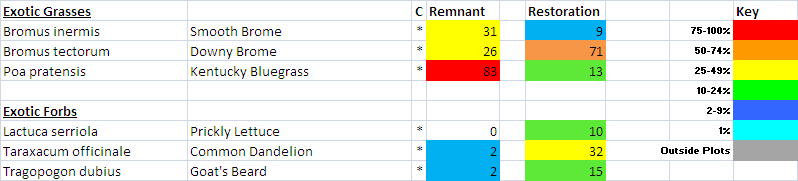
Based on experience, I'm sure Kentucky bluegrass and smooth brome will increase over time in the restoration, but so far we've been able to manage those species to keep them from overwhelming the plant diversity in other older restorations. Apart from those two species there are no serious invaders that in the restoration that might threaten the remnant, which is good to see.

It’s easy to find differences between the remnant and restored plant communities in this example – some plant species are much more abundant in one than the other.  On the other hand, very few plant species from the remnant are missing completely from the restored prairie, and those that are less abundant are likely to increase over time.  As a prairie ecologist, I can see some obvious visual differences between the restored and remnant prairies, but most visitors to our site see the two as one large prairie.  But… Does any of this matter?  How do I decide?

First, remember that the objective of this restoration project was NOT to replicate the remnant sand prairie, but to increase the viability of the species and communities living in it.  Given that, the real questions I need to answer include the following:  Does the restored prairie increase the population size of species formerly constrained by the small remnant prairie?  Does the combination of the restored and remnant prairies provide suitable habitat for species that don’t occur in prairies the size of the remnant alone?  Does the restored prairie add to the overall resilience or ecological function of the remnant prairie?  Any questions about similarities or differences in the abundance of individual plant species need to be framed within the context of these kinds of broader questions – and tied to the specific objectives for the restoration project.  Comparisons outside of that context are relatively meaningless.

To begin evaluating the impact of the restored prairie, one first step could be to look at a few at-risk species in the remnant prairie to see if the restoration appears to benefit them.  If the remnant prairie has been harboring a small population of Franklin’s ground squirrels, for example, it’d be good to find squirrels (and their burrows) in the restored prairie as well.  If there was a rare penstemon species in the remnant (bumblebee pollinated) it’d be interesting to follow bumblebees from the plants in the remnant to see if they also visit penstemon plants in the restored prairie  – indicating that the restored prairie has facilitated growth of a genetically-interactive penstemon population.

Besides at-risk species, it would be worthwhile to search the restored prairie for the presence and/or abundance of species from other categories as well.  These categories might include:

–          Species that are representative of various types of relationships (e.g. predators and their prey, parasites/parasitoids and their hosts, insects and their larval host plants, etc.).

–          Species that have a cascading effect on other species and ecological processes (e.g. allelopathic or parasitic plants, burrowing insects/animals, etc.).

–          Species that are particularly important as food sources for a range of other species (e.g. springtails – aka Collembola, grasshoppers, “soft-bodied insects” like caterpillars and other similar larvae, etc.).

–          Area-sensitive species that may not have been able to survive in the small remnant alone but that might have a chance in the combined restored/remnant prairie (e.g. prairie chickens, badgers, and other vertebrates).

It’s also important to evaluate impacts of the restoration project on groups of species that influence ecological processes – such as pollinators and seed dispersers.  Pollinators are relatively easy to observe, and both the pollinators themselves and the resources they depend upon can be evaluated.  Ideally, of course, it’d be great to have several years of data on the species richness and abundance of pollinating insects in a small remnant prior to initiating a restoration project, followed by similar data collection after the restoration has established.    However, simply looking at whether or not purple prairie clover plants (for example) in the restored prairie are getting pollinated by the same species and numbers of pollinators as the prairie clover plants in the remnant could be very informative.  From the resource perspective, if the remnant prairie tends to lack an abundance of flowering plants at a particular time of year (late spring, for example, or early fall), measuring whether or not the restored prairie provides appropriate blooming plant species to fill that gap is very important.

Purple prairie clover being pollinated by a native bee.

There are numerous other things that could be measured, including taxonomic groups we really don’t know much about at this point.  For example, soil fauna, fungi, and obscure groups of invertebrates may very well have strong roles to play in ecological functioning of prairies, but we don’t know much about what those roles might be or how to evaluate them.  While it’s certainly important to learn more about those other taxonomic groups, our lack of knowledge shouldn’t stop us from measuring what we do know in the meantime.

The last thing to consider is whether or not a restored prairie could be actually be negatively impacting the adjacent remnant prairie or its species.  One example of this could be an invasive species that becomes established in the restored prairie – thus threatening the remnant.  A second possibility is that the restoration could function as an “ecological sink” for some species from the remnant, in which a species is drawn out of suitable habitat into attractive-looking but perilous habitat instead.  We’ve actually been testing for one possible example of this in our Platte River Prairies.  Regal fritillary larvae feed only on violets, but adults don’t lay their eggs directly on violet plants.  Our lowland remnant prairies have lots of violets, but our restored prairies have very few (so far) because we are unable to harvest large numbers of seeds.  We’re trying to make sure fritillaries aren’t laying eggs in the restorations where the larvae would be doomed to starve because of the near absence of violets.  (So far it looks like it’s not a big problem.)

As I mentioned at the beginning, we’re just starting think about how to measure the effectiveness of restored prairies as conservation tools.  Since the initial practical work of a prairie restoration project involves the establishment of a new plant community, it’s natural to assess the success of the various species we included in the seed mixture.  Unfortunately, it’s also easy to overemphasize the importance of floristic differences between a restored prairie plant community and nearby remnant prairies.  For many reasons, it’s not practical to recreate a historic prairie or replicate an existing remnant prairie.  However, it is possible to use prairie restoration to increase the viability of our remaining remnant prairies.  It is imperative to set clear objectives for this kind of restoration work, including the specific ways we want the restored prairie to help abate threats to species and communities.  Clear objectives will lead to easier decisions about how to measure success.

Many of the suggestions here are just first steps, and they and subsequent steps will require considerable resources, as well as collaboration with academic researchers.  Yes, there’s a lot to measure, but as we start to establish consistent patterns of success with some kinds of species or ecological processes, we can start focusing attention more narrowly on others.  We don’t have to test everything at once, and the most important measures at each site are those that evaluate whether or not specific objectives for that restoration project are being met.  However, it will be critical that we all share what we learn – successes and failures alike – to build up our cumulative knowledge as quickly as possible.

There are a number of examples of restoration projects where remnants have been enlarged or reconnected by restoring adjacent lands.  We should look closely at those existing sites to see if we can find evidence of success or failure (based on some of the suggested strategies above – and others).  That knowledge can guide us as we plan and implement new projects in the coming years.  It’s unlikely that we’ll be able to design restoration projects to benefit every prairie species and function, but we can certainly do a lot of good.  There’s a lot of work to be done, but I’m very optimistic about our ability to make a real difference.
How Should Landowners Evaluate Their Prairies?

This week, I’ll be attending the annual Tallgrass Prairie Seminar in southeastern Nebraska.  The meeting is organized by Kent Pfeiffer (Northern Prairies Land Trust) and other staff of the Tallgrass Prairie Partnership office in Beatrice.  One of the best things about the seminar is that well over half of the 100 or more participants are private landowners (the remaining are mostly agency biologists).  I always enjoy talking with landowners about their prairies because it helps remind me what’s important to them.  I already know what I want to see happen in the prairies I manage, but every landowner has their own individual goals for their prairie.  Many rely on their prairies for at least some income, and that plays a large role in determining their annual management strategies.  However, almost all prairie landowners (that come to this seminar) are also very interested in the wide variety of species, from pheasants to bees, that live in their prairies.

As I was thinking about going to the seminar this year, I started thinking about how landowners measure success related to prairie management.  When I wrote my recent book on prairie management, I felt like some of the most important portions of the book were the ones that dealt with setting objectives and evaluating whether or not management strategies were helping to meet those objectives.  Unfortunately, those were also the hardest for me to write. 

Measuring success is really difficult for professional biologists, let alone landowners with much less formal training in science and monitoring techniques.  In my book, I tried to suggest some examples of fairly simple, but effective, methods of monitoring the biological diversity of prairies, the response of the prairie to management, and threats such as invasive species.  While I think my suggestions were useful, they were also relatively vague.  I’ve thought a lot about the subject since and feel like it’s worth revisiting. 

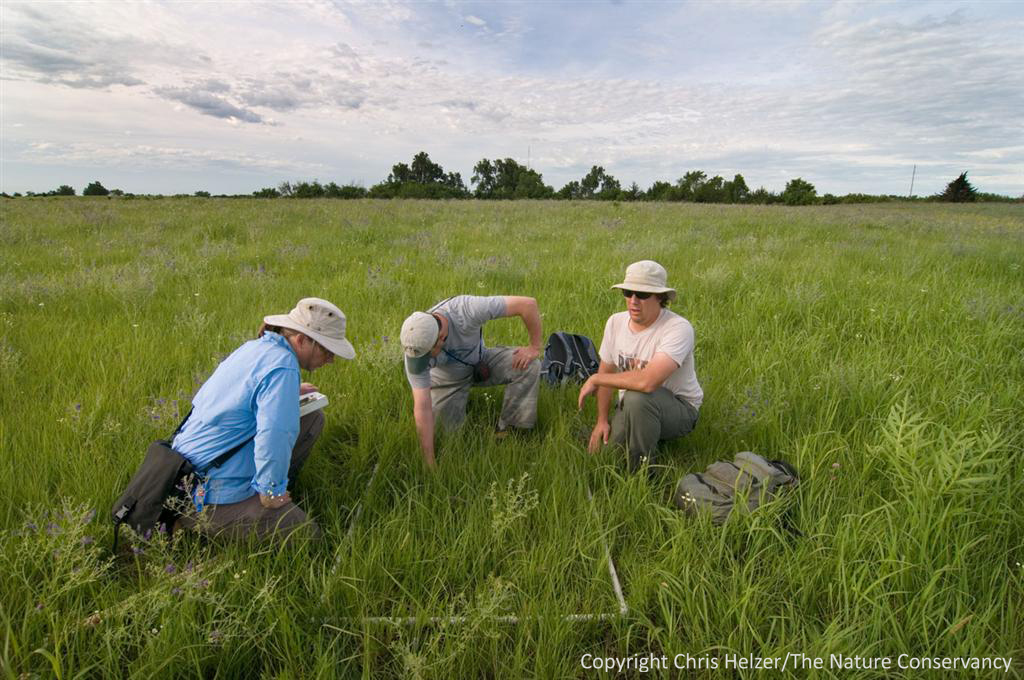
Biologists find it very difficult to evaluate prairies. It can be time consuming and expensive, and it is also difficult to design evaluation strategies that really measure the right things. (Biologists from the Illinois Natural History Survey collecting data on prairie plants)

What I’d really like to do is lay out some brief ideas in this blog post and get feedback from those of you who read it.  I’m hoping that you’ll help me refine some of my thoughts, and that you’ll add to my short list.  I’d really like to hear from landowners, as well as biologists.  The overarching goal here is to come up with an array of measures that can help track how a prairie is doing.  (Is the prairie maintaining or increasing its diversity of plants and insects?  Are invasive species increasing or decreasing?  etc.) The evaluation techniques need to be effective, but also accessible to biologists and non-biologists alike.  They also need to be logistically feasible, and can’t take too much time or money.  Should be easy, right?

Here are some ideas I have.  I wouldn’t expect anyone to employ all of these, but rather pick and choose the ones that are most feasible for them, and the ones that best meet their individual objectives.

1.       Measuring the number of plant species – at multiple scales.  Counting plant species can be a challenge because of the relative difficulty of identifying plants (especially when they’re not blooming) and because the total number of species in a prairie can be very high.  While it can be interesting to keep a comprehensive list of the plant species in a prairie, the primary value in doing that is probably to help the prairie owner learn plant identification.  However, I think it can be more useful to count plant species at a much smaller scale – at the 1m2 or ½ m2 scale, for example.  A landowner could walk around the prairie and stop in 10-20 random places and simply count the number of different plant species he/she sees within a plot frame laid on the ground.  Identifying the species by name is not necessarily important – just counting the number of DIFFERENT species within the plot is the key.  If grass species are too hard to separate, even just counting the number of broadleaved species would probably work.  I’ve seen some interesting fluctuations in species numbers at this scale as a result of different management techniques, and I also think it can be a useful measure of long-term trends in plant community changes.  Establishing permanent plots and counting the species in those each year would be even more valuable – but more difficult as well.

2.       Tracking rare plant species.  This can be very difficult to generalize because every rare plant species is so different.  Prairie fringed orchids, for example, may bloom one year but not for the next several, and that may have almost no relationship to management.  Some rare plants may occur in only a single patch each year, while others may be spread thinly across an entire prairie.  I think it can be valuable, however, for a landowner to identify rare plants that are in their prairie, and find a way to track them – even if it’s as simple as walking the prairie during the time that plant blooms each year and estimating the number of individual or patches of plants.  Keeping track of long-term (not short-term) changes in abundance can be important.

3.       Tracking insect abundance/diversity.  Because of the incredible diversity of insect species, their wild fluctuations in numbers from year to year, and the difficulty in identifying species, I’m having a hard time coming up with a reasonable method of tracking insect diversity over time.  I like the idea of something simple – like putting out several types of sticky traps and counting the number of different-looking insects they find.  I’m just not sure that would be very effective at detecting changes over time.

I wonder if it would be useful to select a couple of common wildflowers, one that blooms in the early summer and one in the early fall, and count the number of pollinators visiting them?  A landowner could select 5 different plants and estimate the number of different species (and total number) of pollinators that visit each plant during a 10 minute interval. 

Other ideas I have, but don’t really feel comfortable with, involve things like counting spider web numbers on dewy mornings, and the number of galls on goldenrod and other plant species.  Bill Whitney, of Prairie Plains Resource Institute, has talked in the past about being able to hear the difference between a nice prairie and a CRP field because of the cacophony of insect sounds in a prairie, but I’m not sure I can translate that into an evaluation method!  I could really use some help on this…

4.       Counting Grassland Bird Species.  Yes, I just wrote a blog post on how poorly grassland birds work as indicators of prairie quality.  However, they CAN be useful when they’re only a part of a larger monitoring regime – and birds are relatively easy to identify.   I think just counting the number of grassland bird species (those that actually nest in prairie vegetation) across a prairie can provide useful information about the functional size of a prairie and the types of available vegetation structure. 

Red-winged blackbirds are one of the grassland breeding bird species least sensitive to prairie size.

An absence of grassland nesting birds can indicate that a prairie lacks the habitat size or distance from edges necessary to make them feel comfortable nesting there.  Species such as dickcissels and red-winged blackbirds are some of the least sensitive to prairie size, and upland sandpipers, Henslow’s sparrows, and bobolinks are among the species generally considered to be more sensitive.  Seeing only species that aren’t sensitive to prairie size could indicate that a prairie is too small or skinny for those species.  It could also indicate that there are too many trees (or not enough area that is far away from trees) for those species to be present – and that might be something that management changes could fix. 

However, birds also rely on habitat structure, so those needs have to be factored in when interpreting results of bird counts.  For example, if a landowner only finds 3 species of grassland birds each year, and all three tend to nest in the same type of vegetation (short/sparse or tall/dense) the prairie is likely pretty homogeneous in terms of habitat structure.  On the other hand, if there are about 3 species each year, but the species change from year to year, the prairie’s habitat structure type is probably changing from year to year as well.  Ideally, it’d be nice to see more like 5-8 species of grassland breeding birds each summer, and to see them in different locations from year to year – indicating a shifting mosaic of habitat structure across the prairie, and adequate prairie size to attract those species.  Yes, it’d be nice to know whether or not they’re successfully raising broods (looking for adults carrying food to young birds could help measure that) but measuring nesting success is generally well beyond the capacity of landowners, and most biologists as well.

5.       Counting tracks in the snow.  This obviously works better in northern prairies than southern prairies, but I like the idea of somehow incorporating tracks into evaluation.  I don’t know that it has to be very rigorous to be useful.  I’ve noticed here in Aurora that the small prairies right along the edge of town have very few tracks of mice and other small mammals on the snow compared to larger prairies further from town.  My guess is that the lack of tracks in/near town is due to a combination of factors, including high predator pressure from cats, foxes, etc., frequent prescribed fires that burn all or nearly all of each prairie in the same year, and the lack of other nearby grassland habitat for mammals to recolonize from when/if the small populations in our small prairies disappear.  It seems to me that seeing an abundance of tracks (of multiple species) during the winter is a positive sign that a prairie is providing habitat and relatively low threat levels for a number of species.

Can the tracks of small mammals in snow-covered prairies indicate how a prairie is doing?

6.       Tracking Invasive Species.  Just as with rare plants, appropriate methods of tracking invasive species (plants or otherwise) will vary widely by species.  However, I do think it’s important to have some measure of whether high priority invasives are increasing or decreasing in abundance or impact.  Some species, like trees, can be easy to track just by counting the total number or the number per acre.  Others, like leafy spurge or crown vetch, may generally appear in relatively distinct patches, and can be tracked by counting and measuring the size of those patches in at least some portions of a prairie.  Invasive grasses such as smooth brome, Kentucky bluegrass, or tall fescue can often be so ubiquitous that there is no point in trying to count stems or measure the extent of their occurrence (because they’re everywhere).  With those species, the best measure of whether management is suppressing them or not may be to look at the species the invasives are impacting.  In other words, if smooth brome is everywhere in a prairie, it’s unlikely that management will eliminate it from much of the prairie, but if plant diversity is increasing, that may mean that management is decreasing the dominance of brome in favor of other plants. 

7.       Journal of Observations/Photos.  Finally, I strongly recommend that landowners – or any prairie manager – keep a journal of their observations each year.  It’s hard to recollect exactly how abundant a species was 5 years ago, or how a particular management treatment affected habitat structure, without some notes (and preferably accompanying photos) to record that. 

Journal notes don’t have to be extensive to be useful.  If a landowner got a particularly good kill on Canada thistle last year, writing down what they did and why they think it worked can help them figure out why this year’s treatment didn’t work nearly as well.  If there are an unusually high number of butterflies one year, jotting that down can help in future years when trying to figure out the impacts of management.  Recording general weather patterns (“it was a hot and dry summer”) can help as well.  Maybe the butterflies were abundant because of the spring weather, rather than management, for example. 

Photography can be helpful as well.  Photographs that accompany journal observations can help clarify memories of those observations later.  Some people find that taking photos from the same place, and the same time, each year can help show patterns.  I think that in some cases that can be useful, but it also takes discipline and time, so it may or may not be worthwhile for all landowners. In addition, photo points can help indicate whether or not trees are becoming more abundant, or the blooming abundance of certain flowers, but many other changes don’t show up well in photos.

.

Please help me revise and add to these.  You can leave your ideas below under “comments” or “reply” so that others can respond to your ideas as well as mine.  Thank you!