Tomorrow, I’m leading a photography workshop; something I rarely do. I’m looking forward to the workshop, but always feel a little funny teaching photography for a couple reasons. First, photography is a very individual activity, by which I mean that every photographer interprets the world in their own way. Because of that, trying to “teach” someone how to be a photographer seems like kind of a crazy thing. As a result, I’ll be talking very little about the interpretive part of photography, and concentrating mostly on the mechanics of how cameras work and how to use that knowledge to create art. Then I’ll try to provide a lot of examples of what’s possible with photography, hoping to inspire people to develop their own vision.
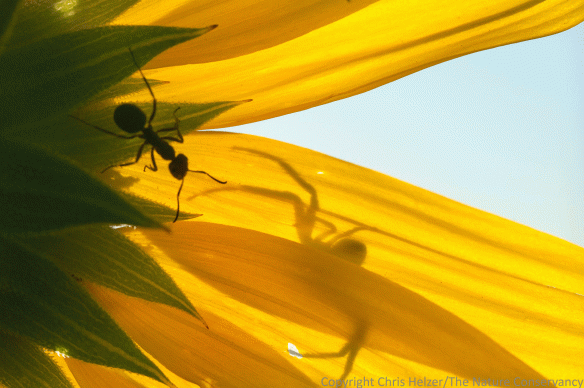
Bugs (in the broad, non-scientific sense) and flowers are subjects I feel comfortable with. Landscapes, wildlife, and other subjects are much less in my wheelhouse.
The second reason I hesitate to lead workshops in photography is that I feel pretty limited in my own knowledge. After all, I spend most of my time on my knees, photographing tiny bugs and flowers, and I’ve learned how to do that using the few pieces of equipment I happen to own. I suppose I know more than the average person, but I don’t feel like I have the kind of broad knowledge of camera equipment or techniques held by many photographers I admire; people like Michael Forsberg, Clay Bolt, Piotr Naskrecki, and Joel Sartore. Also, when I stray from my narrow range of expertise, I tend to make a lot of mistakes. That seems to happen particularly often when I attempt night time photography.
The latest example of my night time photography foibles came during the trip Kim and I made to the Niobrara Valley Preserve over the holiday season. The weather was very cold while we were there, but I braved the temperatures one night and went out to photograph in the light of a half moon. I worked along the river, mostly, shooting starry scenes with the river and silhouetted trees in the foreground. Because of the moonlight, the stars weren’t really popping in the photos, so I decided to switch and shoot the moon instead. I wandered over to “the chute”‘ a locally famous waterfall on the Niobrara River, right near the Norden Bridge. Because of the sub-zero temperatures, much of the river was frozen, but the water pouring over the falls was still ice free, and there was fog (is it really called fog in those conditions?) coming off the falls and rising up toward the moon. It was a magical scene, and I worked for about an hour to capture images of it.
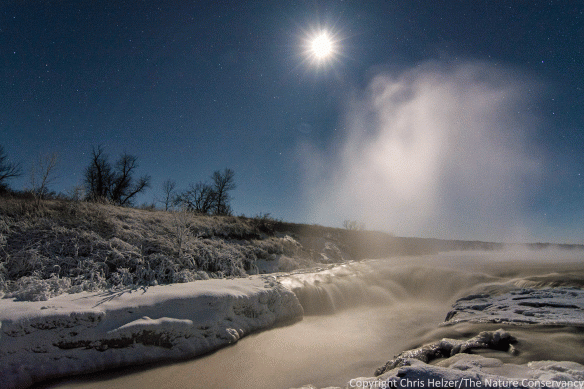
Here is one of the three images I brought back from more than an hour photographing ice and water in the moonlight. All three photos were taken with a Tokina 12-28mm lens at ISO 800, f/4, and a shutter speed of 6 seconds.
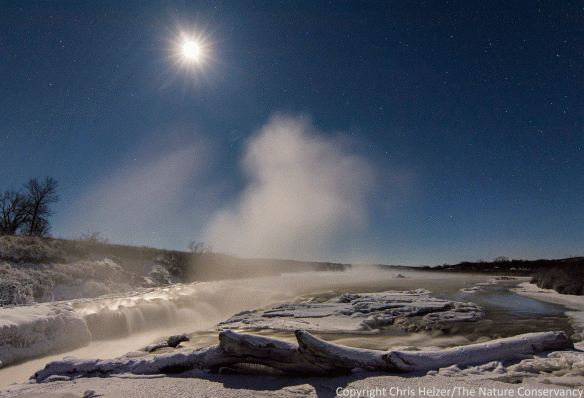
The log in this scene has been stuck on the same ledge for several years now. I keep waiting for a big water event to wash it away…
Unfortunately, my mind must have been as frozen as the the ice I was (carefully!) walking around on. I completely forgot to change my aperture settings on the camera from the wide open settings I’d been using for star photos to settings that would give me more depth-of-field. And because it was dark, I had a hard time focusing anyway, and didn’t notice how out of focus many of my foregrounds were. This led to a lot of almost great photos with blurry images of rocks, ice, and/or water in the foreground. Out of that entire hour, I ended up with three images that were fairly sharp all the way across – only because I was far enough from the foreground for it to be sharp. Anything with a nice close waterfall in the foreground and starry sky in the background turned out to be junk.
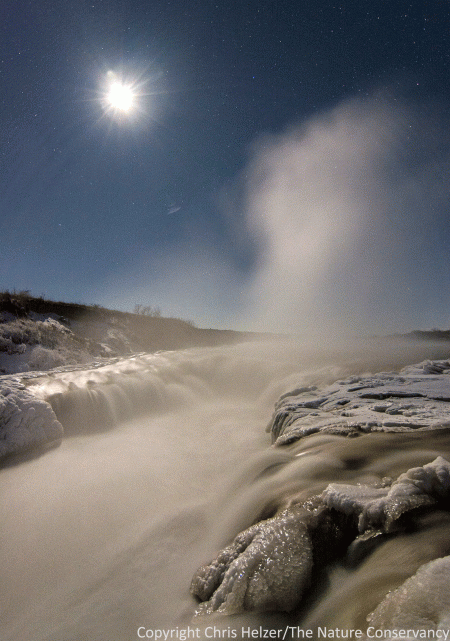
This was my favorite of the three decent shots, mainly because there was something interesting in the foreground (though I had a couple others with that ice formation much closer to the camera that would have been spectacular…)
I sometimes make mistakes photographing bugs and flowers too, but night time photography always seems to give me big problems. In fact, one of my biggest recurring issues with bug/flower photography is tied to night photography… I very often forget to reset my ISO after shooting star photos the night before and end up taking grainy photos of flowers with an obscene ISO of 2500 or so. I’m telling you – night time photography is out to get me. I’d like to think I’ll get better at it if I do more of it, and I’ve been making an effort in that regard, but so far, not much luck. Fortunately, there are lots of bugs and flowers to photograph during the daylight hours, so my ego hasn’t completely deflated.
Gee, this wasn’t a great advertisement for my photo workshop tomorrow, was it? If you’ve signed up and are reading this, I promise I’ll do my best to make it worth your time. The good news is that the workshop happens during the day – not at night!


 The Prairie Ecologist