
How important is plant diversity in restored prairies?
Are diverse prairies more resistant to drought and invasive species than less diverse prairies?
How does plant diversity influence invertebrate communities and their ecological functions?
These kinds of questions have been the focus of multiple research projects in our Platte River Prairies over the last decade or so. We have numerous restored (reseeded) and remnant (unplowed) prairies that provide excellent field sites, and have also established two sets of experimental research plots to help focus specifically on questions related to plant diversity. Those plots are 3/4 acre (1/3 ha) in size and represent varying levels of plant diversity, allowing us to investigate the functional differences between them. Researchers from the University of Nebraska, Kansas State University, the University of Illinois, and Simpson College have been involved in data collection efforts so far.
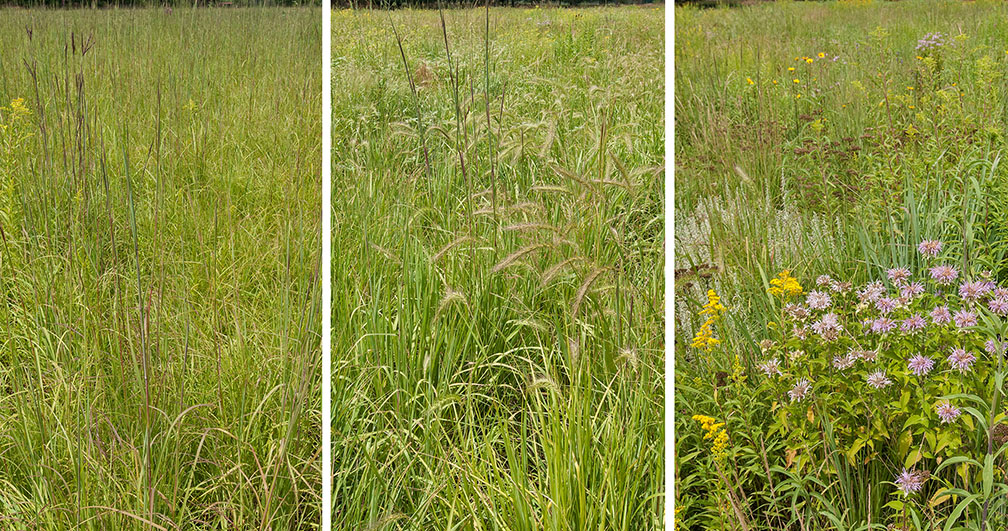
2013 photos from our experimental research plots. The plots from left to right were planted to a monoculture (big bluestem), a low diversity mixture (mostly grasses and a few late season wildflowers) and a high diversity mixture (100 plant species). We are investigating functional differences between these kinds of plant communities.
Craig Allen, Leader of the Nebraska Cooperative Fish & Wildlife Research Unit, and I are hoping to take the next step in these efforts by bringing on either a PhD or Post-Doctoral Research Associate. We have data to build upon, including some intriguing results regarding invasive species and insect herbivory rates at varying levels of plant diversity, but want to greatly expand upon those data. If you or someone you know is interested in these kinds of questions, please read below and contact Craig or me with questions.
Here is the official description of the position:
Ph.D. or Post-Doctoral Research Opportunity: Grassland diversity, restoration and resilience
Ph.D. graduate research assistantship or Post-Doctoral Research Associate. Available starting in May 2015, to investigate the relationship between grassland restorations and ecosystem services and resilience. The assistantship (or Post-Doc) is with the Nebraska Cooperative Fish and Wildlife Research Unit, in the School of Natural Resources at the University of Nebraska, working closely with the Nature Conservancy scientists and resource managers. The research project will include a synthesis of literature to identify prominent knowledge gaps related to the restoration of grasslands and resilience. In addition to synthesis, field work will occur on a suite of restorations in central Nebraska. Some questions of interest are listed below, but ultimately, successful candidates will be expected to develop a specific research project(s). The candidate could approach this project from a broadly ecological, or botanical, or entomological frame.
The successful applicants will be highly motivated, with a strong work ethic, strong and demonstrated writing skills, a passion for field work, and the ability to work in collaboration. Experience in restoration ecology is helpful, but not required. Ph.D. applicants should possess a M.S. in Wildlife, Biology, Zoology, Botany, or Entomology, or a related field and have a valid driver’s license. Post-doctoral applicants should possess a Ph.D.
Interested applicants should send a cover letter, names and emails of 3 references, GPA and GRE scores, and an updated CV as an electronic PDF or Word document to Craig Allen, allencr@unl.edu
Review of applications will begin March 15 and continue until a qualified candidate is identified. For more information on the Nebraska Coop. Unit and the University of Nebraska-Lincoln please visit us at:
http://snr.unl.edu/necoopunit/default.asp
Applicants should also review:
Specific projects could include all or part of the following:
Relationship between restoration diversity and ecosystem services, such as invasion resistance and herbivory; interactive effects that might mediate some resilience properties; responses to multiple disturbances; how invasions might weaken the ability to cope with disturbance; microbial diversity and ecosystem function and services; response to pulse and press disturbances and mechanisms driving responses; functional trait diversity and redundancy and resilience.


