Photographing the Niobrara Valley Preserve

One of the perks of working for The Nature Conservancy in Nebraska is that I usually get a couple of business trips a year to our Niobrara Valley Preserve.  The Preserve is located along the stretch of the Niobrara that has been designated as a National Scenic River.  It is the site of an incredible convergence of ecosystems, and the resulting diversity of natural communities and topography makes it a pretty nice place to visit.

This photo was taken at about 5:30pm, or about two hours prior to sunset. The sun was low enough that it wasn't as bright and colorless as it has been earlier in the day, but the absence of clouds still made for relatively harsh light and not much interesting in the sky. This photo is actually two photos stitched together (horizontally) as an attempt to capture the impressive scale of the Niobrara River Valley.

At the same time, the Niobrara Valley Preserve has always provided a kind of paradox for me as a nature photographer.  On the one hand, the landscape is so photogenic, it’s almost impossible not to come away with attractive photos of the site.  On the other hand, there is so much size, texture, and complexity to the site, I’ve never felt like I’ve done it justice.  I often end up taking a lot of close-up photos of flowers and insects because it’s easier to put my head down and look for one or two things at a time than it is to try to somehow synthesize everything around me into a coherent photographic image.

Last week, we had a state board meeting at the Preserve, so I made a quick trip up to participate.  I was on site less than 24 hours this time – and very little of that was free time for photography.  Add to that the fact that the weather was breezy with bright cloudless skies, and the chances of getting good landscape photos seemed pretty low.  Nonetheless, I was determined to try to increase my scant supply of photos of the Niobrara River itself.

I had four windows of opportunity for photography – early evening, sunset, nearly midnight, and early dawn.  Below are some of the photos that resulted from those opportunities.  All of them came from the same ridgetop, which provided both upstream and downstream views of the river.  Repeatedly shooting from that single location, but at different times of day, created an intriguing series of images that really shows the impact of lighting conditions in photography.  And, of course, the photos – though pretty decent – really don’t do justice to the overwhelming beauty of the place.  But it’s what I got.  I hope you enjoy them.  Even better, you should just make your own trip up there and see the site for yourself.

As the sun went down in the evening, I tried to find opportunities for landscape photos, but the shadows created such strong contrast between light and dark that I gave up and just waited for the sun to drop below the horizon. I then played with the reflection of the afterglow on the river itself.

.

This was one of the last shots of the evening, as even the afterglow of the sunset was fading.

.

Clear sunny skies make daytime landscape photos tricky, but they sure make great starscapes at night. I'd convinced myself I was going to sleep, rather than stay up to take star photos, but I found myself blundering through the dark prairie at around midnight anyway.

.

Around 6:30 in the morning, the stars were fading as dawn approached. This photo is nearly the same composition as an earlier shot, yet the "feel" is much different. (This is facing away from the impending sunrise.)

.

Before the sun came up, a mellow orange glow grew along the east horizon, providing a counterpoint to the cool blue river channel.

.

Before the sun came over the horizon the light was strong enough to see colors - though contrast was low.

.

Returning to the same composition as several earlier photos, I utilized what pre-sunrise light was available to me by including a little foreground in the shot. A few minutes after this photo was taken, the sun came up behind me, but because it had to come over a high ridge first, it was already strong and bright when its light first hit the scene. The long contrasty shadows didn't give me anything I could make a pleasing photo out of, so I packed up and headed out for my long drive home.

Photo of the Week – June 2, 2011

The Nature Conservancy’s Niobrara Valley Preserve (NVP) on the northern edge of Nebraska’s sandhills is a pretty amazing place.  I had the chance to spend a couple days there last week, something I always enjoy.  While there, I managed to get a few photos of bison from one of the two herds on the property.

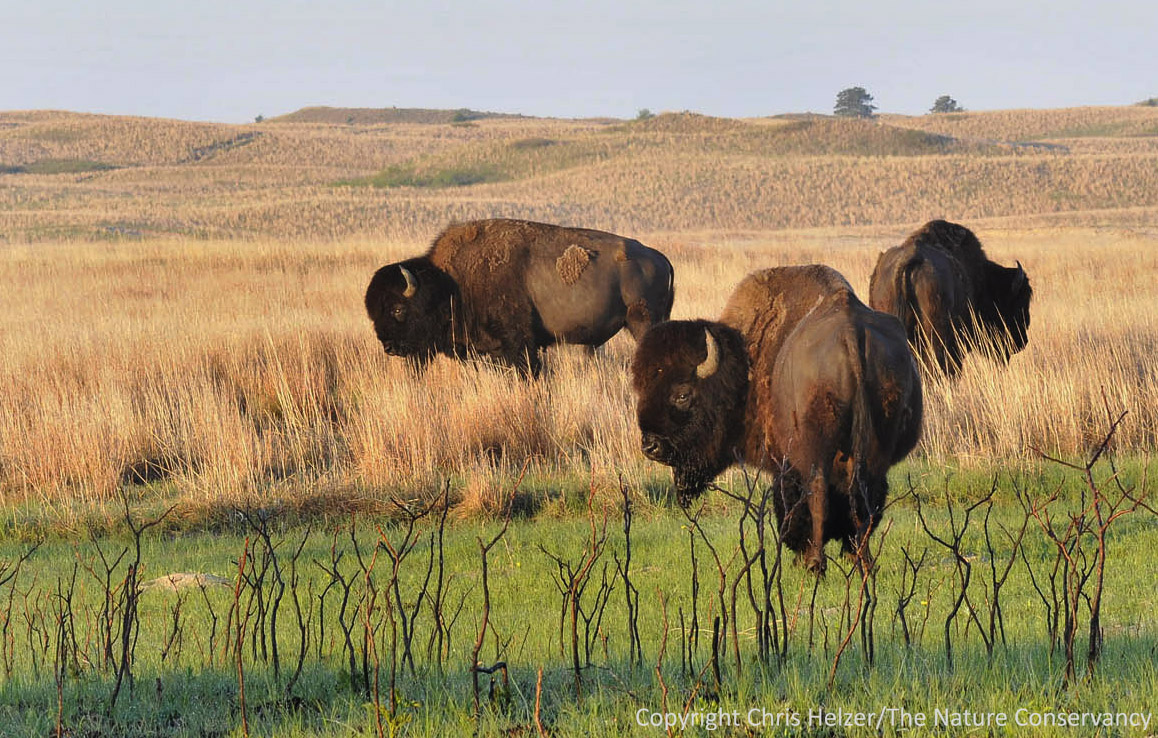
Three bison bulls on the edge of burned sandhill prairie - The Nature Conservancy's Niobrara Valley Preserve, Nebraska. These three bulls were feeding in the burned area until I wandered along with my camera. They then kept a safe distance (for both of us) as I hiked past on the trail. Click for a larger view.

In addition to being an important site ecologically – and a beautiful place to visit – the NVP was also a key site in the development of the fire/bison grazing model that eventually developed into today’s patch-burn grazing.  Al Steuter and others used the Preserve as an incubator for the initial idea of moving bison grazing intensity around large prairies by shifting the location and season of fires.

I’m often asked about the differences between the way bison and cattle impact prairies.  As we continue to experiment with patch-burn grazing, we’re finding that the forage selection differences (they way they choose which plants to eat) between the two animals are pretty slight when they’re managed with patch-burn grazing or similar systems.  Under light stocking rates, both bison and cattle prefer to graze in recently burned patches, and both prefer grass over wildflowers and other plants.

The major differences between bison and cattle appear to be mostly behavioral.  Cattle like to walk in single file, forming trails, while bison tend to move in loose groups.  Cattle tend to sit/stand/poop in water on hot days, while bison don’t hang around water or shade for long periods.  While these can be important differences, there are ways to mitigate the more negative impacts of cattle – e.g.  fencing out sensitive areas and/or keeping stocking rates low.   

On the other hand, there are some disadvantages to using bison to manage prairies instead of cattle.  These are mostly logistical.  With rare exceptions, it’s not possible to lease herds of bison, so if you run bison, you have to own them.  Among other issues, that usually means an annual roundup for innoculations and sorting of animals to thin from the herd (assuming you don’t have unlimited land).  It also means big strong fences and corral systems.  In short, bison can be expensive and time-consuming.  Also, they work best in prairies of several thousand acres or more.  On those large prairies, they can be an important part of good prairie management.  On smaller prairies, cattle can be a very good substitute, if managed carefully.