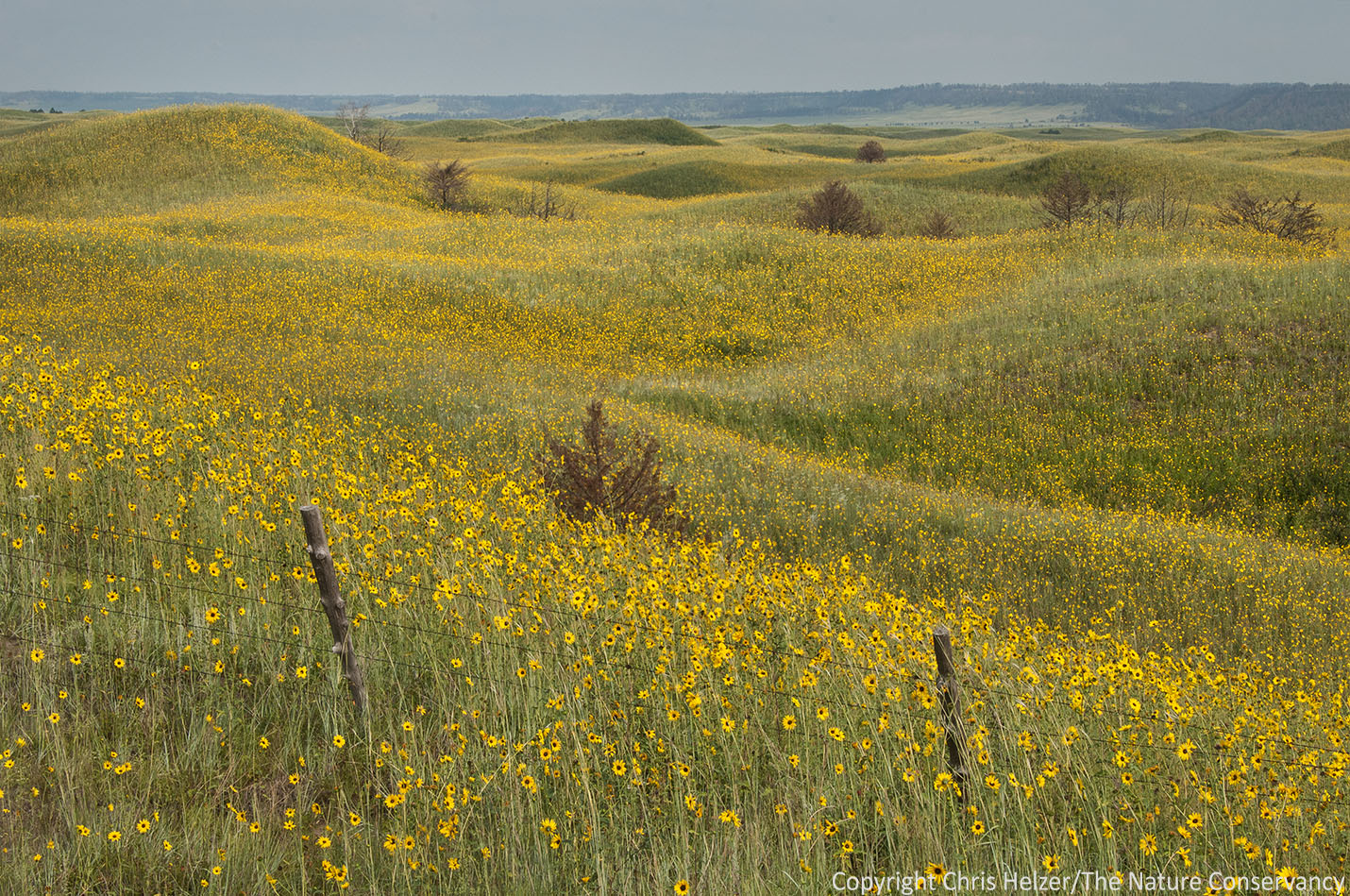
Sunflowers!

The emotional response you have to this photo will say a lot about your background, experience, and cultural influences.

A profusion of sunflowers in sandhill prairie at The Nature Conservancy's Niobrara Valley Preserve in north central Nebraska.

A profusion of annual sunflowers (Helianthus petiolaris) in sandhill prairie at The Nature Conservancy’s Niobrara Valley Preserve in north central Nebraska.

The sandhills of Nebraska consist of nearly 20,000 square miles of prairie.  The scale can be hard to comprehend until you have driven through it for hour after hour, gaping at the beauty spreading out all around you.  When I drove through a good portion of the eastern sandhills this week, a lot of it looked like this photo – covered with blooming yellow sunflowers.

Many readers of this post will be thinking, “Wow!  What a beautiful year in the sandhills!”  But I know others of you are thinking, “Ugh, what do we have to do to get rid of these invasive weeds?”

I’m going to get to that discrepancy, but let’s first back up and look at why the sunflowers are so abundant this year.  First, the sunflower species we’re talking about here is an annual called plains sunflower (Helianthus petiolaris).  It germinates from seed in the spring, flowers in the summer, and dies at the end of the same year.

During the drought of 2012, annual sunflowers were among the few plant species able to continue growing and flowering during the hot dry summer.  Because of that, sunflowers were able to produce copious amounts of seed, many of which ended up on the ground at the end of the year.  Few other grassland plants produced anything comparable to the seed crop of those sunflowers.

The spring of 2013 brought abundant rain to the dry sandhills.  In addition, the plant litter from last year’s dry growing season was thin and sparse, allowing a lot of light to hit the soil. That combination of abundant light and moisture was exactly what all those plains sunflower seeds needed, and they germinated.

Of course, germination doesn’t ensure survival, and many annual plants germinate each year, only to be quickly overshadowed and outcompeted by strong perennial plants.  Perennials have the advantage of a pre-existing root system that can monopolize moisture and nutrients from the soil while annuals are still struggling to get started.  In years when perennial grasses and wildflowers are strong, there is very little space for annuals to grow, except in places where the soil and plant community were disturbed by digging animals or intensive grazing/trampling.

However, in the spring of 2013, not only were conditions perfect for plains sunflower germination, competing perennial plants were also weak from drought and grazing in 2012, leaving lots of open space belowground for sunflower roots to take advantage of.  In short, you couldn’t have designed a better situation for the sunflower.  It was one of the few plant species to produce seed in 2012, and then it got light, moisture, and weak competition in 2013.  It’s no wonder the hills are yellow!

Some people will look at this photo and see an amazing abundance of pretty wildflowers.  Others will see weeds running amuck.

Some people will look at this photo and see an amazing abundance of pretty wildflowers. Others will see weeds running amuck.  At the Niobrara Valley Preserve, last year’s wildfire increased the favorable conditions for plains sunflower by creating massive amounts of bare ground for germination.  While it looks like a monoculture from a distance, hidden among the sunflowers are lots of grasses and other plants that are slowly regaining their vigor.  By next season, this will be a very different looking prairie.

Ok, back to the perception issue.  Sunflowers are one of the most popular and well-known flowers in the world.  They are big, attractive, and easy to recognize.  On the other hand, many farmers and ranchers have grown up learning that sunflowers (of any kind) are weeds.  The presence of sunflowers in a field or pasture – especially an abundance of them – can be seen as a badge of shame for the landowner who is clearly not managing his/her weed problems adequately.

The important thing to remember if you’re a rancher, however, is that the sunflowers are not outcompeting perennial grasses.  Instead, the sunflowers are opportunists, taking advantage of the fact that grasses are weak.  As perennial grasses recover from last year’s drought and/or grazing, they will reclaim the root space they lost in 2012 and sunflowers will have much less room to grow next year.  Plains sunflower is a native prairie plant, and it’s role is to fill the space left when other plants are weakened (similar to ragweeds and other opportunistic species).  If sunflower wasn’t filling that space, another “weedy” species would, and the alternative could be much worse.

Some ranchers will be tempted to spray their pastures to kill off the “invading” sunflowers, but that’s actually a counterproductive strategy.  First, the annual sunflowers are going to die at the end of the season anyway, so if you want fewer sunflowers next year, the best strategy is to focus on limiting the germination and growth of next year’s crop by allowing perennial grasses and wildflowers to regain their dominance.  Second, herbicide spraying will kill a number of other plant species that are both valuable as forage and competitors with sunflowers and other annuals.  Why spend money to weaken the long-term viability of your grassland?

It’s also important to remember that cattle do eat sunflowers – they particularly like them early in the season when the leaves and stems are tender, but will also seek out the nutritious buds and flowers later in the season.  The evidence of that can be seen right now; pastures grazed at certain times this year have many fewer blooming sunflowers than those that haven’t yet been grazed this season.  In addition, of course, sunflowers are among the most valuable grassland plants in a prairie for wildlife and pollinators.  They produce large nutritious seeds for birds and other wildlife, and have abundant and accessible supplies of nectar and pollen that attract numerous pollinator species.  In short, sunflowers may not be everyone’s favorite plant, but they’re far from a useless weed or invasive threat.

For those of you who started out reading this post as fans of sunflowers, good for you!  If you get the chance, you should take a drive through Nebraska’s sandhills this summer and enjoy the scenery – it’s not likely that we’ll see another year like this for a while.  For those who are appalled by the abundance of sunflowers this year, maybe you can take some comfort from the fact that it’s a temporary phenomenon, and one tied to a particular combination of weather factors more than anything you or others did as land managers.  Things will be different next year.

Regardless of whether or not you like sunflowers, I guess there’s one thing we can all agree on.  The year 2013 will be one to remember!

Note:  Nebraska has nine species of native sunflowers, seven of which are perennials.  All of them are valuable for wildlife and pollinators, and important components of a healthy grassland community.

Grandpa’s “Accidental” Prairie Restoration Project

In the late 1950’s, my grandfather bought a quarter section of farmland just southwest of Stockham, Nebraska.  At the time, all but about 26 acres of that 160 acre land parcel was in row crops.  The unfarmed areas (the steepest slopes and wettest draws) were a combination of native prairie and other “waste” ground.  From what I understand, Grandpa’s intent was to buy the land and put much of the cropland back to native grass pasture, keeping only the flattest areas and most productive soils to farm.  Regardless of whether or not that was his initial intent, he did indeed do that restoration project in 1962 – using the Soil Conservation Service’s Great Plains Program to provide cost-share for the seeding and construction of a livestock dam.  Approximately 87 acres of cropland was planted with a mixture of native grasses, including primarily big bluestem, indiangrass, switchgrass, little bluestem, side oats grama, and western wheatgrass – with a little blue grama thrown in too.  (We still have the receipts from the seed company.)

Starting in 1964, Grandpa started grazing the new pasture – including the unfarmed portions – and it’s been grazed annually ever since.  The pasture grazing was designed to be both profitable and sustainable, and as far as I can tell it has been.  There is no evidence of chronic overgrazing, and a number of “grazing sensitive” plant species are still abundant, especially in the old remnant areas.  My grandpa died in 1990, and Grandma died earlier this year.  After Grandma’s death, most of the other family farm land was sold, but after some long discussions, we kept the ¼ section in the family.  My wife and I now own a 2/3 interest and my aunt and uncle own the other 1/3.  Although I was helping Grandma manage the pasture for more than a decade before her death, actually owning the land makes me see the pasture in a much different way.  Before we shelled out our hard-earned money to buy it, the pasture was an interesting place to go cut cedar trees and walk around, and I tried to help Grandma set up the grazing leases to ensure that the land stayed in good condition while bringing in a reasonable income.  Now, as an owner, that lease income means a whole lot more, as does the current and future condition of the grassland.  Decisions about how to balance stocking rate and income with plant community impacts are a little more real!

I bring all this up as background discussion for the real subject of this post.  Though I’m sure it wasn’t Grandpa’s intent when he seeded the site back to grassland in 1962, he actually did some pretty great prairie conservation work.  He took a series of very small isolated remnant prairie islands and filled the space between them with grassland habitat.  It’s hard to know how many plant and insect species populations have larger and more viable populations now because of his work.  Certainly the site has improved habitat conditions for the grasshopper sparrows, western meadowlarks, and other grassland birds that are nesting there.

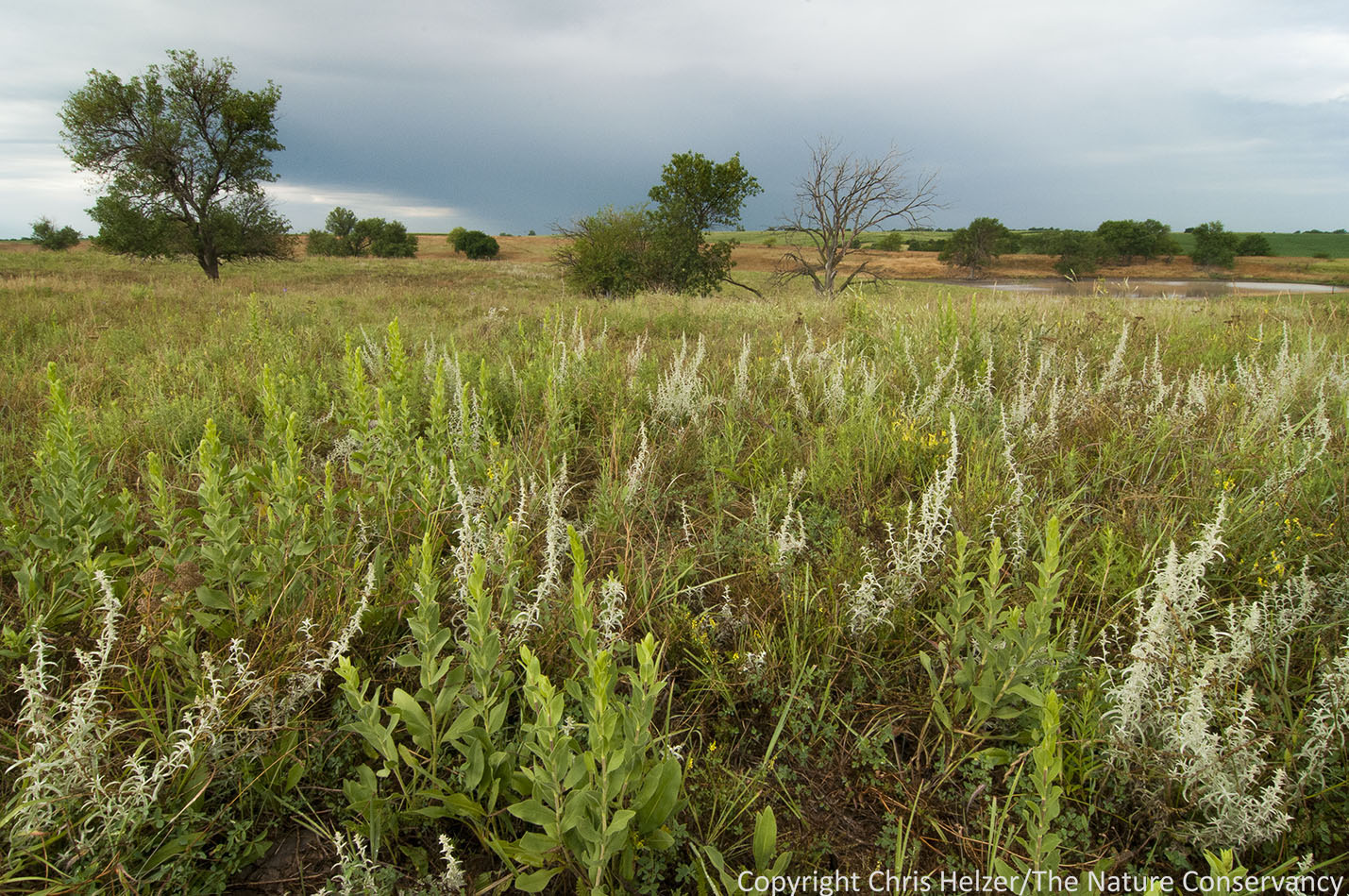
A portion of remnant (unplowed) prairie on our farm. It has retained a good mixed-grass plant community, with fairly abundant leadplant, stiff sunflower, prairie clovers, and other characteristic prairie plants. Shown here are Missouri goldenrod, white sage, stiff goldenrod, and many others.

While any grassland is better than no grassland, the re-seeded areas of the prairie are still distinct in appearance and composition from the unplowed areas.  Many of the prairie remnants contain fairly abundant populations of conservative forb species, including leadplant, stiff sunflower, prairie violet, prairie clovers, and many others.  A few of those species have moved into the re-seeded areas, but mostly at low abundances.  The re-seeded areas are dominated by grasses, but also have an abundance of many common forb species such as goldenrods, white sage, ironweed, hoary vervain, yellow prairie coneflower, dotted gayfeather, yarrow, and others – along with strong populations of sweet clover.

This photo shows some of the re-seeded prairie. Many native forbs have moved into the stand of grass that Grandpa planted, but others are still rare or missing.

I only recently found some hand-drawn maps showing the exact locations of the unplowed areas, and was able to cross-check those with old aerial photos from before and after the 1962 seeding.  Now that I know those locations more exactly, I’ll be able to start making even better comparisons between the remnant and re-seeded areas.  I started that process this last weekend, taking an inventory of plant species in the re-seeded areas (I found 65 species).  I’m sure I’ll add to that list over time, but that’s not too bad, considering only 6-7 grasses were planted there initially.  I don’t know yet how many plant species are in the remnant portions – I’m still working on that.

This aerial photo from 1956 shows our 1/4 section just prior to Grandpa buying it. The darkest areas are the unfarmed portions. You can see how small and isolated many of them were. Only the steepest and wettest areas avoided the plow.

In some ways, it’s amazing to see the diversity of plants in those previously farmed areas.  If I took a botanist to the site without divulging its history, I’m pretty they’d have no idea it had once been farmed.  At the same time, while there is good plant diversity at the site, it’s interesting to see how few conservative plant species have made their way into the previously farmed areas.  I’ve seen a few individuals of leadplant, a few patches of purple and white prairie clover, some areas of purple coneflower, and a few stiff sunflower colonies.  Prairie violets have begun creeping from the remnants into the re-seeded areas too – but in 50 years, they’ve only made it about 20 or 30 yards.

All of this points out the importance of protecting and managing remnant prairies to avoid losing those conservative plant species.  Once they’re gone, it’s not realistic to expect them to just come waltzing back in from nearby sites.  During the last 10 years or so, I’ve been overseeding portions of the re-seeded prairie with locally harvested seed.  As is typical, the results of that have been fairly muted, but I’m hoping my work gets those plants to establish a little faster than they otherwise would have…

This false sunflower is one of a handful of species that is showing up here and there across the old farmed portions of the prairie as a result of our overseeding efforts. It's a slow process, but one that will, I hope, pay long-term dividends.

Of course, if Grandpa’s restoration project was being done today, and the main goal was really to ecologically reconnect those small prairie islands, the cropland around the prairie remnants would be seeded with a high-diversity mixture of prairie plant species.  That would help ensure that the seeded area facilitated a number of ecological needs, including the availability of host plants for a variety of insects and genetic flow between plant species.  In 1962, no one in Nebraska was even thinking about anything like that, and Grandpa’s goal was (I think) simply to take a piece of land that was being overused and make it into productive agricultural land.  I’m pretty sure he’d never heard of a grasshopper sparrow.  Regardless of his initial goal, there is now a 108 acre prairie in southern Hamilton County, Nebraska – and that’s a rare and valuable commodity.  The nearest prairie to ours is at least several miles away, across many acres of cropland.

I don’t know exactly know how to measure the ecological value of our prairie, but I’m sure proud to own it.