In Defense of Erosion

The Nebraska Sandhills region consists of about 12 million acres of sand dunes with a thin layer of vegetation draped across them.  That vegetation has come and gone over the last several thousand years, as long-term climatic patterns have shifted from wet to dry and back.  We are in a relatively wet period (geologically speaking) today, and grassland is clinging to the hills.  For now.

Except where it can’t.  Here and there, throughout the sandhills, particularly on steep hills, sand breaks through.  Most of the time, blowouts are triggered by a combination of topography and some kind of physical disturbance.  A two track road or cattle trail up a steep slope, for example, or a favorite hangout of livestock.  Just as with frayed fabric, once a small hole in the vegetation starts, it tends to spread.  Most Sandhills ranchers see blowouts as a great risk to their livelihood and work hard to prevent them, or to heal them once they start.  Those ranchers are encouraged in that view by watchful neighbors and a long history of agencies and university extension staff warning of the dire impacts of wind-induced soil erosion.
Sandh

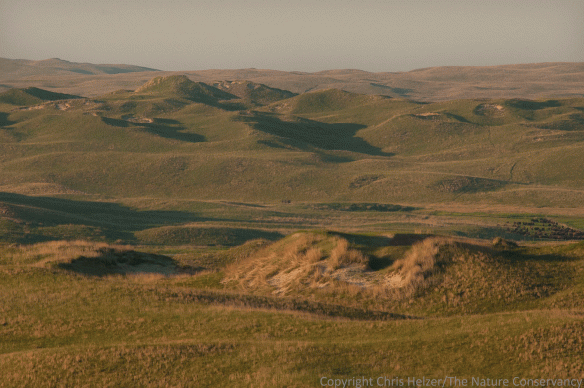
Small blowouts dot the steeper hills in the background and a couple larger ones appear in the foreground.  Overall, these make up a tiny percentage of the landscape, but many ranchers see them almost as badges of shame.

big

A very large blowout like this can cause not only a loss of forage for a rancher’s livestock, but also a huge challenge for fence maintenance.

The Sandhills is ranch country, and all but a tiny fraction is privately-owned and managed for livestock production.  Most ranchers are conservative with livestock numbers and grazing strategies, trying to preserve that thin fabric of grass that feeds their livestock, and thus their families.

While there are certainly places that are prone to wind erosion and practices that can accelerate it, the risk of blowout creation and spread has also become a kind of mythology.  In much of the Sandhills, blowouts are actually difficult to create (we’ve tried) and the percentage of a ranch that could potentially be covered by blowouts is very small.
wet

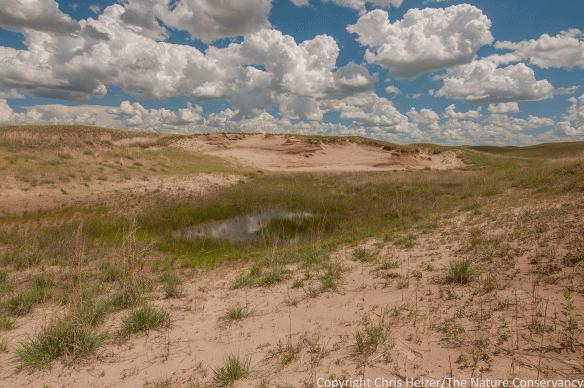
Sometimes, wind erosion digs a blowout deep enough that it intersects groundwater, creating wetlands.

While conservative grazing has helped maintain healthy prairies in the Sandhills, it has also led to a loss of open sand habitat for a group of plant and animal species that depend upon blowouts and similar areas.  Those species are important, but asking a rancher to allow, let alone encourage a blowout, is much like asking a business man to go to work wearing Bermuda shorts with his sport coat.  The peer pressure and social norms associated with blowouts can be more influential than any potential loss of livestock forage they might cause.  Just as farmers judge their neighbors by the weeds in their fields, Sandhills ranchers judge their neighbors by the blowouts in their pastures.
blow

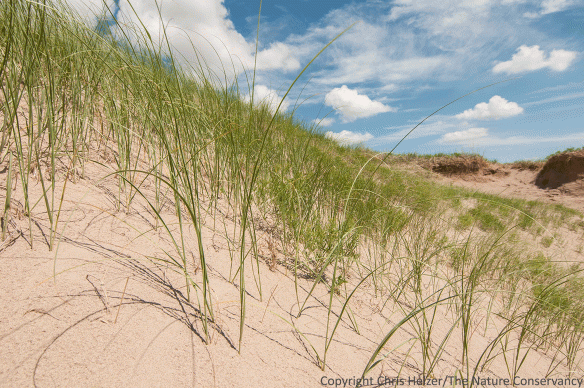
Blowout grass (Redfieldia flexuosa) is one of a select group of plants that can colonize a blowout and begin to stabilize the sand.

penstemon

Blowout penstemon (Penstemon haydenii) is a federally listed endangered plant that is found exclusively in blowout habitats.  This one is in a blowout that is healing and might not support penstemon populations much longer.

tiger beetle

Many species of tiger beetles can be found in Sandhills blowouts, including several of conservation concern.  These impressive predators hunt small insects in patches of open sand.

lesser earless lizard

Lizards, including this lesser earless lizard and other species, are often seen in and around blowouts, where they can forage in open areas but retreat quickly to cover to escape predation.

Regardless of the social or economic ramifications of blowouts for ranchers, bare sand patches really are important habitats for many prairie species.  The discussions I’ve had with ranchers about the ecological values of blowouts have always been polite, but I can’t say they’ve been met with great enthusiasm.  I understand that, but that doesn’t change the need to continue having those discussions.

spider

Spiderwort (Tradescantia occidentalis) grows on the edge of a large blowout, surrounded by bare sand and a cast of other plants struggling to survive in the shifting substrate.

It may be that changing climate will render moot our discussions about whether or not to allow or encourage blowouts in the Sandhills.  Eventually, we will experience enough consecutive years of hot dry weather that even the most conservative grazing won’t prevent widespread blowing sand once again.  We can’t predict whether those conditions will arrive in the next few years, or not for many decades.  When they do arrive, both the ecological and human communities of the Sandhills will be glad to have species that are well adapted to open sand.  Plants like blowout penstemon and blowout grass, for example, can help restabilize areas of bare sand, and they also provide food for both livestock and wildlife.

For now, the Sandhills provides a vibrant grassland that supports both humans and wildlife.  That will likely change at some point in the future.  Hopefully, blowout-dependent species will find enough habitat to maintain their populations until we really need them.

…and hopefully no one will feel like they have to wear Bermuda shorts in order to make that happen.

From the Ashes

Last Friday, I wandered through the small prairie we burned back on March 10.  Even though it is still very early spring, there were already a number of prairie plants popping out of the ground.  I posted photos of this site right after the fire was completed.  Today, I’m posting some photos taken 10 days later at the same site, along with some discussion of the impacts and effectiveness of prescribed prairie fires.

Purple poppy mallow (Calliroe involucrata)

Purple poppy mallow (Callirhoe involucrata) begins its new year of growth.

Most prairie plants grow from belowground buds, making them much less vulnerable to fire than trees and shrubs, which start their new growth above ground – from buds at the tips of branches.  When fire burns woody plants, those aerial buds and living tissue are destroyed, stressing the plants and forcing them to start over from ground level.  However, fire (at least during the dormant season) simply burns up the old stems and leaves of non-woody prairie plants, causing no injury.  Instead removing those dead stems helps stimulate growth in the coming season, especially via increased sunlight, which warms the ground and is available to new shoots as they first emerge.

Scribner's panicum (Panicum oligosanthes), a native cool-season grass.

Scribner’s panicum (Panicum oligosanthes), a native cool-season grass.  In this photo, you can see that the tips of the grass leaves had just started to grow when the fire came through ten days earlier.  Since the leaves grow from the base, those burned tips don’t impede plant growth.

Increased sunlight hitting the ground has helped the small area we burned on March 10 green up much faster than unburned prairie nearby.  Our main objective for the fire was to remove thatch in order to improve the effectiveness of planned herbicide treatment/re-seeding of some smooth brome patches within the small prairie.  The brome is responding very strongly to the fire, and its rapid growth (and the absence of thatch to intercept spray droplets) will make the grass more susceptible to our herbicide treatment.  However, since many other plants are also popping up, we’ll carefully spray only the thickest patches of brome where no other species are growing.

Green sage (Artemisia campestre)

Green sage (Artemisia campestre) growing next to its old stem from last year.

Prescribed fire can be a useful tool when trying to temporarily flip the balance of power from cool-season invasive grasses (smooth brome, Kentucky bluegrass, etc.) to native warm-season grasses (big bluestem, indiangrass, etc.).  However, timing is critically important.  A dormant season or early spring fire is actually counterproductive unless it is followed by herbicide treatment, mowing or grazing.  Those early fires stimulate the growth of cool-season plants – including smooth brome and Kentucky bluegrass – giving them a big advantage over later-season plants which won’t start growth until late April or early May.  By the time those warm-season plants start growing, the early plants will have had a month or more to extract soil moisture and nutrients, and will be big enough to dominate competition for light and root space.

If we’d wanted to suppress smooth brome solely with fire (and not follow up with herbicide), we would have waited until late April or early May to burn.  That late season burn would have stressed the actively-growing brome and bluegrass and provided direct sunlight to freshly emerging shoots of big bluestem and other warm-season grasses.  More often, we combine periodic fire and grazing to suppress brome and bluegrass and facilitate greater plant diversity.

Here's one of the grasses we would like not to see coming back after a fire - Kentucky bluegrass (Poa pratensis).

Along with smooth brome (Bromus inermis), Kentucky bluegrass (Poa pratensis) also responded well to the fire.  This particular plant will likely have a very good year, but the brome and bluegrass in the thicker patches of this prairie will be sprayed with glyphosate herbicide and re-seeded.

The regrowth of prairie plants after fire can seem almost magical.  Fire is absolutely an important natural process and a very useful tool for prairie managers.  However, prescribed fire is not magic, and doesn’t automatically lead to better prairies.  As with any tool, fire has to be applied thoughtfully (and carefully!) in order to meet objectives.

The timing of fire dramatically impacts the way prairie plant communities respond.  Early spring, late spring, summer, and fall fires each have different effects on plants, and those effects are also influenced by soil moisture, the presence/absence of grazers, and many other factors.  Prescribed fire can also have serious impacts on some animals, even during the dormant season.  Many invertebrates, for example, overwinter in the aboveground plant stems or thatch, making them very vulnerable to fire. It’s important not to burn an entire prairie at once – especially if that prairie is isolated from other grasslands.

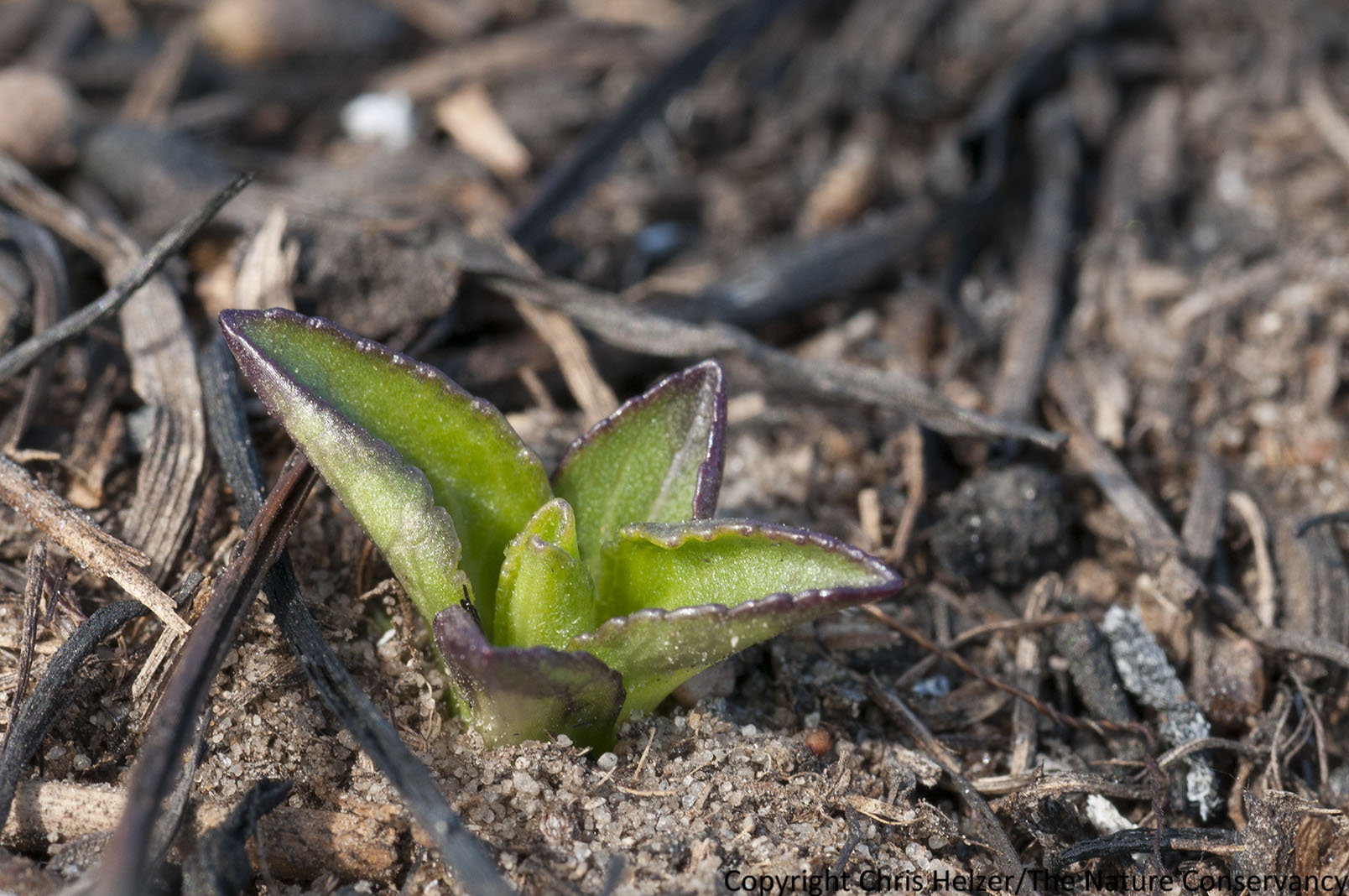
I'm not sure what species of wildflower this is.

I’m not sure what species of wildflower this is but I’m looking forward to finding out as it gets bigger!

Fire plays many critical roles in prairie ecology – suppressing woody plants, removing thatch, stimulating microbial activity, aiding in nutrient cycling, and more.  However, while fire is important and its effects are both useful and aesthetically pleasing, it is not automatically positive.  Safe use of prescribed fire requires training, experience, and caution.  The effective use of fire requires clear objectives and careful planning that ensures those objectives will be met.

As I’ve discussed before, the actual process of conducting a fire can be very stressful.  However, once the smoke clears and I can relax, its easy to appreciate both the beauty and ecological benefits of prairie fires.  The emergence of bright green prairie plants through black ash is one of my favorite sights, and I love watching plant and animal communities respond and adapt to changing habitat conditions.

In prairies, rising from the ashes is more than a metaphor – it’s a way of life.