
An Ill Wind…

You know, it’s not hard to grow native plants in a greenhouse.  We’ve had pretty good luck over the years…  But that assumes that you HAVE a greenhouse.  Which we did – until early this morning, when a grain bin smashed it to smithereens.

We had big thunderstorms roll through last night.  Other than having to get up and shut off the weather alert radio at 4am, I didn’t think much about the storms until our land manager called me early this morning.  Then my plans for the day changed on the spot and I went out to help the guys clean up.
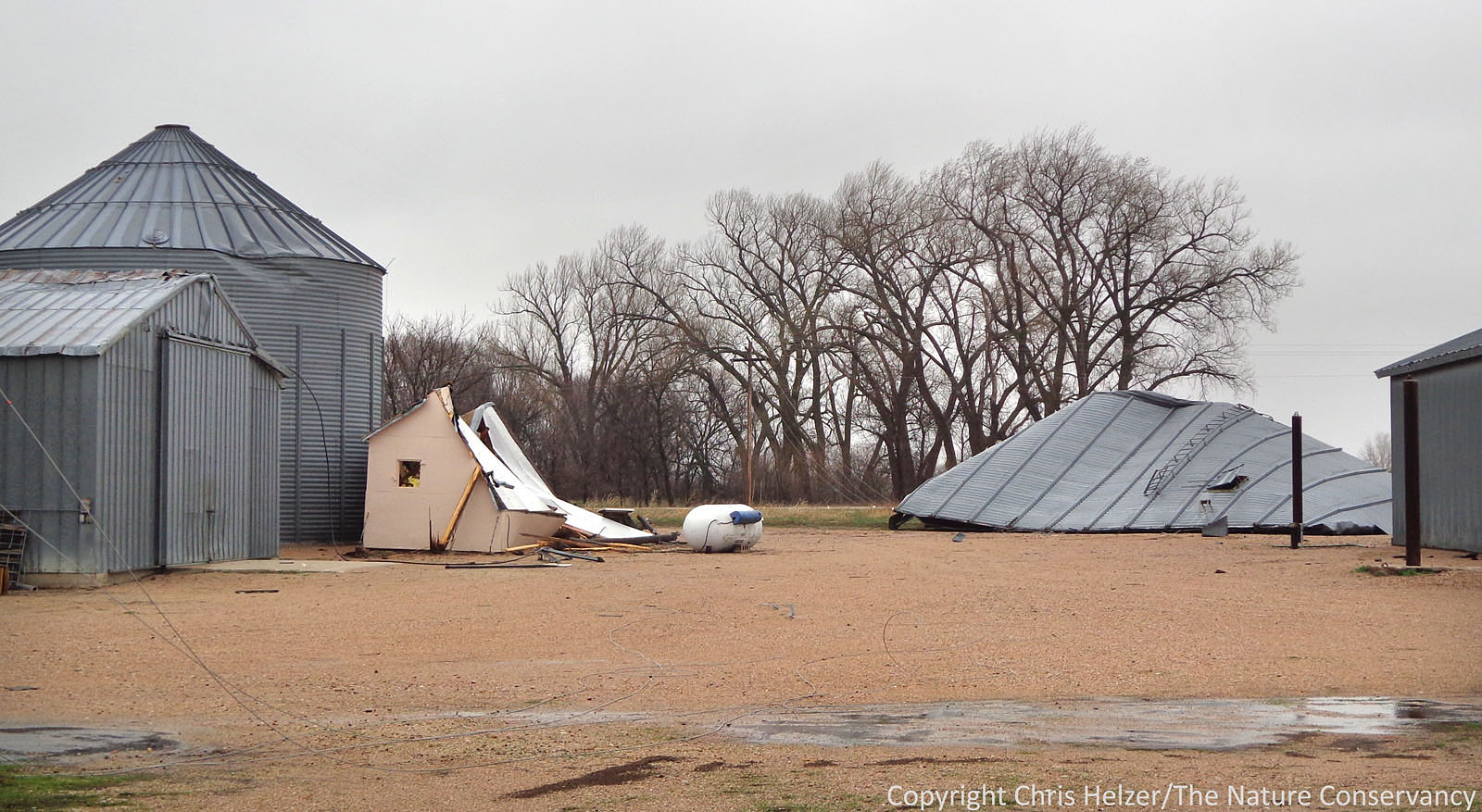
Storm damage at our shop this morning.

Storm damage at our shop this morning.  The grain bin caused most of the damage as it flew across the lot.  The Nature Conservancy’s Platte River Prairies – Nebraska.

The bad news: A flying (bouncing?) grain bin crushed our greenhouse, the doors to our main shop building won’t open (our trucks are in there), we’ve got dinner plate-sized holes in the roof of that same building, and we lost a lot of shingles from the house our seasonal crew lives in.  Oh, and we lost power.
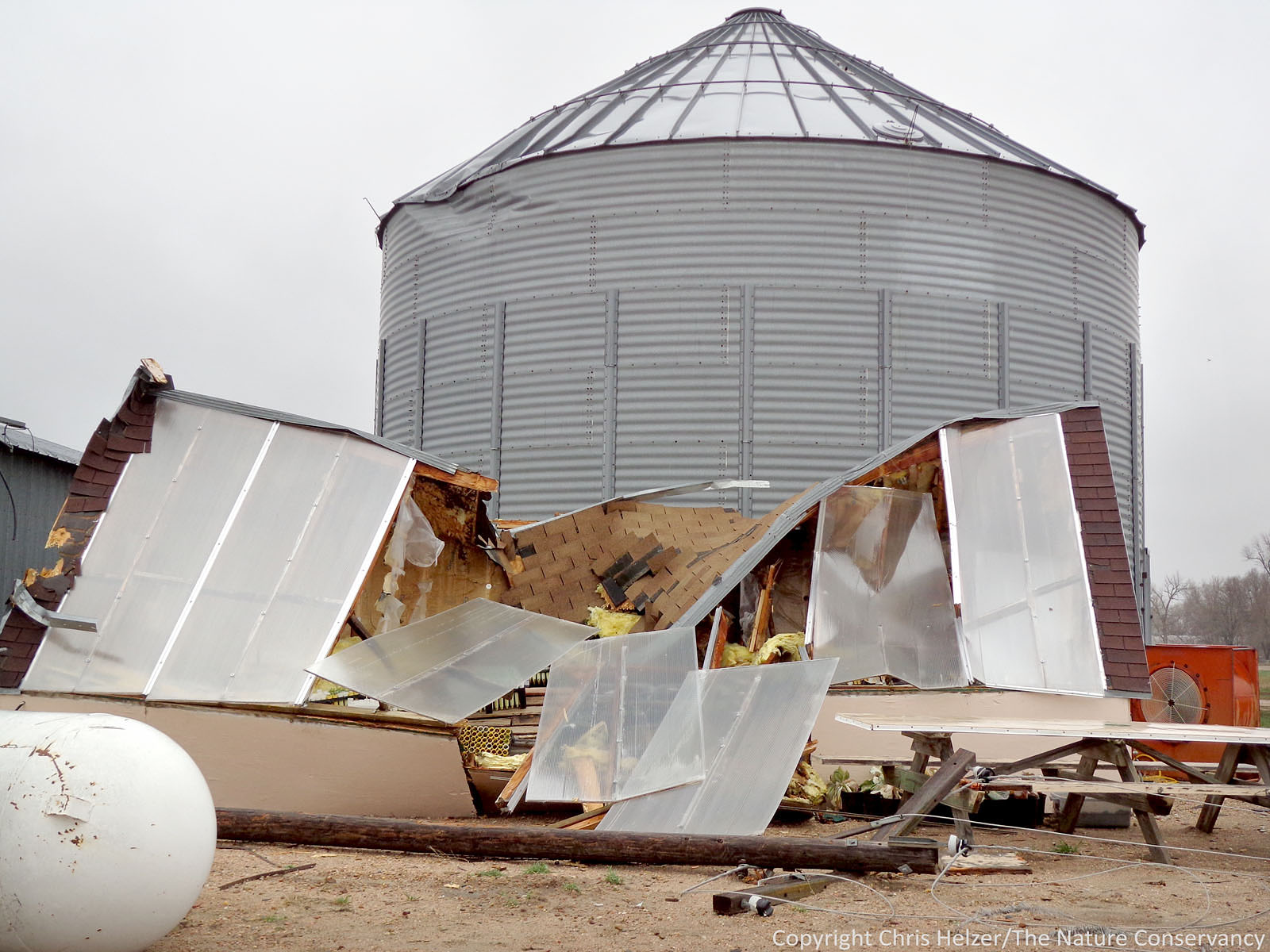
Our greenhouse was a total loss.

Our greenhouse was a total loss.  We had just put on new panels last fall…

.
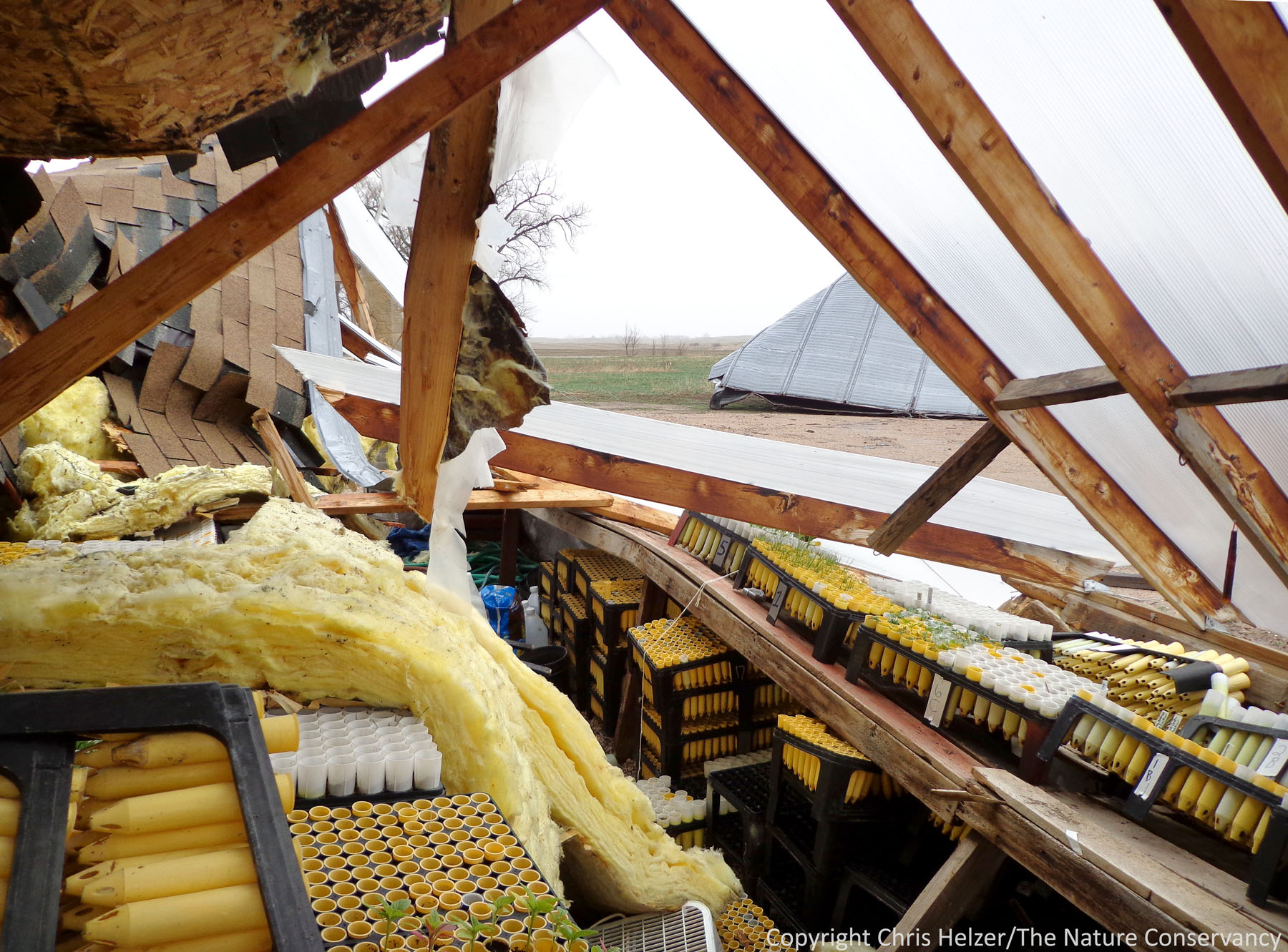
We did manage to salvage most of our plants from the greenhouse.

We did manage to salvage most of our plants from the greenhouse.  They’re now riding out the winter storm in a nice warm garage.

The good news: We were able to get most of the plants out of the greenhouse and into another building before the winter storm hit this afternoon.  We’ve got tarps on the crew quarters roof, so it should be watertight for the near term.  Most impressively, the crew from Southern Public Power District was on site within a half hour after I called them and were busily replacing broken power poles and lines.  (THANKS GUYS!)

The rest of the repair work can wait until the snow, ice, and wind subside a couple days from now.
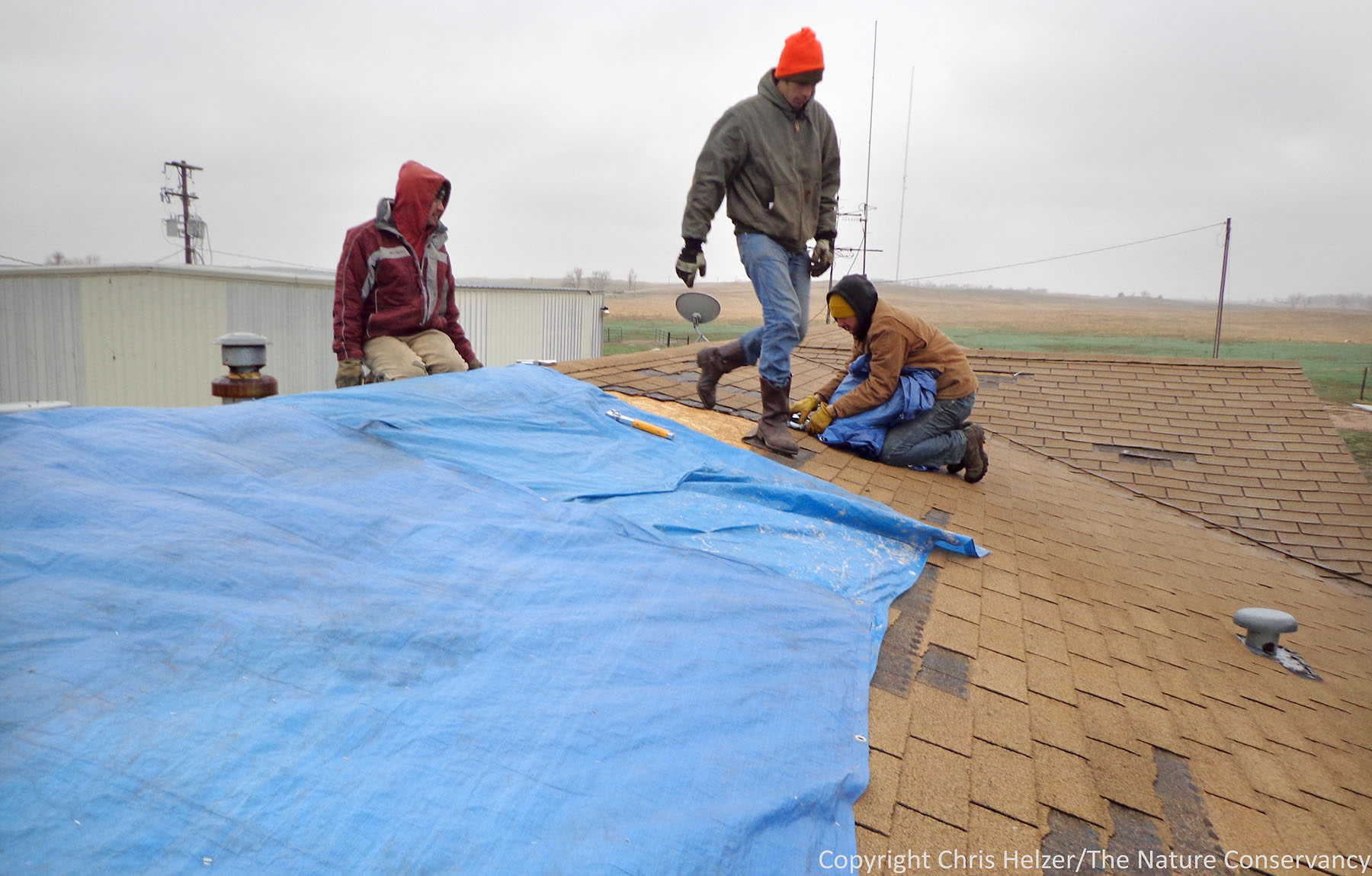
Stapling tarps to the roof of the crew quarters house at our shop facility.

Stapling tarps to the roof of the crew quarters.

It could have been a lot worse.  No one was hurt.  Our trucks, atvs, seed, and plants all seem to be ok.  Water damage in the house seems to have been limited to some small wet spots on the ceilings of two rooms.

And, while it was a high price to pay for it, I guess we did get some decent rain out of the storm…

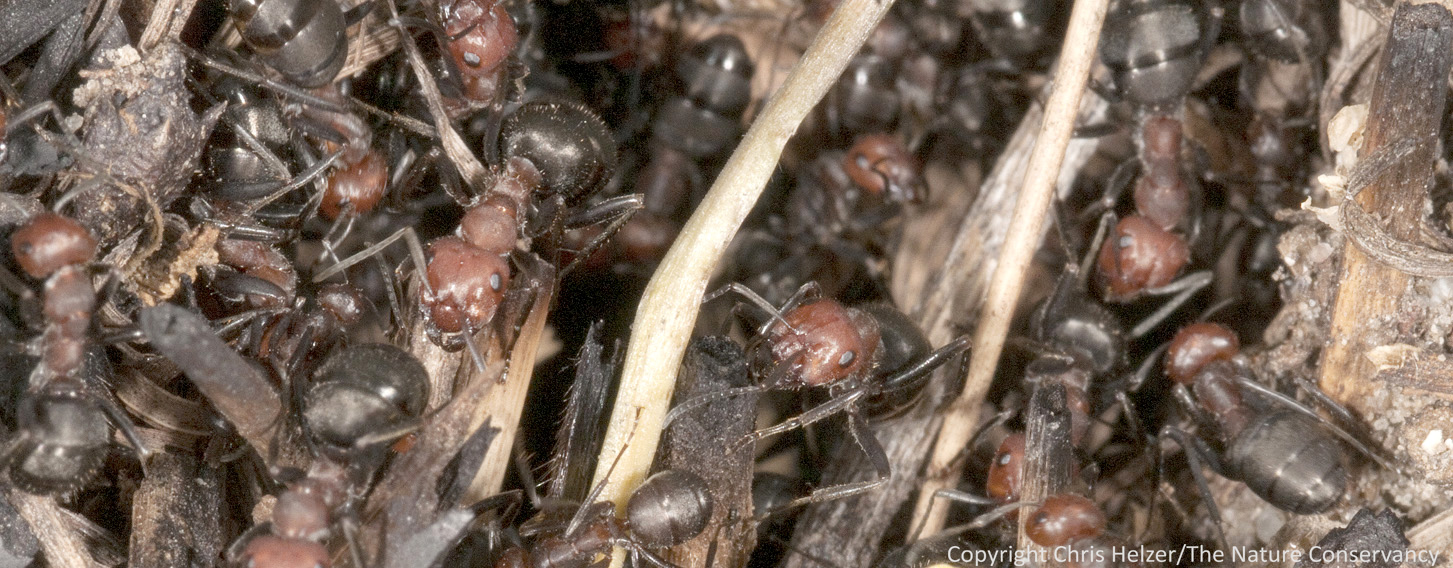
Photo of the Week – March 21, 2013

Last week, I found ant species #23.

Formica obscuriventris - aka ant species #23.  It's a mound-building ant of prairies and savannas.

Formica obscuriventris – aka ant species #23. It’s a mound-building ant of prairies and savannas.

If you’ve followed this blog for a while, you know that we’re trying to inventory the ant and bee species (and others) in our Platte River Prairies.  Our main purpose is to see whether or not our restored prairies are providing habitat for the insect species living in our remnant prairies.  If they are, it’s likely that we’re succeeding in our attempt to use restoration to enlarge and reconnect fragmented prairies.  Last fall, I posted the results of the brief survey James Trager helped us with in the summer of 2012.  At that point, we’d found 22 species.

During a prescribed fire last week, we found a big ant mound.  The ants were understandably agitated by the fire…  I noted the location of the mound and went back the next day with my camera (and my new flash kit!) to get some photos.  I emailed James the photos to see if he could identify the ant species, and of course he could – Formica obscuriventris.  More importantly, it wasn’t a species we’d found last summer, so I could add it to our list!

The ant mound had multiple entrance holes.  There was a lot of activity around this particular one.

The ant mound had multiple entrance holes. There was a lot of activity around this particular one.

The mound was in a restored prairie, which was good to see.  Of the 23 species we’ve found so far now, 4 of them are tree-dwellers and 19 are prairie ants.  Of the 19 prairie ant species, we have found 14 in restored prairie.  I’m hoping we just haven’t looked hard enough to find the other 5 in restored prairie (very possible, given our limited sampling effort so far).  If that turns out to be true, it would be a great indication that our restored prairies are acting as new habitat for those ants, and enlarging/reconnecting formerly fragmented prairies.

Formica obscuriventris

Ants carrying the carcass of one of their compatriots.

I’m sure many of you could have identified this ant species without James’ help, but I couldn’t and am grateful to him.  He pointed out that it’s the boxy cross-section of the clypeus that separates this species from a couple other possibilities.  …But you probably already knew that…

Here's the mound, with a 72mm lens cap for scale.

Here’s the mound, with a 72mm lens cap for scale.

For those of you interested in the photography side of this, I photographed the ants with a 105mm Nikon macro lens on a Nikon D300s camera.  The images above are variously cropped to show the ants better. 

It was a partly cloudy day, and the light kept switching from dark cloudy to bright sunny – neither of which was great for photography.  To mitigate that, I used a diffuser (thin white cloth on a big collapsable plastic circle about 2 ft in diameter) to reduce the light when the sun popped out and then used flash to fill in the rest of the light needed to use a fast shutter speed.  My flash kit is a Nikon R1 Close-up Speedlight system, which has two small flashes – mounted on either side of the lens. 

…I might start to like this whole flash photography thing.