
One of my favorite spring flowers is prairie ragwort (Senecio plattensis, aka Packera plattensis). Its bright yellow flowers add welcome color to prairies every May, especially when it appears in high numbers. We always try to harvest as much seed from the species as we can when we’re doing prairie restoration projects – partly because it fills some important ecological roles, and partly because I just like it.

Prairie ragwort was blooming along our hiking trails last week. The Nature Conservancy’s Platte River Prairies, Nebraska.
Ragwort is typically a biennial, so it germinates and forms a rosette (a few basal leaves) its first season, then blooms and dies the next year. I’ve read that the rosettes can survive more than one year before blooming, but I’ve never watched closely enough to confirm that at our sites. Regardless, it’s one of a suite of opportunistic plants that can take advantage of open space created by drought, fire, and/or grazing. I have a soft spot in my heart for those species because their presence and abundance helps me read what’s happening in our prairies. When I see lots of ragwort and other opportunistic species in our sites, it tells me that the vigor of dominant grasses has been suppressed (because of weather, management, or both). Suppressing dominant grasses is a major focus of our management work because that suppression facilitates the establishment and spread of many other plant species, not all of which are “weedy”. While a number of opportunistic species (ragweeds, annual grasses, and many others) can indicate grass suppression, ragwort is nice because it also happens to be attractive – and because it flowers at a time of year when few other showy plants are blooming.
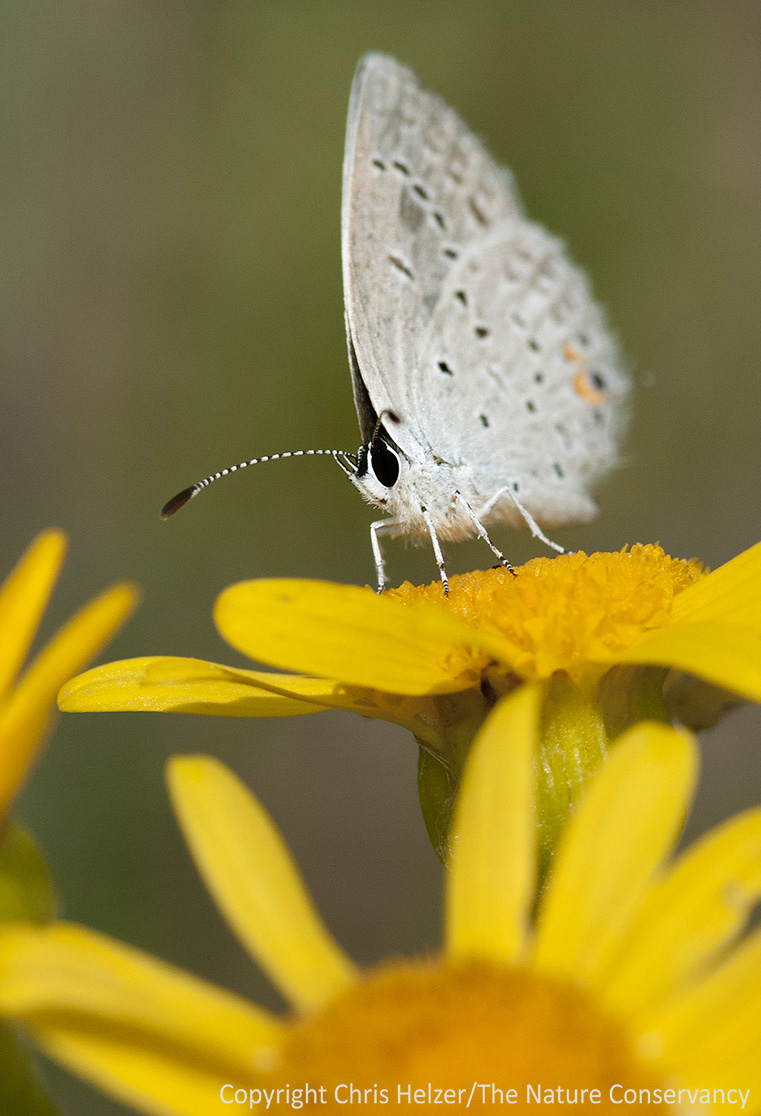
This eastern-tailed blue butterfly was feeding on ragwort at the Helzer family prairie a couple weeks ago. Near Stockham, Nebraska.

A sweat bee on ragwort at the Helzer family prairie.
Prairie ragwort attracts a large number of pollinators, including bees, flies, moths, and butterflies. It is an equal opportunity resource for pollinators because it doesn’t hide or restrict access to its pollen or nectar with funny shaped flowers that require long tongues or other specialized body parts. Everything is right there – available to any insect that lands on it. In years like this one, when ragwort appears in big numbers, it might be the most important species available to pollinators during its blooming period.
I enjoy watching the ebb and flow of ragwort populations in response to our management, but I also like to monitor its establishment and spread in our restored (reconstructed) prairies. Although its seedhead is fluffy like a dandelion, and the individual seeds can travel long distances, most end up falling near the parent plant. As a result, new populations tend to radiate outward from the initial colonizing individual, and the size of ragwort patches can be an indication of the age of a restored prairie. However, that pattern falls apart when a prairie isn’t managed with frequent disturbances because the populations can quickly shrink during years when thatch and vigorous grasses prevent seed germination and establishment.

A common checkered skipper butterfly feeds on ragwort in one of our restored Platte River Prairies last week. The short heights of the grasses surrounding the ragwort plants in this photo are a result of both drought and grazing last year.
Ragwort is certainly not a rare plant in Nebraska, or one that is of conservation concern. The droughty nature of our state helps keep populations strong, as does the prevalance of grazing in many prairies. However, I think it’s important not to judge the value of plants by whether or not they are rare. Ragwort, along with hoary vervain (Verbena stricta), common and show milkweeds (Aclepias syriaca and A. speciosa), and many other “weedy” wildflower species serve as great indicators of ecological events, step up to fill holes in weakened plant communities, and are among the more important wildflowers for pollinators in our prairies.
What’s not to like?


 The Prairie Ecologist