Several years ago, I was walking through one of our restored (reconstructed) prairies in early August, scouting for prairie clover seed harvest sites with one my technicians. About a week earlier, we’d seen an abundance of prairie clover blooming in the same prairie, so we were coming back to see whether it was going to make seed or not. The prairie was being patch-burn grazed, so a portion of it was unburned and was being largely ignored by the grazing cattle while another portion had been burned that spring and was being grazed fairly intensively. We started walking through the unburned portion and were immediately struck by the absence of prairie clover seed heads. There had been a lot of prairie clover flowers here just a week before – where did they go? Finally, we found the seed heads we were looking for, but they weren’t on the plants anymore – they were on the ground (see photo below).
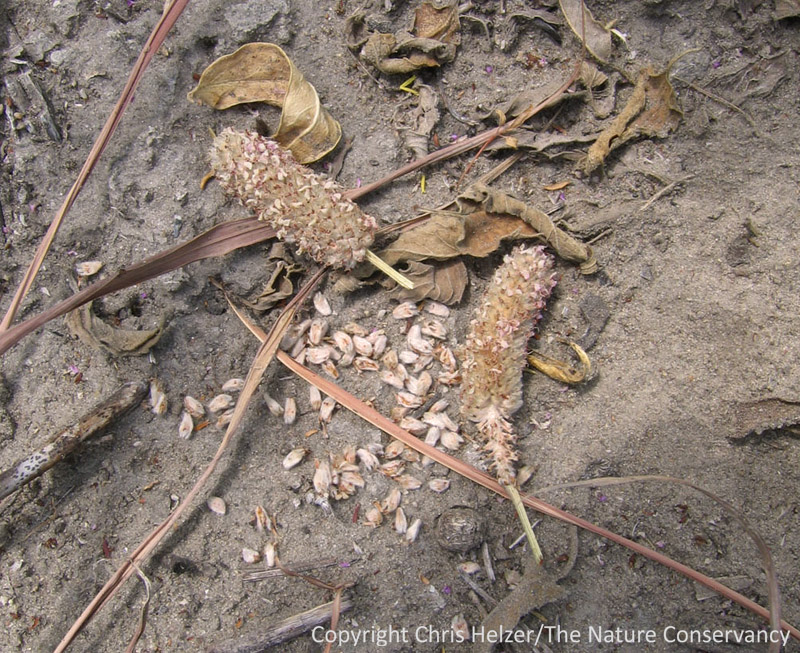
Prairie clover seed heads were scattered around the ground in the unburned portion of our restored prairie. These two happened to be on bare ground, which was convenient for photography.
We decided that some mice or other small mammals were clipping the flowers from the plants and eating the tender young seeds. Nearly the entire crop of seed heads appeared to be on the ground – apparently, we weren’t the only ones who recognized the abundant supply. We chalked it up to a fun ecological lesson and decided we’d look elsewhere for that year’s prairie clover seed harvest. Rather than leaving right away, though, we decided to continue our walk toward the burned portion of the prairie to see how things were looking.
As we crossed the line where our firebreak had been that spring and entered the burned patch, we stopped in surprise. We were surrounded by prairie clover plants with intact seed heads! Just a few feet away from the unburned patch where prairie clover seed heads were scattered around the ground, we were now standing in prairie where every prairie clover plant was loaded with flowers (and the seed looked like it was going to be great.)
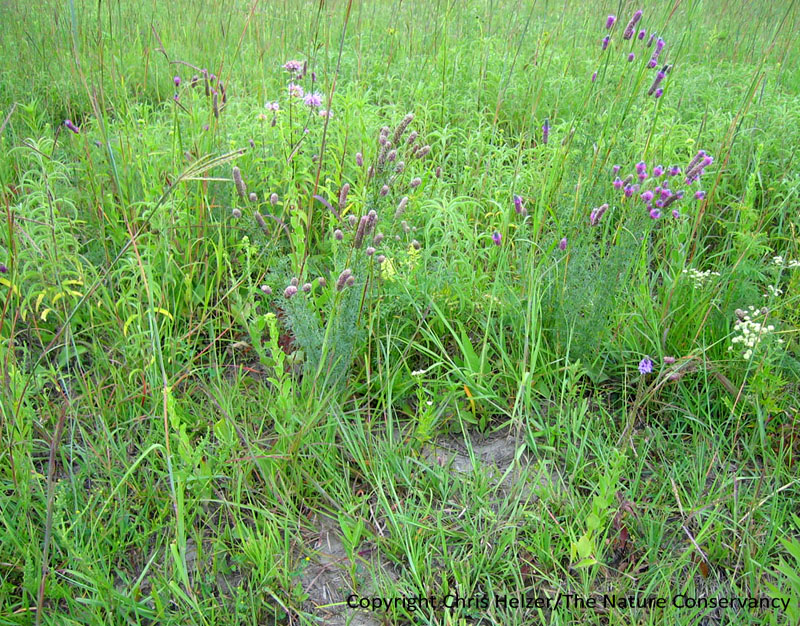
An example of a burned/grazed patch of our restored prairie being managed with patch-burn grazing. The light stocking rate we were using allowed cattle to concentrate their grazing almost exclusively within the burned patch of the prairie, but also to be very selective about the plant species they eat - choosing grasses over wildflowers.
After some discussion, we came up with what I’m sure is pretty close to the real story of what was going on. You’ve probably already figured it out…
In the unburned portion of the prairie where there was little or no cattle grazing, the vegetation was pretty thick. Mice were able to clip the prairie clover heads, pick them apart, and eat the seeds in the relative safety of that dense vegetative cover. However, in the burned portion of the prairie, most of the grass had been grazed by cattle, and although the cattle had left most of the wildflowers ungrazed, the result was relatively sparse cover. Here, any mouse foraging for food would feel very exposed and vulnerable to hawks or owls that might also be out foraging – enough so that they’d apparently decided the risk wasn’t worth the reward.
What I really like about this little anecdote are the multiple interactions. Because we chose to burn one portion of the prairie but not the others, the cattle made the decision to focus their grazing on the recently burned portion to take advantage of the high forage quality of that grass. Our choice to use a light stocking rate meant that the cattle had more than enough to eat, even within the burned patch, and could eat almost exclusively big bluestem and indiangrass (their favorites) and didn’t have to eat prairie clovers or other wildflowers. The uneven grazing pressure between burned and unburned patches led to two different types of habitat structure – dense cover in the unburned patch and sparse cover in the burned. That variety in habitat influenced the feeding behavior of the mice, which, in turn, influenced the seed survival of prairie clover (and probably other wildflower species).
I’m speculating a little now, but based on other observations – and a little data – I think there’s one more ripple from this whole interaction. The prairie clover plants in the burned area were able to produce ripe seeds, but when those seeds dropped they also fell to the ground where there was abundant bare ground, (because of the burn) and where the nearby dominant grass plants were severely weakened by season-long grazing. That set of circumstances, assuming some well-timed rains, provides just about the best possible conditions for the germination and survival of new prairie clover seedlings the following year. In fact, I’ve paid close attention to prairie clover seedlings since I first noticed this whole fire/grazing/mice/seeds scenario, and I definitely find many more prairie clover seedlings each summer in the portions of the prairie that were burned/grazed the previous year than in unburned or more recently burned portions.
I think one important lesson from all of this has to do with the importance of providing a variety of habitat and growing conditions (habitat heterogeneity) across grasslands each year. When multiple options are available, species can make “choices” in the way they interact with the landscape. Grazers choose to graze in recently burned patches, mice choose to feed where there is protective cover. Prairie clover seedlings don’t make choices, per se, but they are definitely able to germinate under some conditions more than others. And because the choices of some species (including us) influence those of others, heterogeneity begets more heterogeneity.
Although it’s a difficult thing to study, my guess is that variability in habitat across a prairie is important for the long-term survival of many species. Mobile species can move around the prairie to find the best possible habitat each year. Less-mobile species, like plants, might experience tough growing conditions in a particular season, but those conditions will change the next year. The result is a dynamic, shifting, mosaic of habitat and species interactions across the prairie. That sounds like a functioning ecosystem to me!